News · SI
Baidu releases ERNIE 5.5 Flash Base, a 280B open-weight base model
Baidu has published ERNIE-5.5-Flash-Base on Hugging Face, a 280 billion parameter mixture-of-experts checkpoint with 14 billion parameters active per token, released at the end of pre-training so developers can do their own fine-tuning and reinforcement learning.
01 / 05
A base model on purpose
Most open releases are instruction-tuned chat models. This one is not. Baidu describes it as "the checkpoint at the end of pre-training, before any mid- or post-training", intended as a common starting point for domain adaptation, instruction tuning and reinforcement-learning research[2].
"We hope this release spares more developers the cost of large-scale pre-training, so they can spend their own resources on the capabilities, tasks and training methods they care about," the ERNIE team wrote[1].
02 / 05
Built for cheap long context
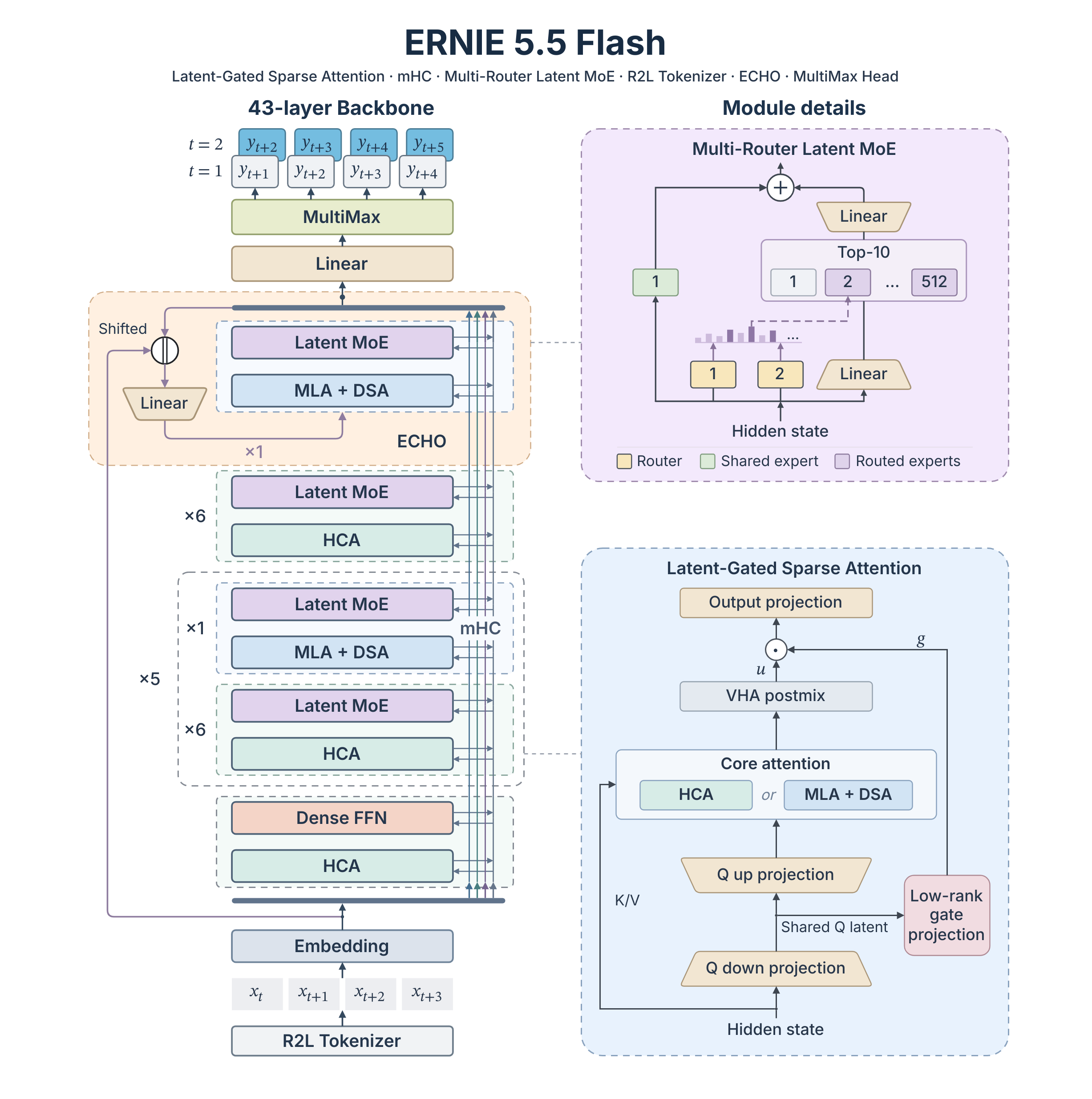
The model has 43 layers: one dense feed-forward layer and 42 mixture-of-experts layers, each with 512 routed experts (ten picked per token) plus one shared expert[2]. It was pre-trained on 33.5 trillion tokens with the Muon optimiser and contexts up to 128K tokens, and Baidu says fine-tuning and inference support a context of about one million tokens.
Efficiency comes mostly from attention. Only six layers keep full token-level access to the context using Multi-head Latent Attention with sparse attention. The other 37 use what Baidu calls Heavily Compressed Attention, which caches a single entry for every 128 tokens, so the memory cost of long prompts stays low[2]. Instead of a separate multi-token prediction module, a technique Baidu calls ECHO reuses the final layer to predict future tokens, and that layer doubles as a built-in draft model for speculative decoding.
Pre-training data leans on repository-scale code and software history, including commits, issues, pull requests and CI-verified fixes, plus curated long-document data[2].
03 / 05
The numbers
On Baidu's unified evaluation pipeline, ERNIE-5.5-Flash-Base scores 93.3 on MMLU, 78.4 on MMLU-Pro, 60.2 on GPQA, 82.3 on HumanEval+ and 40.1 on LiveCodeBench, ahead of DeepSeek-V4-Flash-Base on each of those[2]. It trails on a few benchmarks, such as ChineseSimpleQA and InfiniteBench. All results are self-reported.
04 / 05
Getting it
Weights come in FP8 and BF16, with serving guides for SGLang and for vLLM 0.32.0 via Baidu's vLLM-ERNIE plugin[2]. The model is released under Baidu's ERNIE 5.5 Flash Base Model License Agreement v1.0 rather than a standard open-source licence.
05 / 05
Why it matters
Strong base checkpoints at this scale are rarer than chat models, and they are what teams need to run their own post-training without inheriting someone else's alignment choices. For anyone building agents or domain models, a 14 billion active parameter base with cheap long context is a useful new option, provided the custom licence fits.
Sources
Sources for this story.
FAQ
Frequently asked questions.
01What is ERNIE-5.5-Flash-Base?
A sparse mixture-of-experts language model from Baidu with 280 billion total parameters and 14 billion active per token, pre-trained from scratch on 33.5 trillion tokens. It is text-only.
02Is it a chat model?
No. It is the checkpoint at the end of pre-training, before any mid- or post-training, so it is meant as a starting point for instruction tuning, domain adaptation and reinforcement-learning research. It is served through a completions endpoint rather than chat.
03How long a context does it handle?
It was trained with contexts of up to 128K tokens, and Baidu says fine-tuning and inference support up to 1,048,576 tokens.
04How does it compare with other base models?
On Baidu's own evaluation pipeline it scores 93.3 on MMLU, 78.4 on MMLU-Pro, 60.2 on GPQA, 82.3 on HumanEval+ and 40.1 on LiveCodeBench, ahead of DeepSeek-V4-Flash-Base on each. These figures are self-reported.
05Can I use it commercially?
It ships under Baidu's own ERNIE 5.5 Flash Base Model License Agreement v1.0, not a standard open-source licence, so read the licence before commercial use.
06How do I run it?
Baidu publishes FP8 and BF16 weights and documents serving with SGLang and with vLLM 0.32.0 plus its vLLM-ERNIE plugin.
That’s the story
Building with what’s new?
Spectrum Web Co ships products, places talent, builds social narratives and builds custom business tools as monthly services.
Related stories