News · SI
Deep Principle's Hydrogen-1.0 is a 753B open-weight model for lab science
Hangzhou's Deep Principle has released Hydrogen-1.0, a GLM-5.3 derivative post-trained on chemistry, materials and life-science data plus its own lab records and discovery trajectories. The weights are on Hugging Face and ModelScope under the MIT License, and the company says it beats GPT-6 Astra on FrontierScience-Research.
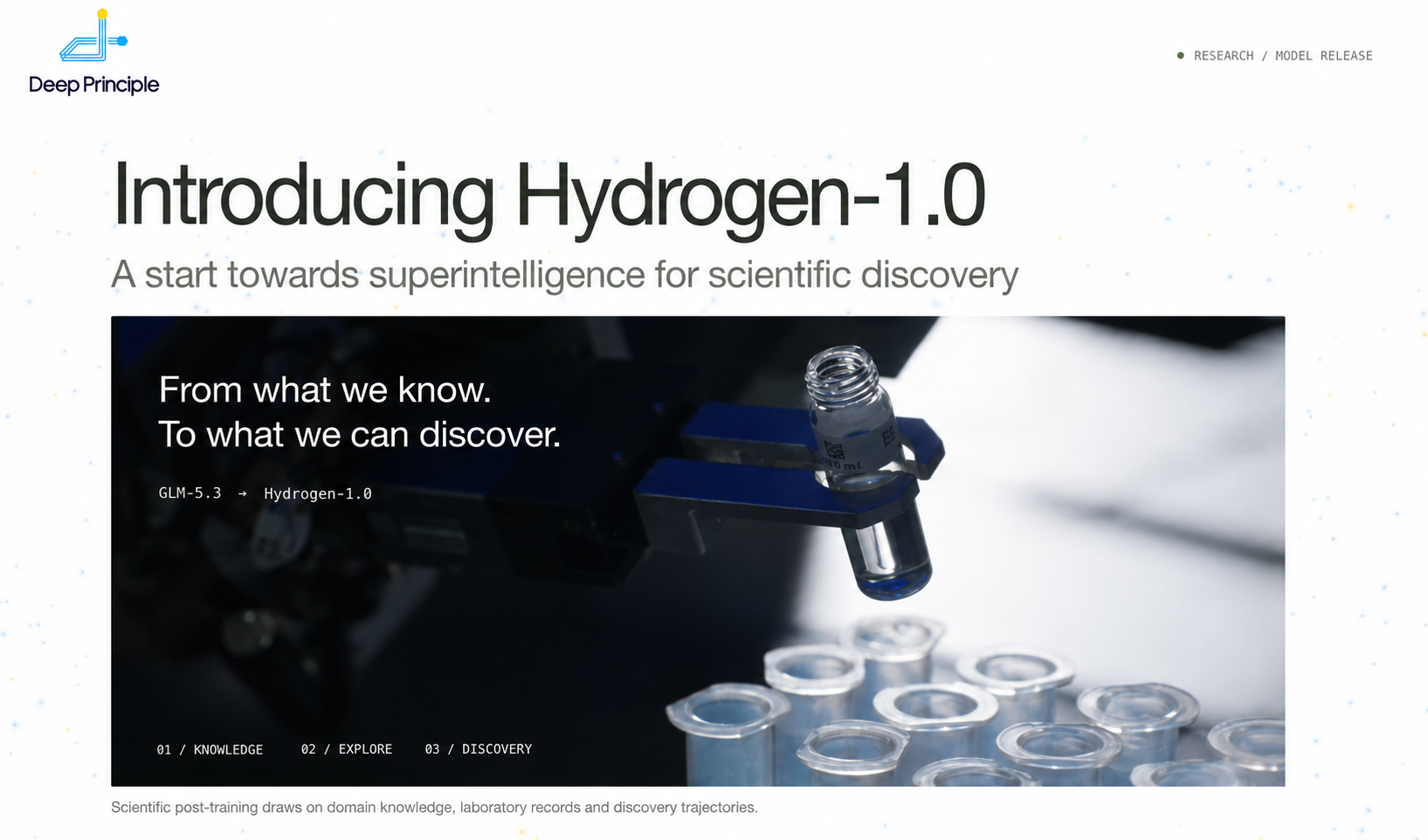
Most of the headline AI-for-science results this year have come from closed models. Deep Principle, a Hangzhou AI-for-materials company, is trying to change that with Hydrogen-1.0, a scientific model built by post-training GLM-5.3 on chemistry, materials science and life-science data, together with records and agent trajectories from its own laboratories[1]. The weights are public under the MIT License[2].
01 / 04
A big open checkpoint
The full BF16 repository lists roughly 753 billion parameters[3]. The model card gives a 1M-token context and a 128K-token maximum output, and the release comes in three versions: unquantized BF16, NVFP4 for NVIDIA Blackwell (team-tested on 8x B300) and MXFP4 for AMD Instinct (team-tested on MI350X)[2]. Deep Principle also offers it through an API on NeuroSpark and inside Mira, its AI scientist product, and on ModelScope alongside Hugging Face[1]. Full training datasets and recipes are not released with the weights[2].
02 / 04
What the company says it can do
In Deep Principle's evaluations, Hydrogen-1.0 outperforms GPT-6 Astra on FrontierScience-Research and improves on GLM-5.3 on GPQA Diamond, roughly matching Kimi K3[1]. On the company's internal research tasks, it leads Astra at maximum thinking by 5.13 percentage points on scientific computing and 4.76 points on one-step forward reaction prediction, while Astra still wins on NMR structure elucidation by 3.33 points[1].
The more interesting claim is about discovery. In a five-round transition metal complex design test, where each model only sees feedback on its own picks, Deep Principle reports a mean best-so-far HOMO–LUMO gap of 4.318 eV for Hydrogen-1.0 against 3.689 eV for GPT-6 Astra and 3.353 eV for Kimi K3[1]. The blog also shows the model writing and repairing a GROMACS polymer simulation, mapping a 27-structure reaction network and compiling a 12-vial Suzuki coupling protocol in a virtual lab before execution[1].
03 / 04
How it was trained
Training combined supervised fine-tuning and reinforcement learning over four kinds of data: domain knowledge, task feedback from the company's scientists, full-cycle electronic lab notebook records, and discovery trajectories that link choices to outcomes, including failed attempts[1]. Deep Principle says it built the pipeline on Megatron and SGLang across both NVIDIA CUDA and AMD ROCm, working with UniPat, Mind Lab and NeuroSpark[1].
04 / 04
Why it matters
Open-weight science models let researchers inspect and adapt the system behind a result, which is hard to do when the best scientific reasoning sits behind a closed API. Hydrogen-1.0 is also a sign of where Chinese open models are heading: a strong general base like GLM-5.3, specialised with proprietary lab data. The caveat is that every benchmark here is self-reported, several are internal, and the card itself warns that outputs need expert review and should not be treated as verified findings[2].
FAQ
Frequently asked questions.
01What is Hydrogen-1.0?
Hydrogen-1.0 is a scientific problem-solving and research-assistance model from Deep Principle, built by post-training Z.ai's GLM-5.3 on chemistry, materials science and life-science data, task feedback from the company's scientists, its own laboratory records and agent discovery trajectories.
02How big is it, and is it really open?
The full BF16 checkpoint lists about 753 billion parameters on Hugging Face, with a 1M-token context and up to 128K tokens of output. The weights are released under the MIT License on Hugging Face and ModelScope; the BF16 repository asks you to accept its terms before downloading. Training datasets and full recipes are not released.
03How does it compare with GPT-6 Astra?
In Deep Principle's own evaluations it outperforms GPT-6 Astra on FrontierScience-Research and improves on GLM-5.3 on GPQA Diamond, roughly matching Kimi K3. On internal tasks it leads Astra at maximum thinking by 5.13 points on scientific computing and 4.76 on forward reaction prediction, but trails by 3.33 points on NMR structure elucidation. These are company-reported figures.
04What hardware does it need?
Deep Principle ships NVFP4 and MXFP4 quantized versions alongside BF16. The team reports testing the NVFP4 build with SGLang on 8x NVIDIA B300 and the MXFP4 build on AMD Instinct MI350X, both serving an OpenAI-compatible API.
05Can I use it without running it myself?
Yes. Besides the open weights, Deep Principle says Hydrogen-1.0 is available through an API on NeuroSpark and inside Mira, its AI scientist product.
That’s the story
Building with what’s new?
Spectrum Web Co ships products, places talent, builds social narratives and builds custom business tools as monthly services.
Related stories