News · Tech

DEEP Robotics sets out five studies for outdoor robots

On 24 October 2026, DEEP Robotics described five research lines it groups as DEEPRobotics-Brain, for robots that have to work where the ground and the scene change. The preprints were already on arXiv. LynxScenes, the outdoor dataset in the set, records 833.6 hours and 3,294.7 km on a LYNX M20, and the paper still calls the files a planned release.

DEEP RoboticsRoboticsEmbodied AILynxScenesWorld models

DEEP Robotics has issued a release, datelined Boston and timestamped 24 October 2026 at 08:20 ET, describing five research lines it says support DEEPRobotics-Brain, an architecture for robots that have to keep working when the ground and the scene change[1]. The five names in the release are DR-WM-1.0, DR-VLA-2.0, DR-APO, DR-Agent and DR-Benchmark. The same note says the preprints sit in the research section of the company's developer center[1].

The preprints were already public. On arXiv, DR-WM, DR-VLA and LynxScenes are dated 13 October 2026, and LynxScenes was updated on 17 October[2][3][7]. Atomic Motion Coordinate, the manipulation paper folded into the release's second section, was first posted on 14 September and updated on 6 October[4]. DR-APO is dated 12 October[5]. EvolvingNav, the memory paper, was first posted on 30 September and updated on 12 October[6]. The 24 October document is the company's grouping of that work.

01 / 06

What the papers are called

The release's DR-WM-1.0 is the paper titled DR-WM[1][2]. DR-VLA-2.0 is the paper titled DR-VLA, and the same section of the release also describes Atomic Motion Coordinate[1][3][4]. DR-Agent is the system the EvolvingNav paper proposes[1][6]. DR-Benchmark is LynxScenes[1][7]. DR-APO keeps its name in both places[1][5].

The release lists collaborators at the Massachusetts Institute of Technology, the University of California San Diego, the University of Illinois Urbana-Champaign, Tsinghua University, Zhejiang University, the Hong Kong University of Science and Technology, and the Beijing Institute of Technology[1]. Each preprint carries its own author list.

02 / 06

Terrain labels that start as a lookup

DR-WM predicts how a quadruped's action will turn out on outdoor ground, then generates the view that motion would produce[2]. The paper says Physcene-Image contains 2.58 million unique RGB-mask pairs: 1.5 million on-robot, 690,000 indoor, 44,600 off-road and 350,000 from the web. Physcene-Robot is more than 100,000 robot clips with images, robot state and control signals[2]. The release's counts, 2.58 million image-mask pairs and more than 100,000 real-robot clips, match those totals[1].

The friction, roughness and stiffness channels are not a sensor reading on every pixel. The paper says masks from 32 semantic classes are filled from a class-to-property lookup built on language-model priors. A calibration learned only on the training set then maps those channels to simulator parameters, using real robot action-response data, and the mapping stays fixed at test time[2]. The release says the priors are calibrated with real-world action-response data. It does not describe the lookup[1].

Video generation uses a dual-ControlNet, conditioned on scene geometry and on camera motion taken from the simulated robot[1][2]. Across 90 scenarios the paper calls challenging, an 8B vision-language model that can read the rollouts beats an unassisted 32B vision-language model on five of six metrics[2]. The release's example, a robot choosing a route through a substation after rain or snow, is an illustration of that idea. It is not identified as one of the 90 scenarios[1].

03 / 06

Human video for walking, and a separate paper for hands

DR-VLA trains on EgoLynx: 10,000 hours of curated egocentric web video and 2,000 teleoperated robot navigation clips from real deliveries[3]. The release prints the same two figures[1]. The paper says the understanding and world-model experts are pretrained on the web video without action labels, then adapted to robot images, with a flow-matching action expert trained on the robot clips[3].

On the held-out EgoLynx-Robot split, DR-VLA improves its Quadruped Navigation Score by about 5% and cuts open-loop final heading error by 14.6%, each against the best other result on that metric[3]. The release repeats both figures and says the score combines safety, instruction compliance, comfort and progress[1]. Trained separately on NAVSIM v1, without the web pretraining, the paper says DR-VLA scores 92.1 PDMS[3]. The release does not mention NAVSIM.

Atomic Motion Coordinate is the manipulation result inside that same section of the release[1]. The paper gives each arm 13 motion atoms: positive and negative translation on three axes, positive and negative rotation on three axes, and a hold[4]. Across 7,520 offline horizon interventions, opposite-atom separation is 92.5% for one atom and 83.1% for two, against 39.1% and 24.0% for a reproduced LA4VLA-style method[4]. The release prints 92.5% and 83.1% and does not print the comparison rates[1].

On the robot, the paper reports 50 trials per task. Force-free AMC reaches 87.8% normalized progress on out-of-distribution fruit tasks, up from 60.5% for a fine-tuned π0.5[4]. Force history then moves the drawer-and-plug task from 59.0% to 78.5% and vase wiping from 71.6% to 75.2%. Those from-scores are force-free AMC, not π0.5, which the same table lists at 55.0% and 65.2% on the two contact tasks[4]. The release says unseen-layout progress reaches 87.8%, and that force feedback raises the drawer-and-plug task to 78.5% and vase wiping to 75.2%[1]. It does not give the trial count or the from-scores.

04 / 06

One optimizer, scored on 20 real scenarios

DR-APO is a reinforcement-learning update meant to improve Gaussian, diffusion and flow-matching policies through the same target step, without scoring several candidate actions with a critic at inference time[5]. On five MuJoCo-v5 tasks, the paper says it leads in 9 of 10 diffusion comparisons and all 10 flow comparisons, and that it stays competitive with Soft Actor-Critic on Gaussian policies[5]. The release states the same 9-of-10 and 10-of-10 counts[1].

For navigation, the paper and the release both say post-training raises NavDP's simulated success from 70.33% to 89.55%, and real-world success from 25% to 65%[5][1]. The simulation table is a wheeled robot in InternScenes. There, DR-APO's success-weighted path length is 74.55, below X-NavDP at 77.67, while its success rate is 89.55 against X-NavDP's 88.63[5]. The release does not mention path length.

The real-world table is 20 scenarios: 25% for pretrained NavDP and 65% after DR-APO[5]. The paper calls that robot a DEEP Robotics M20 quadruped[5]. The release calls it the LYNX M20 wheel-legged robot[1]. The table does not say how many runs sit behind each percentage.

05 / 06

A memory for objects that move, and a dataset still described as planned

EvolvingNav, which the release calls DR-Agent, keeps a time-indexed belief about where a target is likely to be when the robot arrives, including targets that move while unobserved[6][1]. The paper's EvoWorld-Bench spans 54 scenes and 4,860 scene-days, with approximately 239,190 dynamic state changes and 803,680 task instances[6]. The release says 54 simulated scenes, 803,680 task instances and approximately 239,000 dynamic state changes[1]. The paper lists a code repository, a Hugging Face demo and a project page[6].

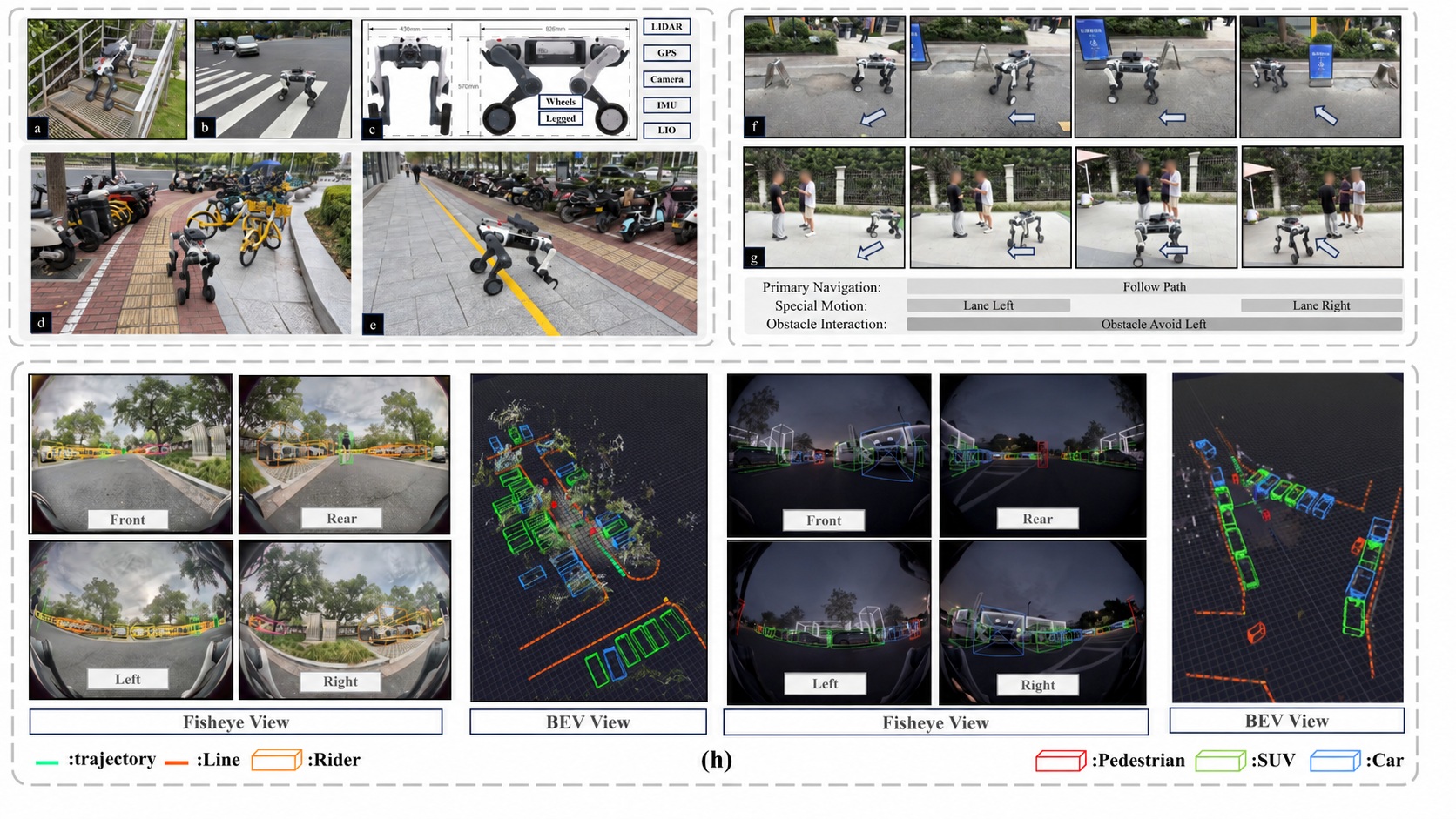
LynxScenes is the dataset under DR-Benchmark[1][7]. Collected on a LYNX M20 the paper calls wheel-legged, it contains about 100,000 non-overlapping 30-second clips, 833.6 hours, 3,294.7 km and 3.0 million annotated frames, with four fisheye cameras, two LiDARs, an IMU, odometry and robot state[7]. Annotations include 20.82 million oriented 3D boxes across 27 categories, 13.89 million road-structure annotations, four road-structure classes, and 20 navigation instructions in three layers[7]. The release's scale figures match the hours, the distance, the approximate clip count and the 3 million frames[1].

The paper evaluates 10 instruction-following policies, 4 bird's-eye-view perception models, 6 world models and 5 reconstruction methods on the same sequences[7]. That is the release's count of 25 models[1]. LynxScenes also defines a Quadruped Navigation Score, with components that include collision avoidance, walkable-area compliance, clearance, progress and instruction adherence[7]. DR-VLA's score of the same name is the one the release defines as safety, instruction compliance, comfort and progress[3][1]. The two papers do not say the scores are the same number.

The LynxScenes paper says the dataset, the splits and the evaluation toolkit are planned for public release[7]. The 24 October release says the preprints are on the developer center. It does not say the recordings can be downloaded[1].
06 / 06

Why it matters

The news on 24 October is a name. DEEPRobotics-Brain is the label the company puts on outdoor-robot research that was already on arXiv, from a world model to a logged benchmark[1]. The scale that is easiest to check is LynxScenes: 833.6 hours and 3,294.7 km on a LYNX M20, with the files still described as forthcoming[7]. The real-robot change from 25% to 65% is one table of 20 scenarios, on a machine the paper calls an M20 quadruped and the release calls a LYNX M20 wheel-legged robot[5][1]. DR-WM's terrain channels start as a language-model lookup over semantic classes, then a calibration fit to robot motion[2]. The figures above are the authors' own evaluations.

FAQ

Questions, answered.

01

What did DEEP Robotics announce on 24 October 2026?

The company posted a Boston-datelined release, timestamped 08:20 ET, grouping five research lines as DEEPRobotics-Brain: a world model, a vision-language-action model for navigation and manipulation, a reinforcement-learning method, a navigation agent that updates a spatial memory, and a real-world benchmark. The release says the preprints are in its developer center. Those preprints were already on arXiv.

02

Can people download the models or LynxScenes?

The 24 October release says the preprints are posted. The LynxScenes paper says the dataset, the splits and the evaluation toolkit are planned for public release. It does not give a download in the paper. The EvolvingNav paper lists a code repository, a Hugging Face demo and a project page. This story does not re-check that those addresses serve the files.

03

What is the jump from 25% to 65%?

The DR-APO paper says post-training a NavDP navigation policy raises real-world success from 25% to 65% across 20 scenarios. The paper calls the robot a DEEP Robotics M20 quadruped. The release calls it the LYNX M20 wheel-legged robot. The table does not say how many runs sit behind each percentage. In simulation, on a wheeled robot, success goes from 70.33% to 89.55%, and success weighted by path length is 74.55 against 77.67 for X-NavDP.

04

How do the release names line up with the papers?

DR-WM-1.0 is the paper titled DR-WM. DR-VLA-2.0 is the paper titled DR-VLA, and that section of the release also summarizes Atomic Motion Coordinate, a separate manipulation paper. DR-Agent is the EvolvingNav paper. DR-Benchmark is LynxScenes. DR-APO uses the same name in the release and the paper.

05

What is in the LynxScenes dataset?

The paper describes about 100,000 non-overlapping 30-second clips, 833.6 hours and 3,294.7 km, recorded on a LYNX M20 with four fisheye cameras, two LiDARs, an IMU, odometry and robot state. It reports 3.0 million annotated frames, 20.82 million oriented 3D boxes across 27 categories, four road-structure classes and 20 navigation instructions in three layers. The same sequences are used for trajectory prediction, bird's-eye-view perception, future scene prediction and multi-view reconstruction.

06

Where do the world model's friction values come from?

The DR-WM paper says segmentation masks are filled with friction, roughness and stiffness from a class lookup built on language-model priors, across 32 semantic classes. A calibration learned only on the training data then maps those channels to simulator parameters, and that mapping stays fixed at test time. The release describes the calibration against real robot motion. It does not describe the lookup.