News · SI
DeepMind's AlphaGenome 2 predicts how DNA variants affect specific cells
On 11 November 2026 Google DeepMind released AlphaGenome 2, a DNA model that predicts how variants affect a chosen cell type or state. Non-commercial research can use the AlphaGenome API today, and commercial research is in a private preview.
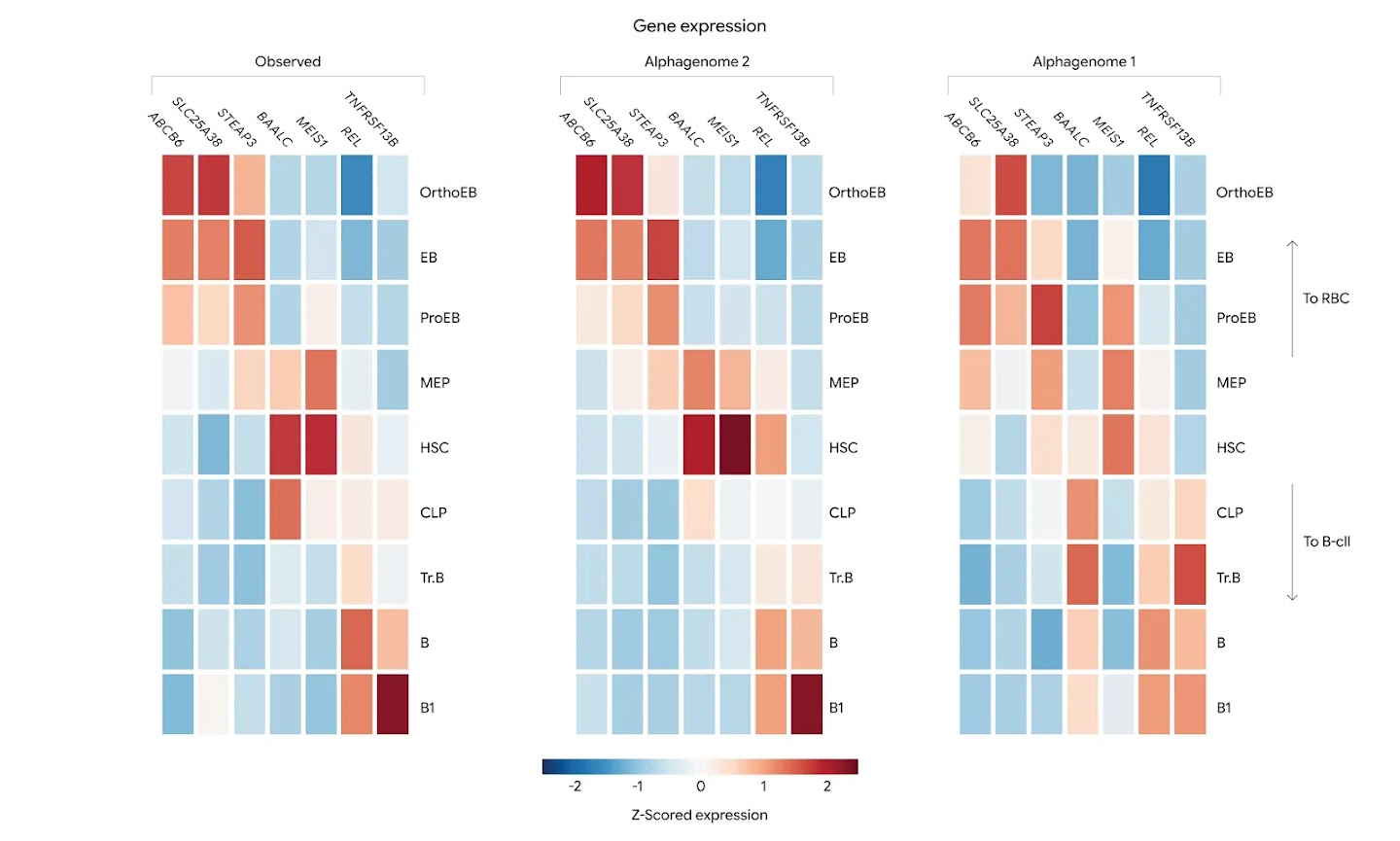
Google DeepMind announced AlphaGenome 2 on 11 November 2026. The model predicts how a DNA sequence of about a million letters, and variants in it, affect one biological condition: a tissue, cell type or state. Which genes are on depends on the cell type and its state, so the effect of a variant depends on both[1].
01 / 04
One condition at a time
The first AlphaGenome predicted many tissue and cell-line measurements from one sequence. AlphaGenome Atlas then stored scores for all 9 billion possible single-letter changes in the human genome[1]. DeepMind says that parallel design made subtle differences between closely related cell types hard to capture[1].
AlphaGenome 2 is conditional. The condition is an input at every stage, chosen from a reference set or built by a cell encoder from a scientist's own single-cell experiment[1]. The technical report linked from the announcement says the sequence is 1 megabase, the condition embedding modulates the network from the earliest layers, and the model also takes a human or mouse flag[2].
Training uses bulk assays and single-cell human and mouse data. DeepMind says that set includes over 107 million individual cell profiles, and more than 100 million profiles across 68 tissues[1]. The report says the expression encoder was trained on over 100 million human RNA-seq profiles across 68 tissues, and that post-training sampled cells from 107 million human profiles[2].
Readouts cover gene expression, histone modifications and chromatin accessibility, and add DNA methylation[1]. The report includes CpG methylation for 185 human reference conditions[2]. Given single-cell gene activity, DeepMind says it can predict an unmeasured property such as chromatin accessibility[1].
02 / 04
What the comparisons show
On held-out regions, the report says AlphaGenome 2 explains a median of 34% of within-tissue cell-type expression differences, against 23% for AlphaGenome 1 fine-tuned on the same single-cell data[2]. On TenK10K, a map of 28 primary immune cell types, DeepMind says the new model finds nearly twice as many causal variants (30% versus 16%) and directional gene effects (43% versus 23%)[1]. The report defines those figures as recall at 90% precision, and at 90% accuracy for the direction of the effect[2].
On a held-out ENCODE CRISPR interference benchmark, the report's precision-recall area is 0.62 for AlphaGenome 2 on enhancers 100 to 2,500 kilobases from a gene, against 0.48 for AlphaGenome 1[2].
At an inflammatory bowel disease locus, DeepMind cites a study in which a distant switch overactivates ETS2 in gut macrophages[1]. Scoring seven fine-mapped variants across ileum immune cells, the report says AlphaGenome 2 predicted a substantial effect only for rs2836882, linked it to ETS2 about 290 kilobases away, and confined that effect to monocytes and macrophages[2].
03 / 04
Unseen cells, and how often it calls
AlphaGenome 2 generalises to a new experiment without fine-tuning. A scientist uploads single-cell RNA-seq from a few dozen cells, and that profile is compressed into a condition. DeepMind says AlphaGenome 2 can match or outperform models trained or fine-tuned on those datasets[1]. The science page says that upload covers unseen states in disease, drug treatment and early development[3]. On unseen data from a COVID-19 mRNA vaccine study, the model separated vaccine-activated immune T cells from resting ones, and a variant linked to severe COVID-19 had a stronger effect in the activated state[1].
The report's precomputed release scores about 7 million variants, fine-mapped GWAS credible sets from Open Targets plus common gnomAD variants above 5% minor allele frequency, across 510 conditions, with enhancer-gene links across 640 conditions[2]. At the threshold used for that atlas, 134,813 variants are called and 6,687,317 are not. At high precision, the report says, the model recovers only a minority of fine-mapped expression QTLs and of putatively causal GWAS variants[2].
Professor Sir Peter Donnelly, chief executive of Genomics, writes that direction and cell-type calls are markedly better than the predecessor's, and that AlphaGenome 2 still "makes confident predictions for only a small subset of the variants that can be queried." He puts confident calls at about 2% of the roughly 6.8 million variants scored. Among variants that fine-mapping identifies as likely causal, he says the call rate in the relevant cell type is around 15 times higher. A missing call, he writes, "should be read as 'no information', not as 'no effect'." Genomics plans to test the model on its own GWAS data and to offer it through the Mystra platform[4].
Žiga Avsec, DeepMind's genomics lead, told The Verge: "When you develop drugs, you're targeting specific proteins and specific cell types." He described the finer predictions as "more expensive" to produce than the first model's. The Verge reports that this cost would have made AlphaGenome 2 impractical for the September Atlas of "every possible DNA letter change in the human genome"[5].
04 / 04
Who can run it
AlphaGenome 2 and Colab tutorials for expression conditioning are available for non-commercial research through the AlphaGenome API. Commercial research is in a private preview. DeepMind says Skills for the model in Google Antigravity will follow, and that AlphaGenome 2 has not been validated or approved for clinical or diagnostic use[1]. The technical report says model source code and weights will be provided upon final publication, and that a filtered set of the precomputed predictions is posted for download[2]. The API repository says the API is free for non-commercial use, that outputs should not be used to train other models, aside from artefacts the terms allow, and that predictions must not be used for clinical decision-making[6].
Sources
Sources for this story.
- AlphaGenome 2: Deciphering how cells read DNA to better understand disease (Google DeepMind)deepmind.google
- AlphaGenome 2 predicts regulatory activity and variant effects across cell states (Google DeepMind)storage.googleapis.com
- AlphaGenome (Google DeepMind)deepmind.google
- AlphaGenome 2: a step change in predicting what DNA does (Professor Sir Peter Donnelly, Genomics)genomics.com
- Google's AlphaGenome 2 zooms in on the cellular roots of disease (The Verge)theverge.com
- AlphaGenome API (Google DeepMind on GitHub)github.com
FAQ
Frequently asked questions.
01What is AlphaGenome 2?
Google DeepMind's DNA sequence model, announced on 11 November 2026. It takes about a million DNA letters plus a biological condition, a tissue, cell type or state, and predicts how that sequence and variants in it affect the condition. The condition can come from a reference set or from a scientist's own single-cell RNA-seq experiment.
02How does it differ from the first AlphaGenome?
The first model predicted many tissue and cell-line measurements from one sequence in parallel. AlphaGenome 2 predicts one condition at a time, and that condition is an input throughout the network. It adds DNA methylation to readouts that include gene expression, histone modifications and chromatin accessibility, and it can impute a missing assay, such as chromatin accessibility from gene activity.
03How many more expression-changing variants does it find?
On TenK10K, a map of 28 primary immune cell types, DeepMind says AlphaGenome 2 identifies nearly twice as many causal variants (30% versus 16%) and directional gene effects (43% versus 23%) as AlphaGenome 1 fine-tuned on single-cell data. The technical report defines those figures as recall at 90% precision, and at 90% accuracy for direction, on fine-mapped single-cell expression QTLs.
04Can it score a cell state it was not trained on?
A lab can upload single-cell RNA-seq from a few dozen cells. DeepMind says that profile is compressed into a cell-state representation and used to condition the model, with no fine-tuning. On unseen data from a COVID-19 mRNA vaccine study, the model separated vaccine-activated immune T cells from resting ones, and a variant linked to severe COVID-19 had a stronger effect in the activated state.
05Who can use AlphaGenome 2, and is it for diagnosis?
Non-commercial research can use it now through the AlphaGenome API. Commercial research is in a private preview. The technical report says model source code and weights will be provided upon final publication. DeepMind says AlphaGenome 2 has not been validated or approved for clinical or diagnostic use, and the API terms say predictions must not be used for clinical decision-making.
That’s the story
Building with what’s new?
Spectrum Web Co ships products, places talent, builds social narratives and builds custom business tools as monthly services.
Related stories