News · SI

DeepSeek's V4.1 Flash update is open, MIT-licensed and cheaper per task

DeepSeek has released DeepSeek-V4.1-Flash-1017, a 763B-parameter update to its Flash model with a 1M-token context, open weights under the MIT licence and higher coding and agent scores. It now powers the deepseek-flash API, and DeepSeek has opened its Search and Fetch APIs to everyone.
DeepSeekOpen weightsAgentsCoding

DeepSeek has released DeepSeek-V4.1-Flash-1017, an update to its Flash model that it says scores higher, finishes tasks faster and writes shorter answers than the version it replaces[^1]. The weights are on Hugging Face and ModelScope under the MIT licence, and the model has 763 billion parameters and a 1 million token context window[^1][^2].

01 / 05

Better scores, shorter answers

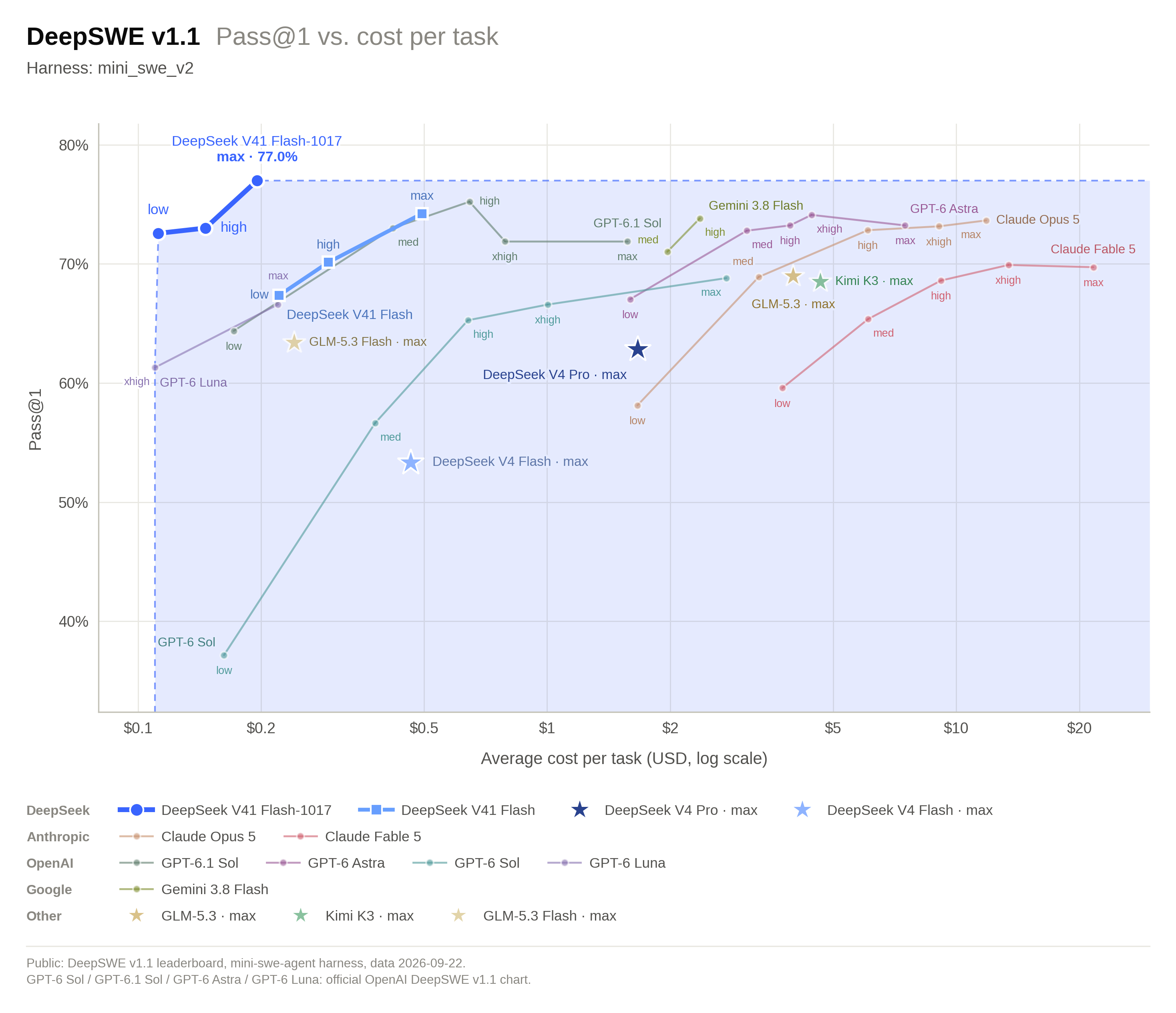
On DeepSeek's own table, the update lifts DeepSWE v1.1 from 74.2 to 77.0 and Terminal-Bench 4.0 from 31.2 to 42.3, and ProgramBench from 20.3 to 29.1[^2]. That puts it ahead of Claude Opus 5 on DeepSWE (74.0) but behind it on Terminal-Bench 4.0 (51.8) and ProgramBench (37.0)[^2]. DeepSeek trained it with reinforcement learning on self-feedback to build whole projects, and its release page shows games and 3D scenes it built from scratch[^1].

The more interesting claim is cost. DeepSeek's chart puts its max-effort DeepSWE run at 77.0 percent for roughly 20 US cents per task, well left of the Claude, GPT and Gemini results on the same chart[^1]. Those are vendor numbers on a vendor chart, but the direction matches the pitch: same or better results with fewer tokens.

02 / 05

What changes on the API

The deepseek-flash model name now points at V4.1-Flash-1017, and the retired deepseek-v4-flash and deepseek-v4-flash-vision-exp names are routed to it at the Flash price[^3]. It supports thinking and non-thinking modes, tool calls, JSON output, vision, and both OpenAI and Anthropic compatible endpoints, with up to 384K output tokens[^3].

Peak pricing is US$0.30 per million input tokens on a cache miss and US$1.20 per million output tokens, and off-peak rates are half that[^3]. Peak hours are 01:00 to 04:00 and 06:00 to 10:00 UTC on weekdays, so Australian teams pay the higher rate from midday to 3pm and 5pm to 9pm Sydney time[^3].

03 / 05

Search and Fetch for everyone

DeepSeek has also opened its Search and Fetch APIs, backed by its in-house search engine, to all users at US$0.75 per 1,000 successful requests each[^1][^3]. Calls made through DeepSeek Harness, Claude Code or Codex stay free until billing starts on 1 November at 00:00 Beijing time[^3].

04 / 05

Self-hosting notes

There is no Jinja chat template in the release. DeepSeek ships a Python reference encoder and deepseek-recipe, a Rust library with Python bindings that converts Messages, Chat Completions and Responses API requests into its prompt format and parses the output back[^2]. It recommends a temperature of 1.0 and at least 256K max tokens[^2].

05 / 05

What it changes for shipping teams

If you run coding agents at volume, this is the model to price against this week. A cheap hosted endpoint that drops into Claude Code or OpenCode, plus MIT-licensed weights you can move in-house later, makes it an easy default for background work such as test fixing and refactors. Schedule batch jobs outside DeepSeek's peak hours to halve the bill, and keep a stronger model for the terminal-heavy tasks where it still trails.

FAQ

Questions, answered.

01

What is DeepSeek-V4.1-Flash-1017?

It is a minor update to DeepSeek-V4.1-Flash that DeepSeek released on 17 October 2026. DeepSeek says it scores higher on reasoning, coding, agent and visual benchmarks while finishing tasks faster and writing shorter answers. The model has 763 billion parameters and a 1 million token context window.

02

Is DeepSeek-V4.1-Flash-1017 open source?

The weights are open. DeepSeek published them on Hugging Face and ModelScope, and both the repository and the weights are under the MIT licence, which allows commercial use. The release has no Jinja chat template; DeepSeek ships a Python reference encoder and a Rust library called deepseek-recipe instead.

03

How much does the deepseek-flash API cost?

The deepseek-flash model name is now served by V4.1-Flash-1017. At peak times it costs US$0.30 per million input tokens on a cache miss, US$0.006 on a cache hit and US$1.20 per million output tokens. Off-peak rates are half that. Peak hours are 01:00 to 04:00 and 06:00 to 10:00 UTC on weekdays, which is midday to 3pm and 5pm to 9pm in Sydney during daylight saving.

04

What happened to the old deepseek-v4-flash model names?

The legacy names deepseek-v4-flash and deepseek-v4-flash-vision-exp still work, but the models behind them are retired. DeepSeek routes those requests to V4.1-Flash-1017 and bills them at the Flash price.

05

What are DeepSeek's Search and Fetch APIs?

They are standalone web search and page fetch endpoints backed by DeepSeek's own search engine, now open to every API user. Each costs US$0.75 per 1,000 successful requests. Server-side calls made through DeepSeek Harness, Claude Code or Codex are free until billing starts on 1 November 2026 at 00:00 Beijing time.

06

How does it compare with Claude Opus 5?

On DeepSeek's own table it beats Opus 5 on DeepSWE v1.1 (77.0 against 74.0) but trails it on Terminal-Bench 4.0 (42.3 against 51.8) and ProgramBench (29.1 against 37.0). These are DeepSeek's figures, so test it on your own repositories.