News · SI
ETRI open-sources TANGO 2, a no-code tool for fine-tuning and deploying LLMs on industry data
Korea's Electronics and Telecommunications Research Institute has released TANGO 2 on GitHub, a browser-based LLMOps platform that lets factory, farm, hospital and shipyard experts build, fine-tune, quantise and deploy LLMs and VLMs without writing code.
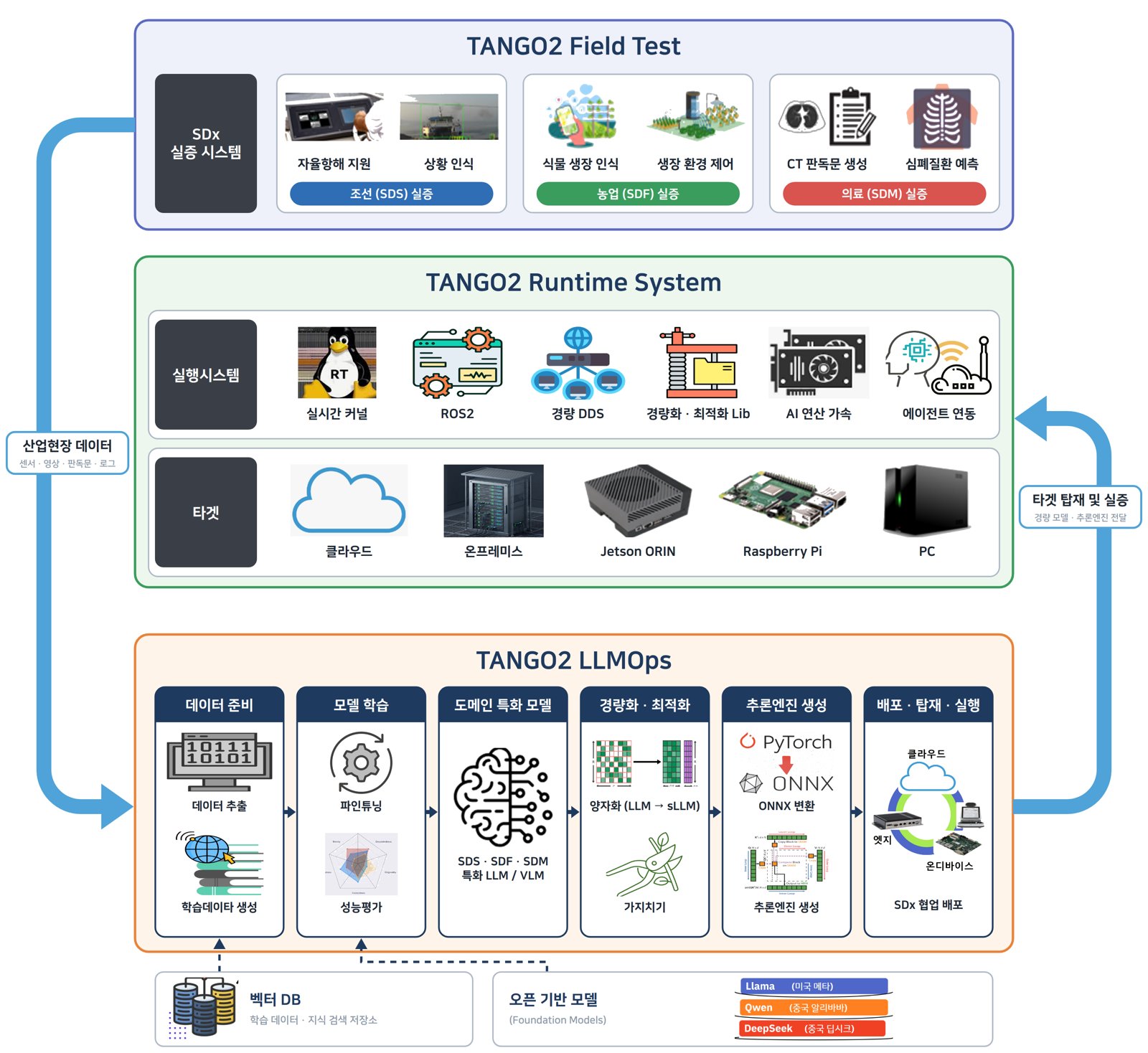
Korea's Electronics and Telecommunications Research Institute (ETRI) has released TANGO 2, a no-code tool for building and deploying large language models, as open source on GitHub[1][2]. The pitch is simple: let the people who know a factory floor, a farm or a hospital ward train their own AI models in a browser, without waiting on a machine learning team.
01 / 04
What TANGO 2 does
ETRI has worked on TANGO since 2021. The first version handled computer vision tasks such as image recognition, and TANGO 2 extends it to generative AI and LLMs[1]. Its core is an LLMOps platform that runs on a Kubernetes cluster and exposes the whole LLM and VLM workflow through a web UI[2].
The README lists five working areas[2]:
- Data: upload, preprocessing, filtering, generation, human and VLM review, and versioned dataset releases.
- Model: LoRA fine-tuning from Hugging Face or platform models, live training graphs, checkpoints and GGUF quantisation.
- Deployment: cluster serving on vLLM, llama.cpp, TGI, Ollama, Triton or TensorRT-LLM, plus on-device, standalone package and external API options.
- Inference: chat and batch inference against a running deployment, image input for VLMs and prompt optimisation.
- Evaluation: lm-evaluation-harness benchmarks, LLM judging with the Korean LogicKor benchmark, intent and slot scoring, and expert review reports.
A separate runtime layer handles where the model ends up, from cloud and on-premises servers down to Jetson Orin, Raspberry Pi and PCs, with real-time scheduling, failover and monitoring for edge devices[2]. The latest tagged release, tango2-26.11, landed on GitHub on 5 November with VLM demos, an OpenTelemetry tracing stack and a restructured LLMOps codebase[3].
02 / 04
Field tests in ships, farms and hospitals
The repository ships with three industry trials alongside the tool itself[2]. In shipbuilding, Avnautics is testing an AI navigation aid that reads data from a vessel's sensors. In farming, Sure Data Lab is building a generative AI service trained on expert growers' knowledge. In medicine, Seoul National University Hospital has developed automatic radiology report generation from chest CT scans, with a cardiopulmonary and vascular disease prediction trial planned with Seoul National University Bundang Hospital[1].
On the commercial side, ETRI says the LLMOps tool is being linked to Acryl's Jonathan product, and agent AI company Persona AI licensed TANGO technology in April for its GEN STATION platform[1].
03 / 04
The licence fine print
"Open source" here comes with conditions. ETRI's licence agreement applies GPLv3 or later to open-source use, but any commercial use of the code or derived work, including free distribution supported by advertising, falls under a separate ETRI commercial licence[4]. Teams planning a product on top of it should talk to ETRI first.
04 / 04
Why it matters
Most LLMOps platforms assume an ML engineer at the keyboard. TANGO 2 is a government-funded attempt to push fine-tuning and edge deployment down to domain experts, and it comes with working industry examples rather than just a framework. ETRI will walk through the tool at the 5th TANGO Open Seminar in Seoul on 11 November and is seeking an ITU-T standard for no-code LLMOps, with final approval targeted for May 2027[1].
FAQ
Frequently asked questions.
01What is TANGO 2?
An open-source LLMOps platform from Korea's Electronics and Telecommunications Research Institute (ETRI). It runs on a Kubernetes cluster and gives a web interface for building training data, fine-tuning, quantising, deploying, running and evaluating LLMs and VLMs.
02Who is it for?
People with deep knowledge of their own field, such as factory, farm, hospital or shipyard staff, but no machine learning background. ETRI says it replaces the usual hand-offs between domain experts, AI specialists and software developers with one tool.
03Where can the models run?
TANGO 2 supports cluster serving with vLLM, llama.cpp, TGI, Ollama, Triton and TensorRT-LLM, on-device edge deployment, standalone packages and external APIs. Its runtime targets include cloud, on-premises servers, Jetson Orin, Raspberry Pi and PCs.
04Is it free to use?
The code is on GitHub under ETRI's licence agreement, which applies GPLv3 or later for open-source use. Anyone who wants to commercialise work built on it needs a separate commercial licence from ETRI.
05Is anyone using it in the field?
The repository includes field tests in shipbuilding, farming and medicine. Partners named by ETRI include Avnautics for vessel navigation, Sure Data Lab for farming, Seoul National University Hospital for chest CT reports, and Acryl and Persona AI on the commercial side.
06What happens next?
ETRI holds the 5th TANGO Open Seminar in Seoul on 11 November and is pursuing an ITU-T international standard for no-code LLMOps, targeting final approval in May 2027.
That’s the story
Building with what’s new?
Spectrum Web Co ships products, places talent, builds social narratives and builds custom business tools as monthly services.
Related stories