News · SI

Microsoft open-sources Agensh, a 1,024-agent harness

Microsoft Research has released Agensh v1.0, an MIT-licensed harness whose workers claim tasks and merge code without a central orchestrator. The 23 October release is a single-node setup. The September paper's 1,024-agent pandoc run, with no internet and a six-hour budget, raised the test-pass rate from 33.89% to 55.06%.

MicrosoftAgentsOpen sourceAgensh

Microsoft Research has open-sourced Agensh, a multi-agent harness whose workers claim sub-tasks, share findings and merge code without a central orchestrator[1]. The repository's news line dates that release 24 October 2026 and says it includes the harness, the experiment launch scripts and a reproduction guide[1]. GitHub published the v1.0 tag on 23 October 2026 at 08:03 UTC[4]. The tagged commit, authored by Zhihao Zhan on 22 October 2026 at 04:33 UTC, says it releases the single-node agent harness, the reproduction guide, the paper and a demo[5].

The preprint is the earlier document. The same news line dates it 22 September 2026[1]. The paper and the project page it links, aka.ms/Agensh, describe a harness evaluated out to 1,024 agents[2][6].

01 / 06

What v1.0 ships

The reproduction guide covers a single-node team, run with Docker Compose, and a standalone single-agent baseline[3]. Both use native Copilot ACP sessions and ProgramBench's v6 cleanroom. The defaults it prints are 8 workers, 6 hours per task, gpt-5.6-sol, high reasoning effort, the Responses API and a 272,000-token prompt window[3].

Release validation used ProgramBench v1.2.5 at commit 27f02157c785f8da3647aa6dbbe6b9137f99f10e[3]. The guide pins Copilot 1.0.70 and Mattermost MCP 0.5.1. The host it specifies is Linux with Docker Engine, Compose v2, systemd and cgroup v2. The README and the guide both say the code is under the MIT License[1][3].

The guide's five-task example uses jgm__pandoc.5caad90, gromacs__gromacs.665ea4c, universal-ctags__ctags.243595e, php__php-src.c891263 and ffmpeg__ffmpeg.360a402[3]. Those short hashes are the commits in Table 1 of the paper[2].

02 / 06

What the September paper measured

The paper tests Agensh on ProgramBench, where agents rebuild the behavior of reference software from scratch, with internet access disabled, inside a six-hour budget[2]. It selects FFmpeg, gromacs, pandoc, PHP-src and ctags, and it calls them the five most difficult of ProgramBench's 200 instances, ranked by the mean test-pass rate of state-of-the-art models. Table 1 lists PHP-src, commit c891263, at 26,266 files, 2,812,757 lines and 119.76 MB, and pandoc, commit 5caad90, at 2,767 files, 104,336 lines and 4.86 MB[2].

With GPT-5.6-sol at high reasoning effort, Copilot as the underlying single-agent harness, and the same six-hour budget, the mean final test-pass rate across the five tasks moves from 19.31% with 1 agent to 20.68% with 8, 26.52% with 32, and 28.78% with 128[2]. The paper calls the 1-to-128 change a gain of 9.47 percentage points, or an approximately 49% relative improvement. The README prints the same 19.31% and 28.78% endpoints and the same approximate relative improvement[1].

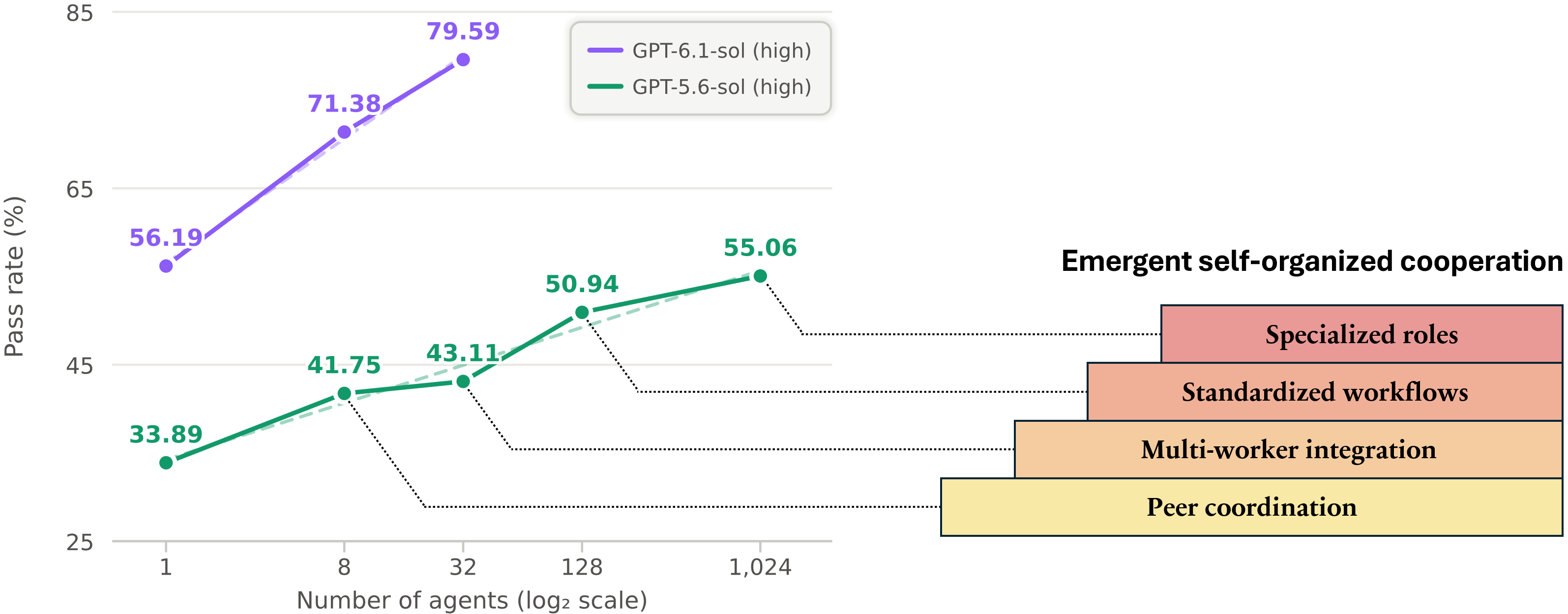
On pandoc, the paper says the final test-pass rate rises from 33.89% with 1 agent to 50.94% with 128 agents and 55.06% with 1,024 agents[2]. It says the 1,024-agent result is 4.12 percentage points above the 128-agent result and 21.17 percentage points above the single-agent result. The project page prints the same 33.89% to 55.06% pair and labels it a "+62% pass rate relative gain"[6].

On timing, the paper says that during the first two hours of the six-hour runs, 128 agents exceed a 30% test-pass rate on pandoc at the 30-minute checkpoint, while 32 agents and 8 agents first exceed that threshold at the 60-minute and 90-minute checkpoints. The single-agent run remains below that threshold throughout the first two hours[2].

The appendix says every reported configuration uses gpt-5.6-sol with high reasoning effort, with a maximal input token limit of 272,000 and a maximal output token limit of 128,000[2]. Activation is staggered: one agent every 30 seconds during the first hour, then one every 3 seconds. In the 1,024-worker experiments, workers are distributed across 16 nodes, with 64 agents per node[2].
03 / 06

The GPT-6.1-sol curve in the README

The README prints a second pandoc series. With GPT-6.1-sol at high reasoning effort, it says the six-hour test-pass rate rises from 56.19% with 1 agent to 79.59% with 32 agents, a relative improvement of 41.64%[1]. The figure in demo/pandoc_results.png is the chart for that comparison. The README's alt text names GPT-5.6-sol and GPT-6.1-sol at high reasoning effort[1]. The paper's pandoc paragraph reports GPT-5.6-sol, and it follows that model out to 1,024 agents[2].

04 / 06

A rerun is a different experiment

The guide says the historical main experiment seeded the older task_cleanroom reference, and that its binary differs from v6 even when version strings match[3]. It says these infrastructure updates mean a new release run should record its own revision rather than claim exact historical reproduction[3].

The release ramp targets 30 seconds per worker for the first 120 workers, then 3 seconds, with a serial 20-second settle wait[3]. The guide says actual startup can exceed those targets, so later workers get less time, that the ramp can overrun the budget, and that a minimum 60-second wait follows. Workers have a 64 GiB memory ceiling and routers have 8 GiB. Those figures are ceilings, not reservations. Worker networks restrict external access to model egress[3].

05 / 06

How the harness is specified

The paper's cooperation loop has five steps. A worker gathers context, claims a sub-task, takes action, verifies the result against the sub-task's acceptance criteria, and merges the contribution into the shared workspace, then starts again[2]. Workers run that loop concurrently and asynchronously. The shared workspace is a Git platform, implemented with Gitea. The message interface is Mattermost: a shared task channel for announcements, and direct messages for urgent one-to-one notes. Shared context, adapted from DeLM, stores short typed entries the paper names OBSERVED, FACT, FAIL, CLAIM and PATCH_SUMMARY[2].

The loop lives in the worker prompt. The paper says the prompt is the same for every worker except the worker ID, and that adapters can place it on an underlying harness such as Claude Code or Copilot without changing the loop, the shared services, or that harness's own agentic loop[2]. The README says the experiments sit on the per-agent loop of the Copilot harness[1].

The paper treats the recorded trajectories as evidence that cooperation changes with headcount, under one shared prompt. At 8 agents it describes workers agreeing an interface and resolving overlapping claims. At 32 it describes peers withdrawing an approval after a counterexample and then merging a fix. At 128 it describes reusable review relationships and a pandoc integration protocol that other workers later pick up. At 1,024 it describes several workers acting as integrators, with a worker contacting more than one and handing code to the first valid responder[2]. Those are the paper's readings of the logs.

06 / 06

Why it matters

v1.0 is a single-node MIT release. Its guide defaults to 8 workers, and the commit that the tag points at describes a single-node harness[3][5]. The 55.06% pandoc figure is the paper's result for 1,024 agents of GPT-5.6-sol, spread across 16 nodes, with no internet and a six-hour budget[2]. The 79.59% figure is the README's result for 32 agents of GPT-6.1-sol on the same task and budget[1]. The reproduction guide tells a new run to keep its own revision, because the cleanroom image has changed since the historical experiment[3].

FAQ

Questions, answered.

01

What did Microsoft release?

The Agensh repository's news line, dated 24 October 2026, says Microsoft open-sourced the harness, the experiment launch scripts and a reproduction guide. GitHub published the v1.0 tag on 23 October 2026 at 08:03 UTC. The tagged commit, authored by Zhihao Zhan on 22 October 2026 at 04:33 UTC, says the release contains the single-node agent harness, the reproduction guide, the paper and a demo. The README dates the preprint 22 September 2026.

02

Is the 1,024-agent cluster in the download?

The reproduction guide covers a single-node team on Docker Compose and a standalone single-agent baseline. Its printed defaults are 8 workers, 6 hours per task, gpt-5.6-sol, high reasoning effort, the Responses API and a 272,000-token prompt window. The paper's 1,024-worker pandoc experiments distribute workers across 16 nodes, with 64 agents per node. The guide says a new run should record its own revision rather than claim exact historical reproduction, because the release uses ProgramBench's v6 cleanroom and the historical main experiment seeded an older cleanroom image.

03

What pass rates does the paper report?

With GPT-5.6-sol at high reasoning effort, Copilot as the underlying harness, a six-hour budget and no internet, the mean final test-pass rate on the five hardest ProgramBench tasks rises from 19.31% with 1 agent to 20.68% with 8, 26.52% with 32 and 28.78% with 128. The paper calls the 1-to-128 change a gain of 9.47 percentage points, about 49% relative. On pandoc alone, it reports 33.89% with 1 agent, 50.94% with 128 and 55.06% with 1,024, and it calls the last of those 21.17 percentage points above the single-agent run.

04

Where does the 79.59% figure come from?

The README, not the September paper, says that with GPT-6.1-sol at high reasoning effort the six-hour pandoc test-pass rate rises from 56.19% with 1 agent to 79.59% with 32 agents, a relative improvement of 41.64%. The chart shipped in the repository is the figure for the GPT-5.6-sol and GPT-6.1-sol pandoc curves. The paper's pandoc scaling sentence reports GPT-5.6-sol through 1,024 agents.

05

How do the workers coordinate?

Each worker runs the same five-step loop: gather context, claim a sub-task, take action, verify results and merge progress. The prompt is the same except for the worker ID. Gitea holds the shared Git workspace, Mattermost carries messages, and a shared-context board stores short typed notes the paper names OBSERVED, FACT, FAIL, CLAIM and PATCH_SUMMARY. The paper says the loop sits in the prompt, so adapters can put it on top of an underlying harness such as Copilot or Claude Code. The release pins Copilot 1.0.70.

06

What license is the code under?

The README and the reproduction guide both say the project is licensed under the MIT License. ProgramBench is installed separately. Release validation used ProgramBench v1.2.5 at commit 27f02157c785f8da3647aa6dbbe6b9137f99f10e. The guide asks for Linux with Docker Engine, Compose v2, systemd and cgroup v2, and it says workers are limited to model egress for external network access.