News · SI

MiniCPM-V 4.7 squeezes a 35B vision model onto a phone

OpenBMB's MiniCPM-V 4.7 comes in a 35B-A3B mixture-of-experts version and a 1B dense version, both open under Apache 2.0. The headline claim is that the 35B model decodes at more than 13 tokens a second in 3 GB of memory on an iPhone 17 Pro Max, thanks to a scheduler that preloads the experts the next layer is likely to need.

OpenBMBMiniCPMOpen weightsOn-device AIVision-language modelsMixture of experts

OpenBMB has released MiniCPM-V 4.7, an open vision-language family in two sizes: a 35B-A3B mixture-of-experts model and a 1B dense model[1]. The pitch is unusual for a 35B model: OpenBMB says it runs at more than 13 tokens a second in 3 GB of memory on an iPhone 17 Pro Max[2].

The release landed on 12 October, with speculative decoding heads following on 15 October[3]. Code and weights are Apache 2.0[1].

01 / 04

The trick: preloading experts

Mixture-of-experts models only use a slice of their parameters per token, about 3B here. The catch on a phone is that each token can pick different experts at each layer, and the full set won't fit in memory. Loading experts from storage on demand works but stalls generation, while locking the model to a fixed subset of experts speeds it up at the cost of quality[2].

OpenBMB's answer is Lookahead Expert Scheduling. It predicts which experts the next layer is likely to need and preloads them, then computes the already-loaded ones first while fetching the rest. The prediction only guides loading: the model still runs exactly the experts its router chooses, so OpenBMB describes it as lossless[2]. Layer-wise quantisation shrinks what has to be moved, and DSpark speculative decoding adds more speed. OpenBMB credits the package with a 5x speedup on real devices[1].

The 13-plus tokens a second figure is OpenBMB's own, measured on one phone. It has published unedited screen recordings of the 35B model on an iPad M4 and the 1B on an iPhone 17 Pro Max[1].
02 / 04

Where it lands on benchmarks

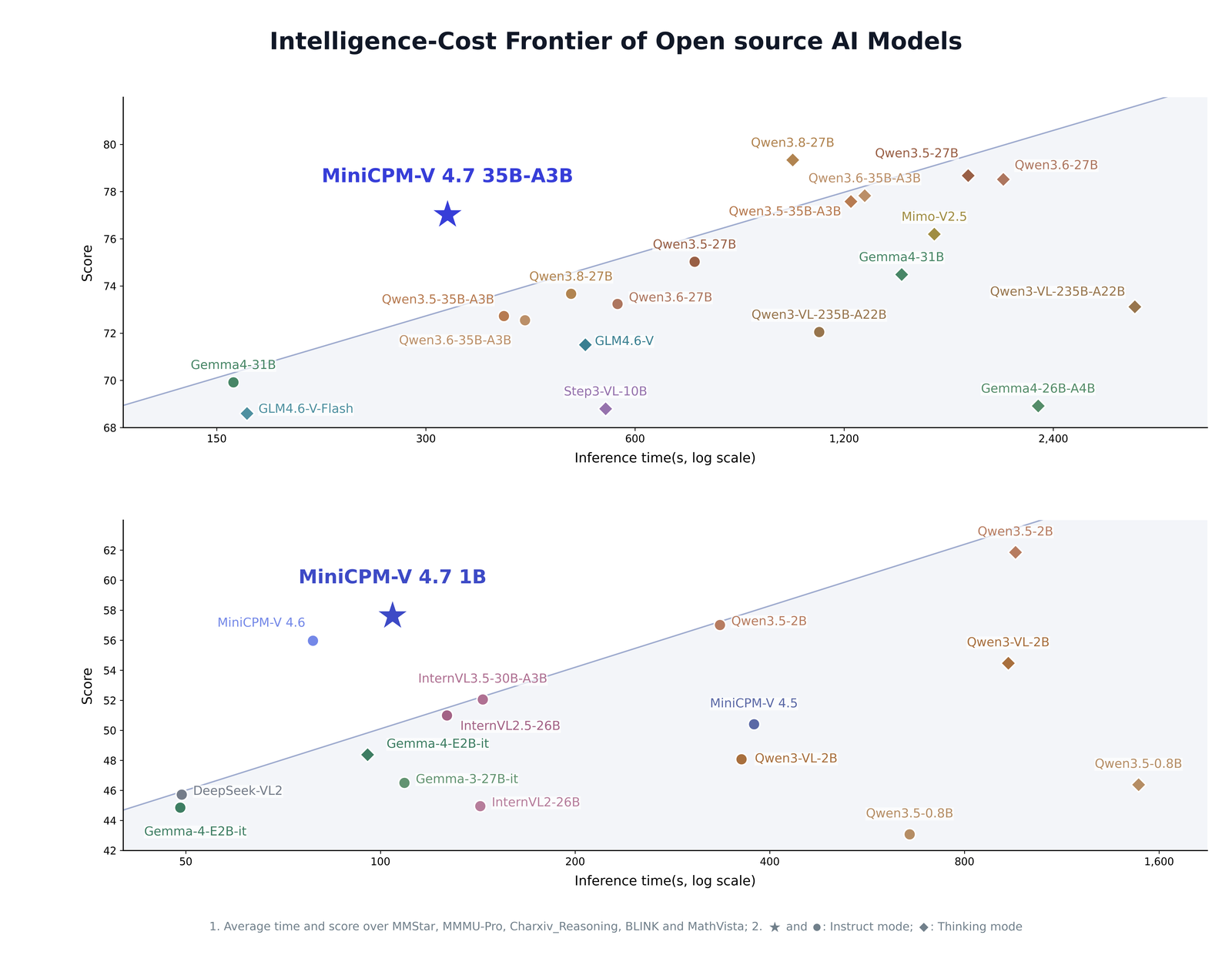
OpenBMB plots average score across MMStar, MMMU-Pro, CharXiv reasoning, BLINK and MathVista against inference time. In instruct mode, the 35B-A3B scores higher than Qwen3.6 35B-A3B while taking less time, and the 1B beats Qwen3.5 0.8B on both counts[1]. The same chart shows some larger Qwen models in thinking mode scoring a little higher, at several times the inference time. The language backbone itself comes from Qwen3.5 and Qwen3.6, with a SigLIP2 vision encoder[2].

To keep image costs down, the model compresses visual tokens early inside the vision encoder and lets developers switch between 4x and 16x compression, trading detail for speed[2].

03 / 04

Getting it running

Weights are on Hugging Face and ModelScope in BF16, with FP8, int4, AWQ, GPTQ and GGUF builds, and the model is on Ollama. OpenBMB lists SGLang, vLLM, llama.cpp and Transformers for inference, SWIFT and LLaMA-Factory for fine-tuning, and day-zero support on Rockchip, Houmo, Intel, AMD and Arm chips[2]. It also released Self-Replay Fine-Tuning, a method meant to add new skills without the model forgetting old ones[1].

04 / 04

Why it matters

Most on-device models are small dense ones, because MoE models are cheap to compute but awkward to store. If expert scheduling holds up outside OpenBMB's own tests, it changes that maths: a much larger model with a phone-sized working set, private by default and with no API bill. For teams building camera, document or screen-reading features into mobile apps, the 35B-A3B and its Apache 2.0 licence are worth a test on their own target devices.

FAQ

Questions, answered.

01

What is MiniCPM-V 4.7?

It's the latest open vision-language model family from OpenBMB, developed by Tsinghua University's THUNLP lab and ModelBest. It handles single images, multiple images, video and documents, and comes in two sizes: a 35B-A3B mixture-of-experts model, the first MoE in the series, and a 1B model. OpenBMB released it on 12 October 2026.

02

Can it really run on a phone?

OpenBMB says the 35B-A3B model decodes at more than 13 tokens a second using 3 GB of memory on an iPhone 17 Pro Max, and it has published screen recordings on an iPhone and an iPad M4. That's the company's own measurement on one device, not an independent test, and 3 GB is the working memory budget, not the full size of the model on disk.

03

How does a 35B model fit in 3 GB?

Only about 3B parameters are active per token, but different tokens use different experts, so the rest have to be loaded from storage as needed. OpenBMB's Lookahead Expert Scheduling predicts which experts the next layer will want and preloads them, while still running whichever experts the router actually picks. Combined with layer-wise quantisation and speculative decoding, OpenBMB says this gives a 5x speedup on real devices.

04

How good is it?

On OpenBMB's chart, averaged over MMStar, MMMU-Pro, CharXiv reasoning, BLINK and MathVista, the 35B-A3B in instruct mode scores higher than Qwen3.6 35B-A3B in less inference time. Some larger Qwen models in thinking mode score higher still, but take several times longer. The 1B beats Qwen3.5 0.8B on both score and speed, per OpenBMB.

05

What's the licence and where can I run it?

Code and weights are Apache 2.0. Weights are on Hugging Face and ModelScope in BF16 plus FP8, int4, AWQ, GPTQ and GGUF builds, and it's on Ollama. OpenBMB lists support for SGLang, vLLM, llama.cpp and Transformers, fine-tuning through SWIFT and LLaMA-Factory, and apps for iOS, Android and HarmonyOS.

06

What else shipped with it?

DSpark speculative decoding draft heads for both sizes, added on 15 October, and Self-Replay Fine-Tuning (SRFT), a method OpenBMB says lets developers add capabilities cheaply while reducing forgetting of existing ones.