News · SI

MiniMax unmasks 'Space Bunny' as M3.1 Flash, a cheaper agent model

MiniMax has officially launched M3.1 Flash, revealing it as the anonymous 'Space Bunny' model that ran on OpenRouter from September. The Chinese lab claims near-triple inference speed and 70% lower agent-task costs than its predecessor at US$0.15/US$0.60 per million tokens. Weights are promised later.

MiniMaxM3.1 FlashAgentsCodingPricingChina

MiniMax has taken the wraps off one of OpenRouter's mystery models. The Chinese AI company officially launched M3.1 Flash on 19 October and said "Space Bunny", the anonymous model that processed more than 200 trillion tokens while it ran unnamed, was an early version of it[1].

OpenRouter first listed Space Bunny Alpha on 23 September as a stealth model with a 1-million-token context window that takes text, image and video input, and now says it was MiniMax M3.1 Flash. Its free stealth period is over[2].

01 / 04

Cheaper and faster

The headline is cost. MiniMax says agentic tasks cost 70% less overall than with its previous model, and that online inference is nearly three times faster[1]. Pricing is a flat US$0.15 per million input tokens, US$0.60 per million output tokens and US$0.015 per million cached input tokens[1].

MiniMax credits "more aggressive sparsity" for the speed, and says everyday output reaches more than 200 tokens per second, with a median above 170[1].

02 / 04

What MiniMax says it can do

MiniMax's published numbers put M3.1 Flash at 76.2 on BankerToolBench, 73.7% on the DeepSWE v1.1 coding benchmark, 61.7 on OSWorld 2.0 and 29.6 on Agents' Last Exam, ranking first among Chinese models on those last two computer-use tests[1]. It also reports 82% on the CyberGym vulnerability benchmark[1].

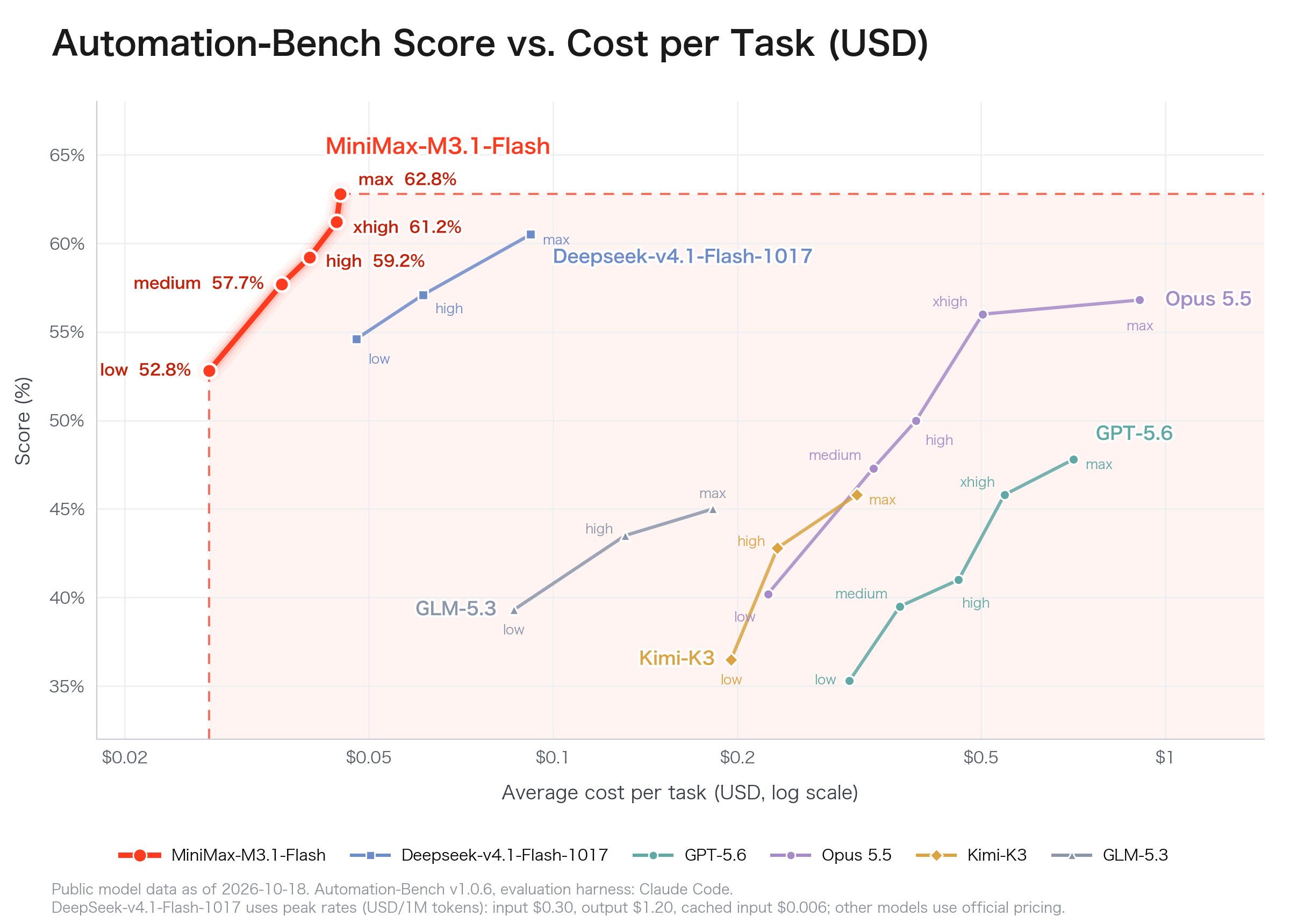
Its comparison table is more mixed than the headline. M3.1 Flash leads Automation-Bench v1.0.6, a test of business workflows across SaaS tools, at 62.8, ahead of DeepSeek V4.1 Flash-1017 at 60.5, Opus 5 at 50.3 and GPT-5.6 Sol at 45.8[1]. But Opus 5 is well ahead on Terminal Bench 4.0 (51.8 against 38.1) and OSWorld 2.0 (70.6 against 61.7), and DeepSeek's latest Flash still beats it on DeepSWE v1.1 (77.0 against 73.7)[1].

Where MiniMax is really competing is price per task. Its Automation-Bench chart has M3.1 Flash scoring between 52.8% and 62.8% depending on reasoning effort, at under five US cents a task. Every other model on the chart scores lower at its top setting, and costs more per task to get there[1]. All of these are MiniMax's own figures and haven't been independently checked.
03 / 04

How to use it

M3.1 Flash is available now through the MiniMax API, MiniMax's M Plan and its MiniMax Code desktop app[1]. MiniMax says the weights "will be released later", and that a bigger Pro model "will also arrive later"[1]. Reuters, reporting the launch from Beijing, noted the company's claims of "generational" gains in agentic tasks, programming and cybersecurity[3].

04 / 04

Why it matters

Agent workloads burn through tokens, so a model's price per finished task matters more than its price per token. MiniMax is betting that a fast, cheap model near the top of the agent benchmarks is more useful than a slightly better one that costs many times as much per task. Stealth-testing it as Space Bunny first also gave MiniMax real-world usage at scale before it put its name on the model. The open-weights release, if it lands, is the next thing to watch.

FAQ

Questions, answered.

01

What is MiniMax M3.1 Flash?

M3.1 Flash is the latest fast, low-cost model from Chinese AI company MiniMax, released on 19 October 2026. MiniMax pitches it at agentic work, coding, computer use and cybersecurity, and says it is available through the MiniMax API, its M Plan and the MiniMax Code app.

02

Was M3.1 Flash the 'Space Bunny' model on OpenRouter?

Yes. MiniMax says Space Bunny was an early version of M3.1 Flash and processed more than 200 trillion tokens while it ran anonymously. OpenRouter now lists Space Bunny Alpha, released there on 23 September 2026, as a stealth model revealed to be MiniMax M3.1 Flash, and says its free stealth period has ended.

03

How much does M3.1 Flash cost?

MiniMax charges a flat US$0.15 per million input tokens, US$0.60 per million output tokens and US$0.015 per million cached input tokens. It says the overall cost of agentic tasks is 70% lower than with its previous model.

04

How fast is it?

MiniMax says online inference is nearly three times faster than before, thanks to more aggressive sparsity, with everyday output speeds above 200 tokens per second and a median (P50) above 170 tokens per second.

05

How does it compare with Claude, GPT and DeepSeek?

On MiniMax's own table it leads Automation-Bench v1.0.6 at 62.8, ahead of DeepSeek V4.1 Flash-1017, Opus 5 and GPT-5.6 Sol, and ties Opus 5 on BankerToolBench at 76.2. It trails Opus 5 on Terminal Bench 4.0, OSWorld 2.0 and NL2Repo-Bench, and DeepSeek V4.1 Flash-1017 on DeepSWE v1.1. None of these scores has been independently checked.

06

Are the weights open?

Not yet. MiniMax says the model weights 'will be released later', and that a larger Pro model will also follow. For now M3.1 Flash is API and app only.