News · SI
Mirendil raises US$1B Series A to democratise frontier AI R&D
Mirendil, a San Francisco AI lab founded by former Anthropic researchers, has raised a US$1 billion Series A led by Kleiner Perkins and Clearlake Capital. The company says one researcher, working with agents, pretrained a competitive coding model from scratch in 3.5 months for less than US$10 million in compute.
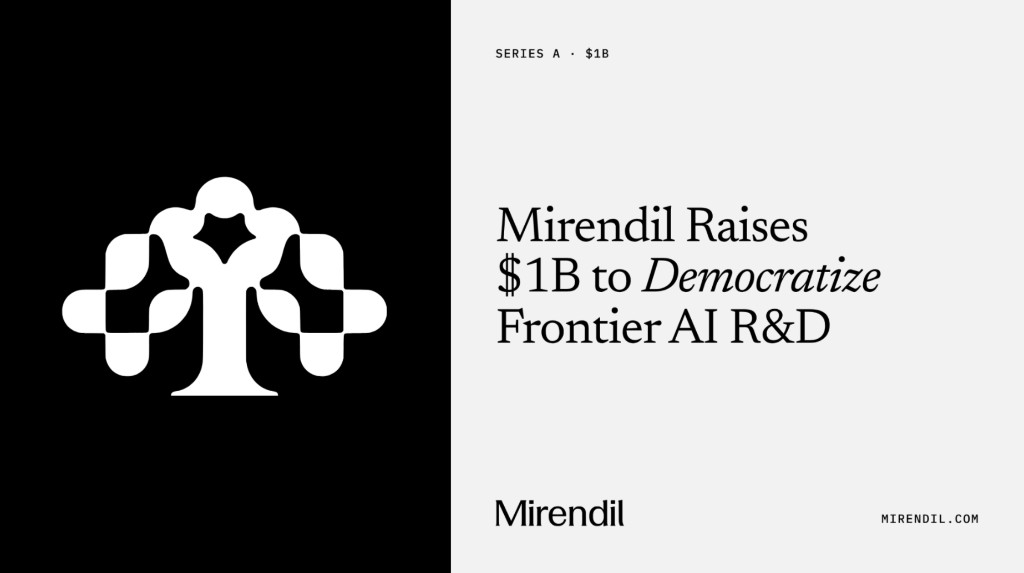
San Francisco AI lab Mirendil has raised a US$1 billion Series A led by Kleiner Perkins and Clearlake Capital[1][2]. Battery Ventures, Doerr Capital, Gil & Co, Google, M13, Pear VC and S32 also took part, along with other new and existing investors[1][2]. Mirendil published the announcement on 12 November 2026, at 9:00 am PT[1].
The company says it is building tools to democratise frontier AI research and development, and to put that work within reach of every scientist and engineer[1]. It says making AI research and development more accessible is the most direct path to AI that solves humanity's most pressing problems across science and technology[1].
01 / 04
From a June seed
Dealroom describes Mirendil as a San Francisco AI lab founded by former Anthropic researchers[2]. Chief executive Behnam Neyshabur co-led Google DeepMind's Blueshift team[2]. Chief technology officer Harsh Mehta built the first version of Anthropic's internal AI research platform[2].
Dealroom puts five months between the seed and this Series A[2]. It says Mirendil launched in June with a US$200 million seed led by Andreessen Horowitz and Kleiner Perkins, at a valuation of around US$1 billion, and that Nvidia joined later[2]. Unite.AI dates that launch to 24 June 2026[3]. It says Mirendil described a founding team of 20 researchers and engineers from institutions including Anthropic, xAI, Google DeepMind and OpenAI, and that investment from Nvidia and others followed the seed[3].
Dealroom says Mirendil has not disclosed a valuation for the Series A[2]. It also says that in September, Bloomberg reported the company was in talks to raise up to US$1 billion at a US$5 billion valuation[2].
02 / 04
A coding model from one researcher
Mirendil says results it has shared over the past three weeks point to the same shift: when agents do the hands-on work, the size of a team stops limiting what can be built[1].
One researcher, working with agents, pretrained Mirendil-Base, a competitive coding model, from scratch in 3.5 months with less than US$10 million in compute, the company says[1][2]. Unite.AI reports that Mirendil's 21 October 2026 report counts that sub-US$10 million figure as all-in: research and small-scale experiments, the final training run, agent token spending and data processing[3].
In that run, Unite.AI reports, agents wrote more than 99% of the code, ran the experiments and diagnosed failures[3]. The researcher chose what to try and what to trust, and intervened when needed[3]. The experiment used publicly available code, web pages and public datasets, without purchasing or licensing additional data, and without distillation or synthetic data[3]. Unite.AI says Mirendil-Base sits in the 100 billion to 500 billion parameter range[3]. The larger Mirendil-Base-Large and Mirendil-Base-XL models were still in training when the report was published[3].
03 / 04
Fern, and Lor in private beta
Mirendil says it then post-trained Mirendil-Base into Fern, which holds up to 10 million tokens of context, enough for days of an agent's work[1]. Unite.AI identifies the first model as Fern 0.1[3]. It says the model page describes Fern for high-volume agent work such as debugging training runs, reading complete agent traces and auditing training data, with a context window of up to 10 million tokens, roughly 23 MB or about half a million lines of code. Access is listed as coming soon[3].
Lor, in private beta, is how Mirendil says this way of working reaches other people: hundreds of agents writing code and running experiments for days at a time[1]. The company says it runs on Lor every day[1]. Unite.AI says Lor was introduced on 28 October 2026 as a cloud system whose agents can write code, run experiments, provision compute and operate on machines the user selects. An agent can divide a job across dozens of agents, with hundreds running across projects, and agents can continue for days or weeks and unblock themselves when something breaks[3]. The private beta is free, by invitation, on macOS, Linux and the web[3]. Windows, iOS and Android are listed as coming soon[3].
Mirendil says it is still a small team with a singular focus. People who want to make frontier AI research and development accessible can join, and anyone who wants to build with Mirendil can write to contact@mirendil.com[1].
04 / 04
Why it matters
Mirendil says the round lets it go further: one person can take on what used to need a team, a team what used to need an institution, and the lab can help accelerate science and technology more directly than before[1]. Unite.AI says the Series A connects agent-assisted model development, a platform for delegating research work, and cloud infrastructure for larger experiments[3]. It frames the central test as whether the one-researcher result becomes a repeatable workflow for scientists and engineers outside the company[3].
Unite.AI says Mirendil had already announced a multi-year Google Cloud partnership on 6 August 2026[3]. The partnership puts training, inference and AI research workloads on Google Cloud's AI Hypercomputer, with Google Cloud TPUs, full-stack Nvidia AI infrastructure, and managed training clusters co-designed across compute, storage, networking and control planes[3].
Dealroom calls a US$1 billion Series A rare even in AI, and places Mirendil among the best-funded of the new AI research labs, alongside Safe Superintelligence, Thinking Machines Lab and Recursive Superintelligence[2]. It says the round lands a week before Anthropic, where much of the founding team came from, is set to list on Nasdaq[2].
Sources
Sources for this story.
FAQ
Frequently asked questions.
01How much did Mirendil raise, and who invested?
Mirendil announced on 12 November 2026 that it had raised a US$1 billion Series A led by Kleiner Perkins and Clearlake Capital. Battery Ventures, Doerr Capital, Gil & Co, Google, M13, Pear VC and S32 took part, along with other new and existing investors. Mirendil says the round supports tools meant to put frontier AI research and development within reach of every scientist and engineer.
02Who leads Mirendil, and how did the lab start?
Dealroom describes Mirendil as a San Francisco AI lab founded by former Anthropic researchers. Chief executive Behnam Neyshabur co-led Google DeepMind's Blueshift team, and chief technology officer Harsh Mehta built the first version of Anthropic's internal AI research platform. Dealroom says the company launched in June with a US$200 million seed led by Andreessen Horowitz and Kleiner Perkins, at a valuation of around US$1 billion, and that Nvidia joined later. Unite.AI dates that launch to 24 June 2026 and says the founding team was 20 researchers and engineers from Anthropic, xAI, Google DeepMind and OpenAI.
03What did one researcher train, and what did it cost?
Mirendil says one researcher, working with agents, pretrained Mirendil-Base, a competitive coding model, from scratch in 3.5 months with less than US$10 million in compute. Unite.AI reports that Mirendil's 21 October 2026 report treats that figure as all-in, covering research and small-scale experiments, the final training run, agent token spending and data processing. Unite.AI also says agents wrote more than 99% of the code in that run, using public code, web pages and public datasets, without purchased or licensed extra data and without distillation or synthetic data. It places Mirendil-Base in the 100 billion to 500 billion parameter range.
04What are Fern and Lor?
Fern is the model Mirendil says it post-trained from Mirendil-Base. It holds up to 10 million tokens of context, which the company calls enough for days of an agent's work, and Unite.AI says access to Fern 0.1 is listed as coming soon. Lor, in private beta, is the system for handing that work to agents: Mirendil describes hundreds of agents writing code and running experiments for days at a time, and says Mirendil runs on Lor every day. Unite.AI says the private beta is free by invitation on macOS, Linux and the web.
05Has Mirendil disclosed a valuation for the Series A?
No. Dealroom says the company did not disclose a valuation for the round. It also says that in September, Bloomberg reported Mirendil was in talks to raise up to US$1 billion at a US$5 billion valuation. That US$5 billion figure is Bloomberg's report of talks, as relayed by Dealroom, not a valuation Mirendil has published for this Series A.
That’s the story
Building with what’s new?
Spectrum Web Co ships products, places talent, builds social narratives and builds custom business tools as monthly services.
Related stories