News · Tech

NeodraDynamics' Neo1 is a 4-metre hydraulic humanoid built for jobs people shouldn't do

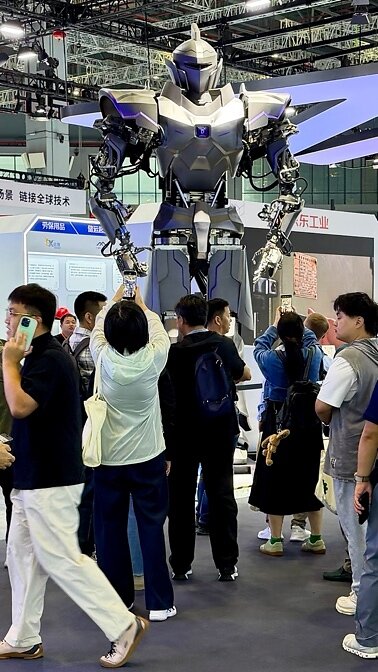
Beijing's NeodraDynamics showed Neo1, a 4-metre-class, 1.2-tonne humanoid with 39 hydraulic joints, at the 2026 China International Industry Fair alongside JD Industrial. The company claims a 500 kg two-arm payload and ±0.005 mm repeat accuracy for mining, nuclear, deep-sea and rescue work. No price, delivery date or customer has been announced.
NeodraDynamicsHumanoid robotsHydraulicsJD IndustrialRoboticsChina

Most humanoid robots are built to be human-sized and battery-friendly. NeodraDynamics went the other way: Neo1 is a 4-metre-class, 1.2-tonne machine driven mostly by hydraulics, and the Beijing company says it's built to do heavy, risky work that people can't or shouldn't[1].

The robot was shown at the 2026 China International Industry Fair (CIIF) with JD Industrial, according to a company release dated 14 October[1]. Photos of it towering over the expo crowd have been doing the rounds online since.

01 / 05

What's inside

Neo1 has 41 active degrees of freedom across its body. All but two, the forearm rotation joints, use NeodraDynamics' own miniature digital hydraulic linear actuators[1]. The company says each actuator weighs about 1 kg and produces ton-level continuous thrust, which is how it arrives at a 500 kg payload when both arms work together[1]. It also claims ±0.005 mm repeat positioning accuracy[1].

NeodraDynamics' website fills in the parts. It lists a hydraulic dexterous hand with 15 degrees of freedom, a 500 kgf grip, 0.01 mm fingertip precision and a working range of -50 to 250°C, plus a 7-DoF heavy-duty arm with a 1.7-metre reach, both pitched at nuclear and deep-sea environments[2].

02 / 05

The case for hydraulics

The company's pitch is a direct challenge to the all-electric humanoids most labs are building. It argues that electric drives run short on power density, load capacity, shock resistance and tolerance for harsh conditions, which keeps most humanoids in demos and light service work[1]. Its answer is to use hydraulics for raw force and keep electric servos where precision matters.

"Robots should not merely replicate human forms but surpass human physical limits to create unprecedented operational capabilities," founder Yang Tao said in the release[1].

The target jobs follow from that: heavy component assembly, port cargo handling, nuclear fuel transfer and maintenance, subsea equipment work, and demolition and clearance in mines and disaster zones[1].

03 / 05

Where JD Industrial fits

JD Industrial's part is commercial. The release says it brings its industrial supply chain and end-user scenarios so the two companies can match Neo1 to real sites and run pilot applications[1]. No contract value or pilot timeline has been published[3].

04 / 05

What's claimed versus shown

Neo1 has now been on public display twice; Aparobot notes it first appeared at the 2026 World Robot Conference in Beijing[3]. The payload, thrust and accuracy numbers are the company's own and haven't been independently tested, and there's no price, delivery date or named customer yet[3].

05 / 05

Why it matters

Humanoid robotics has mostly been a race to make human-sized machines cheap enough for factories and homes. Neo1 is a bet on the opposite end of the market: fewer, much bigger robots for sites where hydraulic excavators and remote manipulators already work and where a person on the floor is the real risk. Whether a 4-metre humanoid beats purpose-built machinery there is still unproven, and the JD Industrial pilots are the thing to watch.

FAQ

Questions, answered.

01

What is NeodraDynamics Neo1?

Neo1 is a heavy-duty humanoid robot from NeodraDynamics Robotics Technology, a Beijing company. The company describes it as a 4-metre-class, 1.2-tonne 'super humanoid' that combines hydraulic and electric drives, aimed at dangerous, dirty, difficult and dull industrial work.

02

How strong and precise is it?

By NeodraDynamics' own figures, Neo1 can carry 500 kg with both arms working together and repeat a position to within ±0.005 mm. Each of its in-house hydraulic actuators weighs about 1 kg and produces what the company calls ton-level continuous thrust. None of these figures has been independently tested.

03

Why hydraulics instead of electric motors?

NeodraDynamics argues that all-electric humanoids lack the power density, load capacity, shock resistance and tolerance of harsh environments needed for heavy industry. Neo1 uses hydraulic actuators for 39 of its 41 active joints and electric drives only for the two forearm rotation joints, pairing hydraulic strength with electric precision.

04

What jobs is Neo1 meant for?

The company lists heavy component assembly and port cargo handling, nuclear fuel transfer and equipment maintenance, subsea equipment maintenance, and demolition and clearance in mining and disaster rescue.

05

What is JD Industrial's role?

JD Industrial exhibited Neo1 with NeodraDynamics at CIIF and, according to the release, brings its industrial supply chain and end-user scenarios so the two can verify real-world uses through scenario matching and pilot projects. No contract value or pilot timeline has been published.

06

Can you buy one?

Not yet, as far as anyone has said. NeodraDynamics hasn't published a price, lead time, delivery date or named customer, and says it is holding 'global industrial cooperation negotiations', which points to a partner and pilot stage.