News · Tech
Nominal raises $240M at a $3B valuation to bring AI agents to hardware testing
Nominal, which builds software for testing aircraft, robots, reactors and other complex machines, has raised a $240 million Series C at a $3 billion valuation led by Lightspeed and Insight Partners, tripling its valuation in eight months as it pushes AI agents into engineering workflows.
Nominal, an Austin startup that builds software for testing complex hardware, has raised a $240 million Series C at a $3 billion valuation, led by Lightspeed Venture Partners and co-led by Insight Partners[1]. Lux Capital, Sequoia, General Catalyst, Founders Fund and Lockheed Martin Ventures are among the other investors[1].
The round triples the company's valuation in about eight months. In March it raised a $155 million Series B extension at a $1 billion valuation, led by Founders Fund[4].
01 / 04
The problem it is going after
Testing is where a machine's design meets physics, and the software behind it has not kept up. Lightspeed describes propulsion engineers copying data off test stands onto USB drives and into folders of Python scripts only one person understands[3]. Nominal's argument is that a general-purpose AI model cannot fix that by itself, because the data is scattered across instruments, files, simulations and teams, and a sensor reading means little without the hardware configuration and past experiments around it[2].
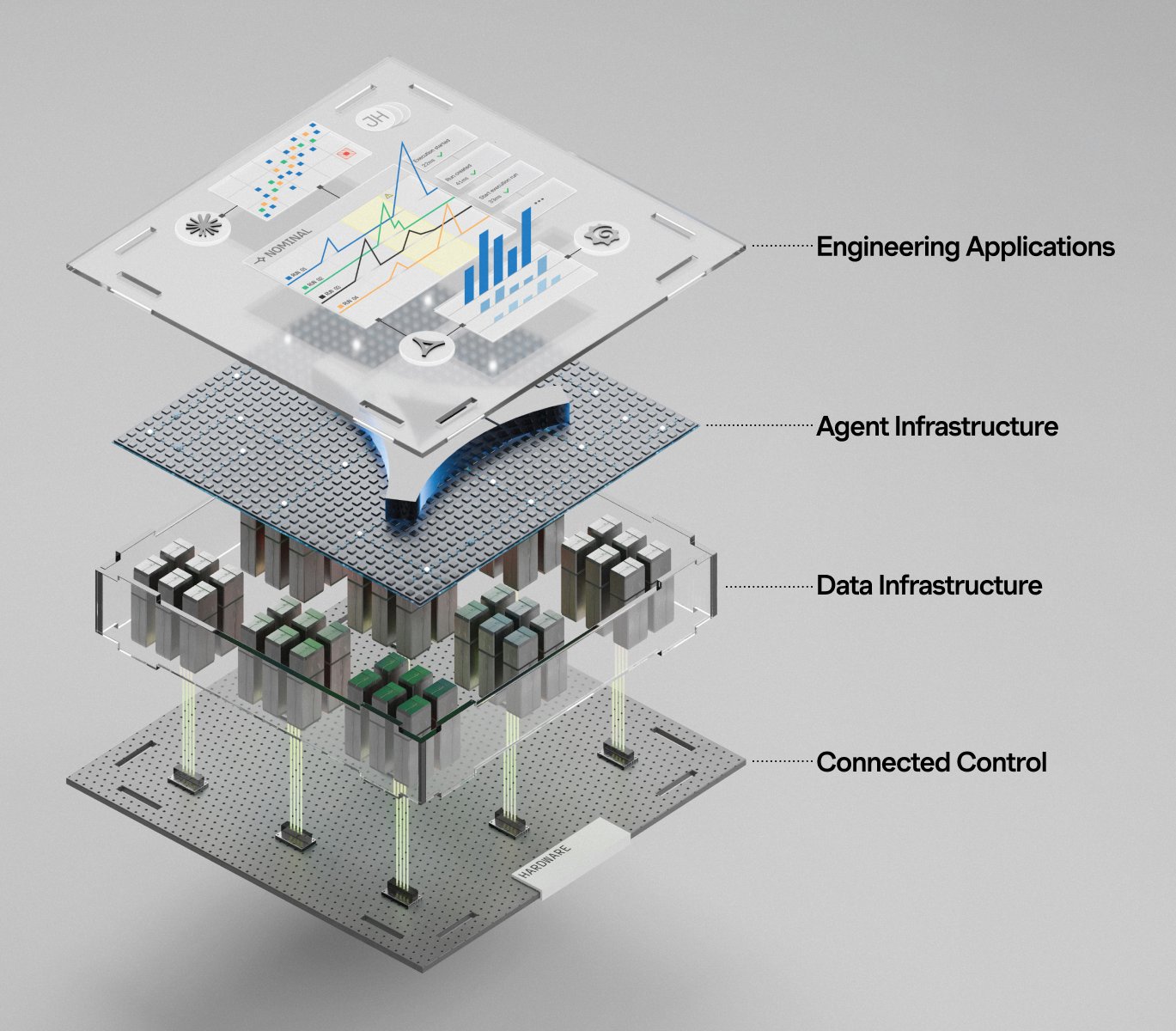
The company describes its platform in four layers: connections to the physical hardware being tested, a data layer that gives engineering data a common structure, an intelligence layer that lets models and agents use that context, and applications built on top[2]. It runs in the cloud, on premises, in air-gapped facilities and on edge devices, and engineers can build their own tools and agents on it through SQL, APIs and MCP[1].
02 / 04
Agents for engineers
Nominal Analyst, the company's first AI agent, investigates engineering data and runs complex analyses, with its answers traceable to the underlying evidence, while engineers keep control of decisions and approvals[1]. Lightspeed says two more are on the way: Execute, which runs a test, controls instruments and can abort if it detects the hardware going wrong, and Plan, which helps decide which test points will give the most information when every test uses up a prototype[3].
03 / 04
Customers and defence work
Nominal says more than 80 commercial and government organisations use it, including five of the seven largest defence contractors[1]. At Anduril more than 300 engineers use it, and analysis that took five to six hours now happens in near real time. An HII pilot cut some production test steps by about half, and Hermeus cut the time between uploading and reviewing data by 80% while building its Quarterhorse Mk 1 aircraft in seven months[1].
The US Air Force recently selected Nominal for a $71.2 million Strategic Funding Increase to support Collaborative Combat Aircraft work[1]. CEO and co-founder Cameron McCord is a former US Navy submarine officer and Anduril alum[4].
04 / 04
Why it matters
Much of the attention in AI goes to models and chips. Nominal is a bet that the bigger gains in physical industries come from wiring AI into the data and workflows engineers already depend on. The new funding goes to agents and applications across a machine's life, from requirements verification and planning to scheduling and fleet health, and to new industries and regions, including through acquisitions such as Fid Labs and Pull Systems this year[1]. With robots, drones and autonomous vehicles all needing constant testing and updates, that tooling layer is starting to look like a market of its own.
Sources
Sources for this story.
- Nominal raises $240M at a $3B valuation to build the intelligence platform for hardware engineering (Nominal)nominal.io
- We raised $240M to build the intelligence platform for hardware (Nominal)nominal.io
- Hardware Engineering Gets Its Intelligence Layer (Lightspeed Venture Partners)lsvp.com
- AI hardware startup Nominal triples valuation to $3B in 8 months (TechCrunch)techcrunch.com
FAQ
Frequently asked questions.
01How much did Nominal raise?
$240 million in a Series C at a $3 billion valuation, led by Lightspeed Venture Partners and co-led by Insight Partners.
02What does Nominal do?
It builds software that collects test data from hardware such as aircraft, satellites, robots and reactors, links it to the engineering context behind it, and gives engineers and AI agents tools to analyse it.
03How fast has its valuation grown?
TechCrunch reports Nominal was valued at $1 billion after a $155 million Series B extension in March 2026, so the new round triples that in about eight months.
04Who uses it?
Nominal says more than 80 commercial and government organisations, including five of the seven largest defence contractors. Named customers include Anduril, HII and Hermeus.
05What are its AI agents?
Nominal Analyst is its first agent, which investigates engineering data and runs analyses with answers traced back to the evidence. Lightspeed says agents called Execute and Plan, for running tests and choosing what to test next, are also coming.
06What will the money be used for?
More agents and applications across a machine's life, from requirements verification and planning to scheduling and fleet health, plus expansion into new industries and regions, including through acquisitions.
That’s the story
Building with what’s new?
Spectrum Web Co ships products, places talent, builds social narratives and builds custom business tools as monthly services.
Related stories