News · SI
NVIDIA opens four Cosmos 3 Nano models for interactive world simulation
NVIDIA released four open-weight Cosmos 3 Nano checkpoints on Hugging Face for interactive world simulation: multi-view driving with LiDAR, simulator-to-RGB transfer, and bimanual robot action-to-video. Each has about 16B trainable parameters under OpenMDW 1.1.
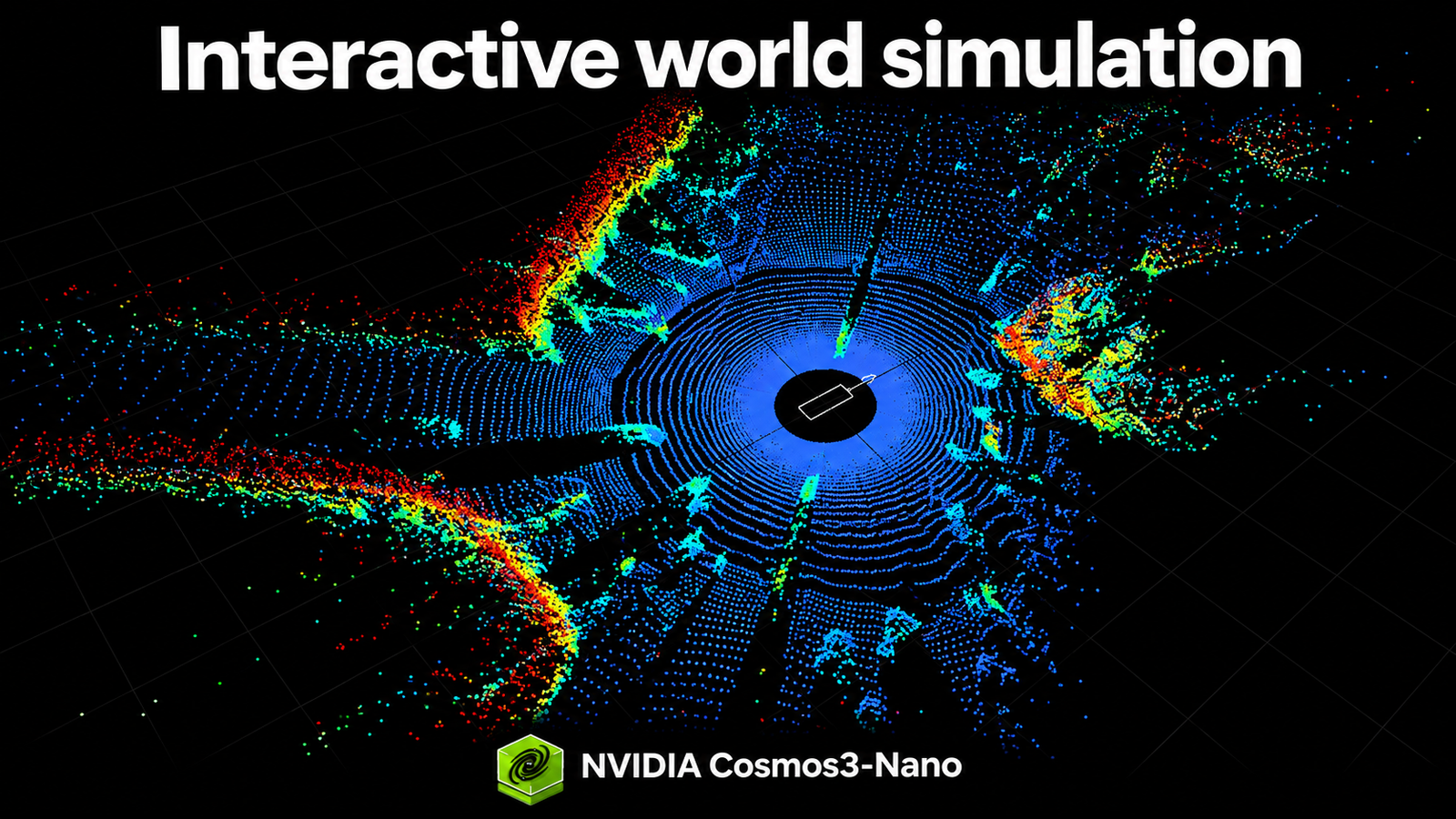
NVIDIA has added four open-weight Cosmos 3 Nano checkpoints to its Cosmos world-model platform for interactive world simulation and multi-sensor multi-view driving scenes[1]. The models were posted on Hugging Face on 5 November 2026, each with about 16 billion trainable parameters and released under OpenMDW 1.1[1].
01 / 04
Four post-trained Nano checkpoints
The release covers complementary jobs rather than a single do-everything model[1]:
- Cosmos3-Nano-Transfer-Auto generates synchronized multi-view driving data with varied weather, lighting and time of day, including up to 11 camera views and optional joint RGB-LiDAR.
- Cosmos3-Nano-Sim-Auto is the streaming, causally distilled variant that produces successive camera and LiDAR chunks for interactive driving rollouts.
- Cosmos3-Nano-Sim-Transfer turns simulator spatial controls (depth, segmentation, edges, blur) and a text prompt into photorealistic RGB for closed-loop policy work.
- Cosmos3-Nano-Sim-Bimanual predicts video from robot or camera actions for interactive two-arm simulation on YAM and AgiBot embodiments.
All four are post-trained examples of Cosmos 3 Nano[1].
02 / 04
Why interactive world models
NVIDIA argues robotics and autonomy need environments that stay consistent as scenes and viewpoints change. Transfer and Sim-Auto keep appearance and geometry aligned across cameras and LiDAR; Sim-Transfer leaves physics with the simulator while generating observations a policy can consume; Sim-Bimanual lets a policy or joystick drive the next visual frame from action[1]. Streaming generation uses a Mixture-of-Transformers backbone with temporal-causal attention and a four-stage recipe that ends in self-forcing so the student trains on its own generated history[1].
03 / 04
Open weights, post-training recipes
NVIDIA is shipping open skills, notebooks and post-training recipes so labs can adapt Transfer-Auto to their own sensor rig, distill a Sim-Auto streamer, or retarget Sim-Bimanual to another embodiment[1]. The company is explicit that these problems remain hard: the point of open checkpoints is to measure where the models support policy learning and where they fall short[1].
04 / 04
Why it matters
Closed world-model stacks are hard to compare and expensive to reproduce. Putting multi-view driving, simulator-to-RGB transfer and bimanual action-to-video under one open Cosmos 3 Nano family gives academic and industry labs a shared starting point for physical AI evaluation without rebuilding the foundation from scratch[1][2].
FAQ
Frequently asked questions.
01What did NVIDIA release?
Four post-trained Cosmos 3 Nano open-weight checkpoints for interactive world simulation and multi-sensor driving scenes: Transfer-Auto, Sim-Auto, Sim-Transfer and Sim-Bimanual. Each has about 16 billion trainable parameters.
02What licence are they under?
OpenMDW 1.1, which NVIDIA says permits commercial and non-commercial use under its terms.
03How do the driving models help?
Transfer-Auto generates synchronized video across up to 11 camera views, including fisheyes, with optional joint RGB-LiDAR and weather, lighting and time-of-day controls. Sim-Auto is the streaming, causally distilled variant for interactive rollouts.
04What about robotics?
Sim-Bimanual predicts video from robot or camera actions for interactive two-arm simulation on YAM and AgiBot embodiments. Sim-Transfer turns a physics simulator's depth, segmentation, edge and blur controls plus a text prompt into photorealistic RGB.
05Where can I get them?
The checkpoints, notebooks and open skills are linked from NVIDIA's 5 November 2026 Hugging Face blog post on Cosmos interactive world simulation.
That’s the story
Building with what’s new?
Spectrum Web Co ships products, places talent, builds social narratives and builds custom business tools as monthly services.
Related stories