News · Tech

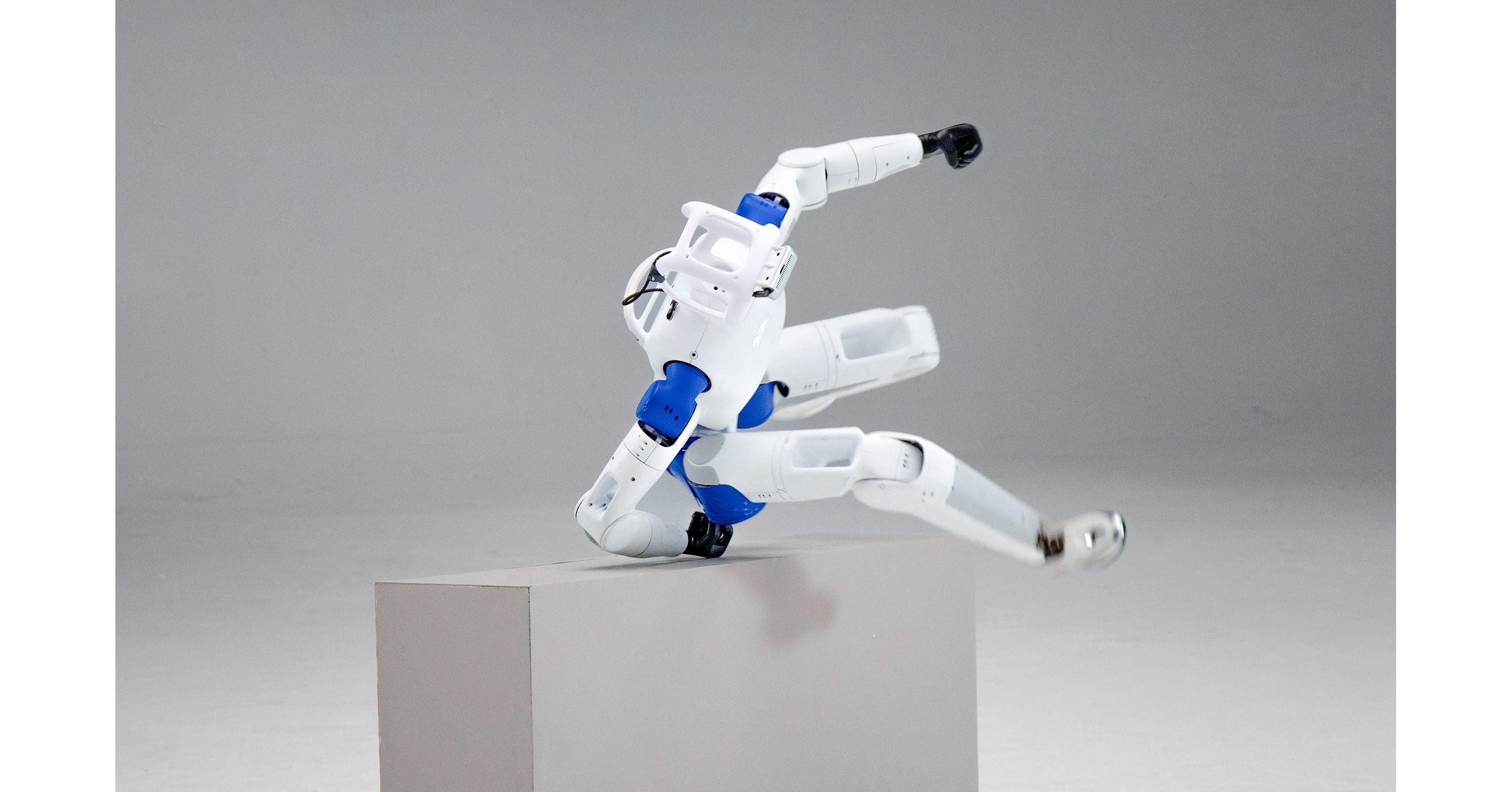
RoboParty's RP1 is a humanoid robot you can open all the way down

Shanghai's RoboParty has launched RP1, a 1.3-metre research humanoid whose CAD, circuit boards, actuators, firmware and training code are published on GitHub. Here is what is actually open, under which licences, and who it is for.

RoboPartyHumanoid robotsOpen sourceRobotics

RoboParty, a Shanghai robotics start-up, has launched RP1, a humanoid robot built for research that it describes as full-stack open source[^1]. Rather than opening only a software interface, the company has published the robot itself: the mechanical design, the circuit boards, the joint motors, the firmware and the tools used to train it[^1][^2].

01 / 04

What you get

The standard RP1 is about 1.3 metres tall with 24 actuated joints, enough for research into walking, balance and moving policies from simulation onto real hardware[^1]. A Pro version has 30, adding a two-joint neck and two seven-joint arms for manipulation and data collection, not counting the hands[^1]. Head modules and wrist tools swap out, including RoboParty's own RP Hand dexterous hand[^1].

Out of the box it can walk continuously, recover when pushed, stand back up after a fall and copy human motion[^1]. It also comes with whole-body control that coordinates arms, torso and legs, and tooling for VR teleoperation, recording and replaying demonstrations, and retargeting motion onto the robot[^1].

02 / 04

How open is open

The GitHub overview splits the project into separate repositories: mechanical source files, electronics and assembly instructions; the ROMOMO joint modules with their firmware and host tools; a Linux board support package and low-level SDK; URDF and MJCF robot models for simulation; a runtime SDK for the IMU, motors, hand, camera and inference; and training code for locomotion and motion imitation[^2]. The hardware repository is licensed CERN-OHL-W-2.0, a weakly reciprocal open hardware licence, while the overview and firmware are GPL-3.0[^2][^3]. Licences differ across the repositories, so check the one you plan to build on.

RoboParty's argument is debugging. When a robot fumbles a task, the fault could be in the model, the control policy, the actuator or the frame, and with a closed robot you can only see the top layer[^1]. Its earlier open-source humanoid project, RPO, launched in January with mechanical and electrical designs plus training and deployment material, and has passed 2,600 GitHub stars from developers reproducing and extending the design[^1].
03 / 04

What it doesn't tell you

The announcement gives no price and no shipping date for built units[^1]. The training repository lists several research projects, but the demo section on GitHub still says coming soon, so treat RP1 as a platform to build on rather than a finished product[^2].

04 / 04

What it changes for shipping teams

Many teams writing robot software build on closed humanoids and work around whatever the vendor exposes. A robot whose CAD, boards, motor firmware and simulation models are all public means a lab or a start-up can change the hardware when the software needs it, and run the same robot in simulation and on the floor from the same files. If you are building robot learning or teleoperation tools, RP1's robot models and SDK are worth pulling into your simulation stack now, even before you buy a robot.

FAQ

Questions, answered.

01

What is RoboParty RP1?

RP1, also called ROBOTO 01, is a humanoid robot from RoboParty, a Shanghai company founded in 2025. It launched on 15 October 2026 (US time) as a full-stack open-source platform for robotics research and embodied AI, meaning the hardware designs, actuators, firmware, control code and training tools are all published.

02

How big is RP1 and how many joints does it have?

The standard RP1 is about 1.3 metres tall with 24 actuated degrees of freedom, aimed at walking, balance and sim-to-real research. The Pro version has 30, adding a 2-DoF neck and two 7-DoF arms for manipulation and data collection. Those counts exclude the dexterous hands, and RoboParty's GitHub lists 24, 28, 30 and 42 DoF configurations.

03

What exactly is open source in RP1?

RoboParty's GitHub publishes mechanical CAD, schematics, PCB layouts, Gerber files, a bill of materials and assembly guides, plus the ROMOMO joint actuator modules and their firmware, a Linux board support package, URDF and MJCF robot models, a runtime SDK, and training code for locomotion and motion imitation.

04

What licence is RP1 released under?

It differs by repository. The RP1 overview, Party_OS and firmware repositories are GPL-3.0, the rp1_hardware design files are CERN-OHL-W-2.0, and the ROMOMO actuator repository is CC-BY-4.0. When we checked, the training repository had no licence file detected, so check each repository before building a product on it.

05

How much does RP1 cost?

RoboParty's launch announcement does not give a price. Researchers can study and reproduce the design from the public files, but anyone wanting a built robot will need to contact RoboParty directly.