News · Tech
SGLang hits v1.0 as NVIDIA, AMD and Google join new consortium
LMSYS Org launched the SGLang Consortium on 12 November 2026 with NVIDIA, AMD, Intel, Google, Meta, Cloudflare, Modal and RadixArk. At the same San Francisco summit, SGLang announced v1.0 and said the full release notes are still to come.
LMSYS Org, the non-profit behind the open-source inference engine SGLang, launched the SGLang Consortium on 12 November 2026 in San Francisco. The founding members are NVIDIA, AMD, Intel, Google, Meta, Cloudflare, Modal and RadixArk. LMSYS says they will work with SGLang's maintainers to help shape the project's roadmap and to advance open-source AI inference. The consortium was announced in the opening keynote of the inaugural SGLang Summit.[1][2]
The summit is the first conference dedicated to SGLang and its open-source community. It runs on 12 and 13 November at the Fort Mason Center for Arts & Culture in San Francisco. LMSYS says more than 100 speakers from AI hardware, models, infrastructure and applications are taking part, and that sessions cover the SGLang ecosystem across reinforcement learning, multimodal models and hardware platforms.[1][2]
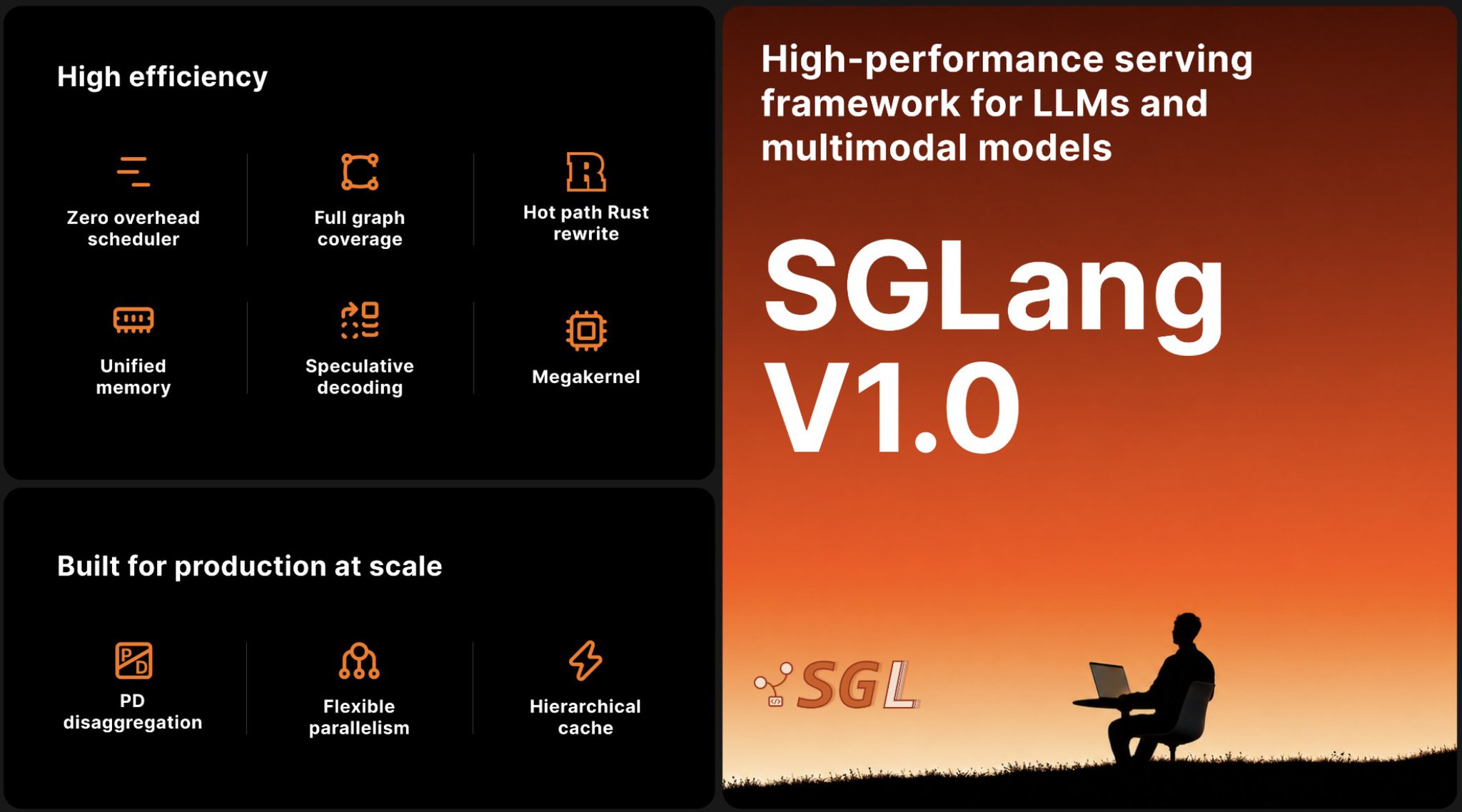
SGLang used the same summit to announce v1.0. In a post from its @sgl_project account, it called v1.0 high-performance inference for large language models and multimodal models, built for production at scale. The post says the details of the release are coming soon, so this announcement does not include the full notes.[3]
01 / 05
A standing forum for the roadmap
LMSYS describes the consortium as a standing forum. Members can discuss emerging inference trends with SGLang's maintainers and turn shared priorities into joint engineering work. The focus LMSYS names is frontier model support, reasoning and multimodal workloads, distributed inference and hardware optimisation.[1][2]
Each founding member will designate a technical representative and join two roadmap meetings a year. LMSYS says a member contributes through engineering expertise, deployment feedback, testing resources or joint development. Working groups may collaborate between those meetings. LMSYS says there will be public updates on roadmap direction and on progress.[1][2]
The maintainers keep the decision. LMSYS says they remain responsible for technical decisions and for accepting code, and that the project stays open to the whole community.[1][2]
02 / 05
Who already runs SGLang
LMSYS calls SGLang a full-stack inference engine for frontier AI, and part of the PyTorch ecosystem. It says the engine runs on hundreds of thousands of GPUs and powers some of the largest production inference deployments in the world, for companies including Meta, Microsoft, Google, Amazon, Thinking Machines Lab, Cloudflare, Reflection and Modal.[1][2]
That sentence is not a membership list. Microsoft, Amazon, Thinking Machines Lab and Reflection are named as production users and are not listed as founding members. Intel and RadixArk are founding members and are not named in that production sentence. Google, Meta, Cloudflare and Modal appear in both.[1][2]
LMSYS cites Deloitte for the size of the workload. According to Deloitte, as relayed by LMSYS, inference is expected to account for roughly two-thirds of all AI compute in 2026, up from about half in 2025. LMSYS says the inference engine determines how fast, and how cost-effectively, that compute runs on each company's hardware.[1][2]
03 / 05
What the founding members said
Ying Sheng, co-author of the original SGLang paper and co-founder and CEO of RadixArk, spoke on behalf of the SGLang team. "The teams running SGLang at the largest scale see what inference needs next before anyone else does," Sheng said. "With the challenges in building new data centers, software approaches to improve AI efficiency will be incredibly important. These lessons will benefit every SGLang user and advance the AI ecosystem."[1][2]
Ian Buck, vice president of hyperscale and high-performance computing at NVIDIA, said: "Better software helps developers get more performance from NVIDIA compute."[1][2]
Ramine Roane, corporate vice president of AI applications at AMD, said: "SGLang gives developers a fast, open inference engine that runs across hardware, including AMD Instinct GPUs."[1]
04 / 05
What v1.0 claims
The v1.0 post is separate from the consortium release. SGLang says the version brings three changes together. On speed, it lists zero-overhead scheduling, performance-critical paths rewritten in Rust, speculative decoding, and megakernels. On memory, it lists unified memory for hybrid models, plus hierarchical caching to keep long agent histories reusable beyond GPU memory. On scaling, it lists prefill/decode disaggregation and flexible parallelism, so a serving setup can be matched to the workload.[3]
SGLang says adoption spans 330-plus organisations, with day-zero support for 217 models, and that the project has grown through contributors and through teams running it in production. The post publishes no benchmark numbers for v1.0. It says the details of the release are coming soon.[3]
05 / 05
Why it matters
LMSYS has put chip, model and infrastructure companies in a standing forum with the maintainers who accept SGLang's code. It cites Deloitte's expectation that inference will be roughly two-thirds of AI compute in 2026, up from about half in 2025, and it says the engine decides how fast and how cost-effectively that compute runs.[1][2]
Membership is not control of the repository. LMSYS has described two meetings a year, a named technical representative, and a contribution of engineering, deployment feedback, testing resources or joint development. Maintainers still take the technical decisions and still accept the code, and the project stays open to people outside the consortium.[1][2]
v1.0 is a separate post from the same summit, not a line in the consortium release. The scheduling, Rust, memory and scaling claims, and the figures of 330-plus organisations and 217 models with day-zero support, are SGLang's own. The post gives no benchmark numbers, and it says the release details are still to come.[3]
Sources
Sources for this story.
- LMSYS Org Launches SGLang Consortium with NVIDIA, AMD, Intel, Google, Meta, Cloudflare, Modal and RadixArk to Advance Open-Source AI Inference (LMSYS Org)lmsys.org
- LMSYS Org Launches SGLang Consortium with NVIDIA, AMD, Intel, Google, Meta, Cloudflare, Modal and RadixArk to Advance Open-Source AI Inference (Business Wire)businesswire.com
- Announcing SGLang v1.0 at SGLang Summit (SGLang on X)x.com
FAQ
Frequently asked questions.
01What is the SGLang Consortium, and who founded it?
LMSYS Org, the non-profit behind the open-source inference engine SGLang, launched the SGLang Consortium on 12 November 2026 in San Francisco. The founding members are NVIDIA, AMD, Intel, Google, Meta, Cloudflare, Modal and RadixArk. LMSYS says they will work with SGLang's maintainers on the project's roadmap and on open-source AI inference. The launch was in the opening keynote of the inaugural SGLang Summit.
02What do founding members commit to, and who accepts the code?
Each founding member designates a technical representative and joins two roadmap meetings a year. LMSYS says members contribute engineering expertise, deployment feedback, testing resources or joint development, and that working groups may collaborate between meetings with public updates on the roadmap. SGLang's maintainers keep responsibility for technical decisions and for accepting code. LMSYS says the project stays open to the whole community.
03What did SGLang announce in v1.0?
In a post from @sgl_project, SGLang called v1.0 high-performance inference for large language models and multimodal models, built for production at scale. It lists zero-overhead scheduling, performance-critical paths rewritten in Rust, speculative decoding and megakernels; unified memory for hybrid models and hierarchical caching for long agent histories beyond GPU memory; and prefill/decode disaggregation with flexible parallelism. SGLang says the details of the release are coming soon.
04Where does LMSYS say SGLang already runs?
LMSYS says SGLang is a full-stack inference engine in the PyTorch ecosystem, that it runs on hundreds of thousands of GPUs, and that it powers large production deployments for companies including Meta, Microsoft, Google, Amazon, Thinking Machines Lab, Cloudflare, Reflection and Modal. That user list is not the same as the founding list. LMSYS also cites Deloitte, which expects inference to account for roughly two-thirds of all AI compute in 2026, up from about half in 2025.
05Did the v1.0 post include release notes or benchmarks?
No. SGLang says the details of the release are coming soon, and the post gives no benchmark numbers. It does say adoption spans 330-plus organisations, and that SGLang has day-zero support for 217 models. The consortium release is a separate announcement and does not describe v1.0.
That’s the story
Building with what’s new?
Spectrum Web Co ships products, places talent, builds social narratives and builds custom business tools as monthly services.
Related stories