News · SI
Tencent's Hy4 adds vision and computer use, with open weights on the way
Tencent has released Hy4, the official version of its 770B-parameter Hunyuan model. It adds image understanding and computer use for the first time, cuts its internal hallucination rate from 15.76% to 5.45%, keeps Hy4 preview's API price, and is live on Tencent Cloud and OpenRouter, with open weights and a system card promised soon.
01 / 06
From preview to release
Hy4 preview arrived on August 28 as a 770B-parameter mixture-of-experts model with 49B active parameters and a context window over 1M tokens[3]. Tencent says the official Hy4 substantially scales up both pre-training and post-training on top of that, and improves instruction following, long-context understanding, long-horizon tasks and deep research[1].
02 / 06
Vision and computer use arrive
The headline change is that Hy4 can see. It combines image perception with reasoning and tool use to read fine image detail and complex charts, and it can operate computers through both the command line and graphical interfaces[1]. Tencent says it trained specifically on professional software such as Blender and CAD and on long workflows that span several apps[1]. OpenRouter lists Hy4 as taking text and images in and returning text, with up to 65,536 output tokens[2].
03 / 06
Where Tencent says it got better
- Game development. Working with developers at Tencent Interactive Entertainment Group, Tencent adapted Hy4 for Unreal Engine, Unity and Godot, and reports gains of 19.1% on GameDev and 9.8% on GameLogic over Hy4 preview[1].
- Finance and office work. In a review of 579 real financial tasks by 213 finance professionals, Tencent says Hy4 ranked first among open-weight models with a score of 3.04, ahead of DeepSeek-V4.1-Flash (2.97), Kimi K3.1 Pro (2.68) and GLM-5.3 (2.68)[1].
- Fewer made-up answers. On internal tests, the hallucination rate fell from 15.76% on Hy4 preview to 5.45%, and speculative errors from 23.1% to 5.6%[1].
- Research tooling. Paired with Tencent's Hyra 2.0 harness, Hy4 helped develop two models Tencent is open-sourcing: HyCell for single-cell representation and HyPDE for physical field modelling[1].
04 / 06
Open weights, with safety checks first
Tencent says it plans to open-source Hy4's weights and will publish a full system card with its safety evaluations when it does, with vLLM (Inferact Inc.) and SGLang support lined up[1]. It says cybersecurity training data was limited to defensive material, red teams from Tencent Xuanwu Lab and Keen Security Lab found no elevated offensive risk, and the model scored 30.4 out of 100 on its biology experiment-design benchmark, well below its high-risk threshold[1]. IT Home reports a faster, cheaper Hy4 flash is also planned[4].
06 / 06
Why it matters
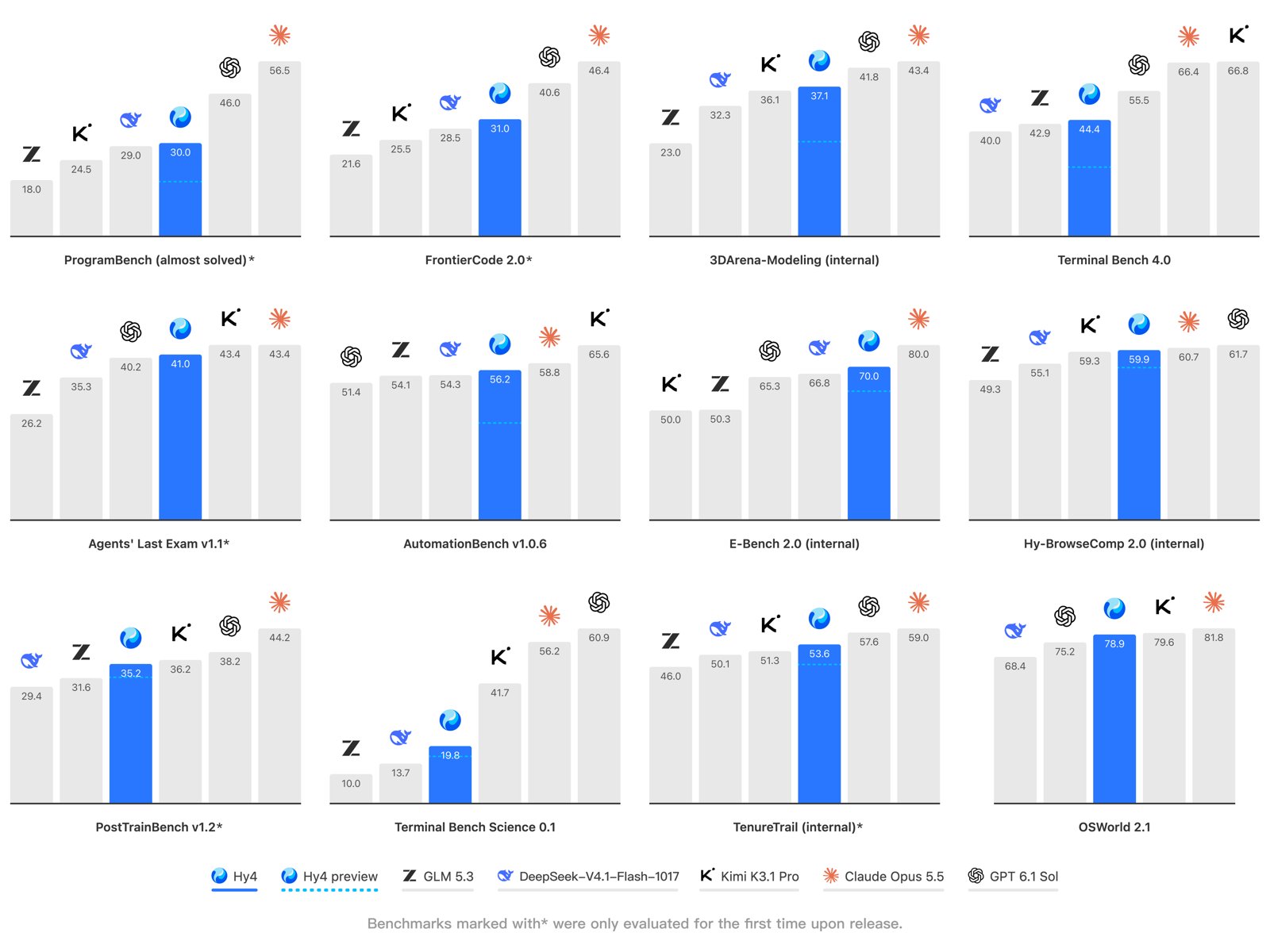
Hy4 adds another serious Chinese contender to the open-weight frontier alongside DeepSeek, Kimi and GLM, at preview-era prices. Tencent is candid that a notable gap remains with top closed models on research-level maths, long-horizon coding and advanced visual question answering, and its own chart shows Hy4 behind Claude Opus 5.5 and GPT 6.1 Sol on most benchmarks[1]. The real test comes when the weights ship and outside teams can run it themselves.
FAQ
Frequently asked questions.
01What is Hy4?
Hy4 is the official release of Tencent's latest Hunyuan large language model, following Hy4 preview from August. Tencent says it scales up both pre-training and post-training and adds vision and computer use for the first time, with better instruction following, long-context understanding, long-horizon tasks and deep research.
02Are Hy4's weights open?
Not yet. Tencent says it plans to open-source Hy4's weights, publishing a full system card with safety evaluations at the same time, and has lined up vLLM (Inferact Inc.) and SGLang support. Hy4 preview's weights were already released under Apache 2.0.
03How much does it cost and where can I use it?
Hy4 is live on Tencent Cloud and OpenRouter, and inside Tencent products such as CodeBuddy, WorkBuddy, Yuanbao and ima. List API pricing is the same as Hy4 preview: $0.834 per million input tokens, $2.501 per million output tokens and $0.042 for cached input. OpenRouter was showing a 50% launch discount and a 1M-token context window.
04How does it compare with top closed models?
Tencent's own chart shows Hy4 trailing Claude Opus 5.5 and GPT 6.1 Sol on most of the twelve benchmarks it published, for example 78.9 versus Claude Opus 5.5's 81.8 on OSWorld 2.1 and 44.4 versus Kimi K3.1 Pro's 66.8 on Terminal Bench 4.0. Tencent itself says a notable gap remains with top proprietary models.
That’s the story
Building with what’s new?
Spectrum Web Co ships products, places talent, builds social narratives and builds custom business tools as monthly services.
Related stories