News · SI

vLLM and NVIDIA use coding agents to nearly double Kimi K3 decode speed, then rethink how to review it

An NVIDIA engineer used agent-assisted development to build a new Kimi K3 decode path in vLLM for GB300 GPUs, reporting 842 tokens per second at batch 1 in a controlled speculative decoding test and up to 1.92x faster decode without speculation. The bigger story is the review problem: vLLM says agent-written kernels are outpacing its line-by-line review, and it is proposing a fast-track process built on isolation and automated validation.
vLLMNVIDIAKimi K3InferenceCoding agentsGB300

vLLM has a new Kimi K3 decode path for NVIDIA GB300 systems that replaces almost all of the model's decode operations with custom CuTe DSL kernels, and NVIDIA engineer Benjamin Chislett says coding agents helped write and tune it[1]. The post, published on 16 October, reports more than 840 tokens per second at batch 1 in a controlled speculative decoding test and 1.5 to 2 times higher decode throughput in several configurations[1].

01 / 05

What changed under the hood

Per layer, stock vLLM ran 23 kernels in 130 microseconds; the specialised path runs 13 kernels in 69 microseconds[1]. The post credits four kinds of work: picking different kernels for small and large batches, fusing the attention output projection with its all-reduce so GPUs publish partial results straight into NVLink-accessible buffers, splitting router and latent projection work across GPUs instead of repeating it on each one, and prefetching the next weights into cache while communication runs[1].

It is deliberately narrow. The initial validation covers GB300 with 8 or 16 GPUs, decode batches up to 64, speculative decoding with various draft lengths and decode context parallelism within one NVLink domain[1].

02 / 05

The numbers, and how to read them

Without speculative decoding, batch-1 decode rises to 193.3 tokens per second on 8 GPUs (1.58x) and 256.4 on 16 GPUs (1.88x), and the 16-GPU setup keeps a 1.62x to 1.71x gain at batches of 16 to 64[1]. For context, vLLM's launch-day Kimi K3 support in July served 118 tokens per second per user on 16 GB300 GPUs without speculation[2].

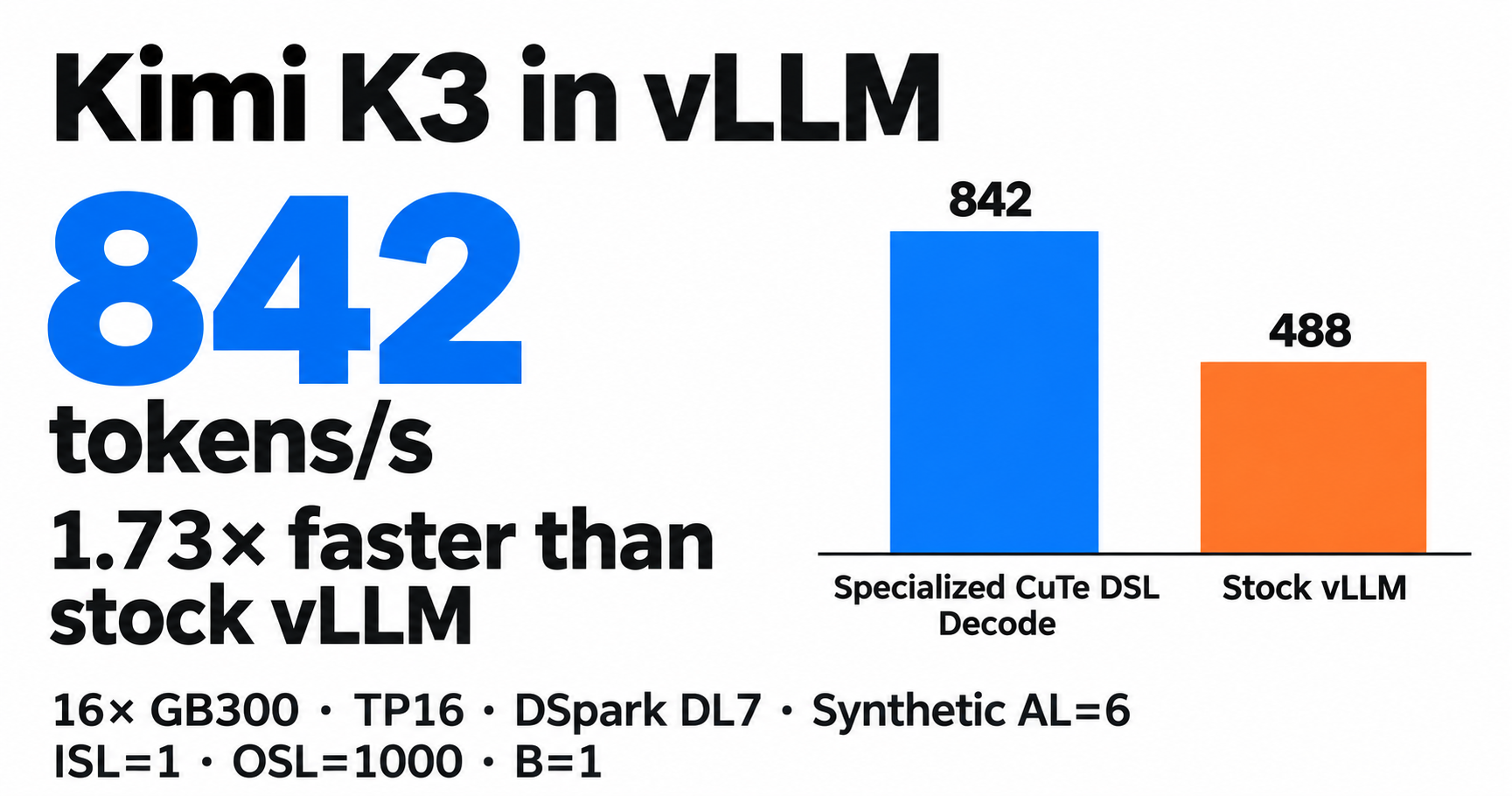
The 842 tokens per second headline uses DSpark speculative decoding with seven draft tokens and a synthetic acceptance length of 6, and it excludes prefill[1]. That is 1.73x the 488 tokens per second stock vLLM gets with the same setup[1]. In July, with real acceptance rates, vLLM reported around 4.73 accepted tokens per step on coding tasks and around 2.61 on creative writing[2], so real-world speed will depend on the workload.

The more realistic number is AgentX, which replays traffic patterns from real coding-agent sessions with synthetic content. There, P90 interactivity at concurrency 1 went from 223.7 to 403.2 tokens per second per user, though the earlier figure was measured on 8 GPUs and the new one on 16[1].

03 / 05

The review problem

The candid part of the post is about maintenance. "Agent-optimized inference code is outpacing our review and maintenance workflow," it says, and skipping line-by-line review risks shipping software that fails in production[1].

vLLM's answer is a proposed fast-track model optimisation RFC. Optimisations stay inside the model's own code, target a defined set of hardware and workloads, keep features like full-context serving, temperature sampling and structured output, and must pass both kernel tests and full model evaluations[1]. Agents are expected to write the tests, run the benchmarks and document where the optimisation works, so human reviewers can judge the design and the evidence rather than every line[1].

That validation caught real bugs. An audit found the compiler had moved activation reads ahead of a synchronisation wait, and long-context and long-generation evaluations such as MRCR and AIME25 exposed numerical issues in attention and communication kernels that standalone kernel tests with mock inputs didn't reproduce[1].

04 / 05

What's next

The same pattern is coming to DeepSeek-V4.1-Flash behind the same opt-in latency_specialized decode switch, early Muse Spark Open results have passed 950 tokens per second per user, and a GLM5.3 version for low concurrency is due in a follow-up[1].

05 / 05

What it means for teams

If you serve Kimi K3 on a GB300 NVL72-class system, this is a large, opt-in latency win worth benchmarking on your own prompts rather than the synthetic headline. For everyone else, the useful lesson is the process: when agents can write kernels faster than people can read them, the bottleneck moves to scoped changes and evaluations that genuinely exercise the new code path.

FAQ

Questions, answered.

01

What did vLLM actually ship for Kimi K3?

A new decode path that fuses and replaces almost all of Kimi K3's decode operations with custom CuTe DSL kernels, covering attention, mixture-of-experts layers and GPU-to-GPU communication. It targets NVIDIA Blackwell systems with 8 or 16 GPUs in one NVLink domain and decode batches from 1 to 64. The post was written by Benjamin Chislett of NVIDIA and published on 16 October 2026.

02

How much faster is it?

Without speculative decoding, vLLM reports 1.58x to 1.88x more decode throughput at batch 1 and up to 1.92x at batch 2, depending on whether 8 or 16 GPUs are used. With DSpark speculative decoding on 16 GB300 GPUs it reports 842 tokens per second versus 488 for stock vLLM, a 1.73x gain.

03

Is 842 tokens per second what I'd see in production?

Not necessarily. That figure comes from a controlled benchmark with a synthetic acceptance length of 6, meaning the draft model's guesses are accepted at a fixed, favourable rate, and it excludes prefill. On AgentX, which replays real coding-agent traffic patterns, vLLM reports 403.2 tokens per second per user at P90 versus 223.7 before, though that compares 16 GPUs against an earlier 8-GPU result.

04

Where do coding agents come in?

vLLM says it used agent-assisted development to write the kernels, fuse operators, overlap computation with communication and tune for different batch sizes and GPU counts. It also says agent-optimised code is now arriving faster than maintainers can review it line by line.

05

How does vLLM plan to review agent-written kernels?

Through a proposed fast-track model optimisation RFC with four principles: keep changes inside the model's own code, bound the supported hardware and workloads without dropping core serving features, validate correctness with both kernel tests and full model evaluations, and let contributors run standard evaluations on their own GPUs before asking for maintainer time.

06

Does this apply to other models?

vLLM says a DeepSeek-V4.1-Flash version follows the same design behind the same opt-in latency_specialized decode switch, that early results on Meta's Muse Spark Open passed 950 tokens per second per user, and that a similar mechanism for GLM5.3 at low concurrency will be detailed later.