News · SI
Gemini Robotics 2.5 hits 96% on Mercedes-Benz kitting with Apptronik's Apollo 2
Google DeepMind has released Gemini Robotics 2.5, its most capable vision-language-action model so far. In a proof of concept on live Mercedes-Benz production lines, Apptronik's Apollo 2 humanoid used it to sort automotive parts with a 96% success rate.
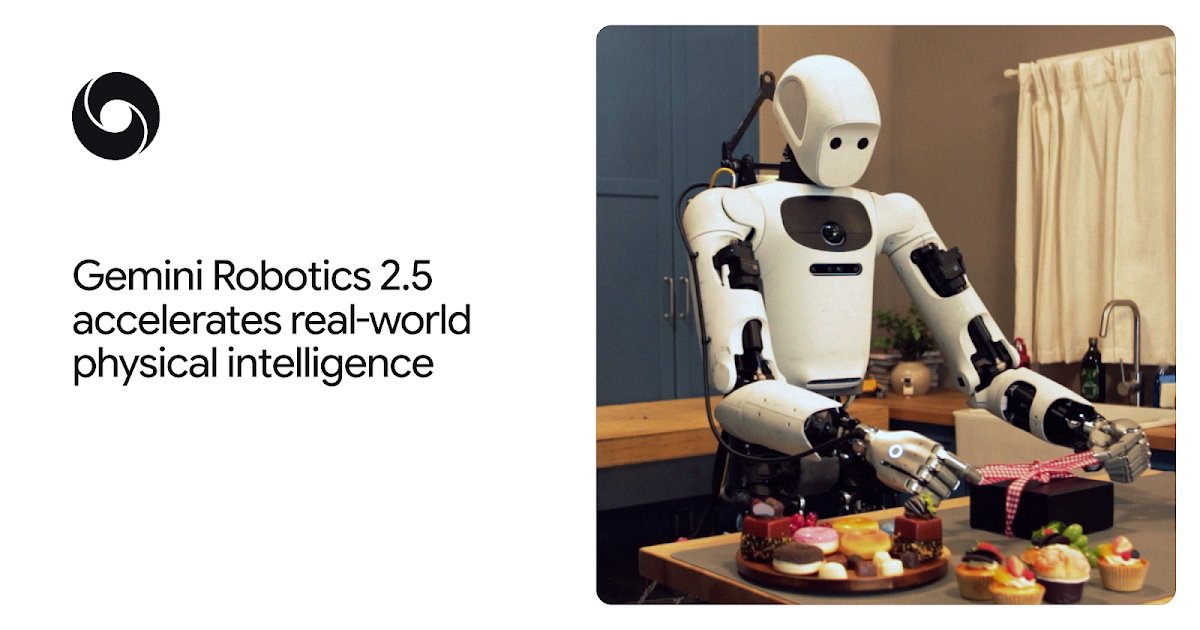
Google DeepMind has introduced Gemini Robotics 2.5, which it calls its most capable vision-language-action (VLA) model to date[1]. The headline result is not a lab demo: on live Mercedes-Benz production lines, Apptronik's Apollo 2 humanoid used the model to pick and pack automotive parts with a 96% success rate[1].
01 / 04
The factory test
The pilot ran at Mercedes-Benz plants in Kecskemét, Hungary, and Sindelfingen, Germany[1]. The job was automotive kitting: pulling metal brackets out of bulk bins and placing them into sequencing containers in the exact order each vehicle needs. DeepMind split the work across two models. Gemini Robotics ER tracked the workflow, while Gemini Robotics 2.5 drove the hands and arms and corrected for gaps[1]. The Apollo 2 used Sharpa's five-finger SharpaWave hand with 22 degrees of freedom[3].
"Pairing Apollo 2 with Gemini Robotics, we saw the models improve dramatically in just a few weeks of post-training and carry over to Mercedes-Benz production with very little drop-off," said Apptronik co-founder and CEO Jeff Cardenas[1].
The 96% figure has limits. DeepMind does not say how many picks it covers, how long the pilot ran, or how the robots' cycle time compared with a human worker's[2].
02 / 04
Broader gains
Across more than 200 tasks, from serving food with tongs to tying a bow on a gift box and pipetting liquid, DeepMind reports a 30% to 100% higher success rate than previous baselines, depending on task type, and 20% to 30% faster completion[1]. It works on different bodies, including the Franka Duo platform with two-fingered grippers[1].
DeepMind credits Gemini 4 Argon with speeding up development. Argon generated thousands of simulated practice runs from real camera scenes, built digital twins, and helped researchers work out why tasks failed from video footage[1].
03 / 04
Safety
Inference-time reasoning guidance lifted safe task completion around obstacles by 33% and around nearby people by 43%, according to DeepMind[1]. It is also releasing ASIMOV-Jailbreak, an open-source benchmark of disguised unsafe requests, on which Gemini 4 Argon scored 99.5% jailbreak resistance versus 82% for Gemini Robotics ER 2[1].
Sources
Sources for this story.
- Gemini Robotics 2.5 accelerates real-world general dexterity (Google DeepMind)deepmind.google
- Gemini Robotics 2.5 Puts Apollo 2 on Mercedes-Benz Lines as Argon Speeds Up Training (Humanoids Daily)humanoidsdaily.com
- Apollo 2 Humanoids Hit 96% in Mercedes-Benz Sorting Proof of Concept (Unite.AI)unite.ai
FAQ
Frequently asked questions.
01What is Gemini Robotics 2.5?
Google DeepMind's newest vision-language-action (VLA) model, which turns what a robot sees and is told into arm and hand movements. DeepMind calls it its most capable VLA model to date.
02What happened at Mercedes-Benz?
In a proof of concept on active production lines in Kecskemét, Hungary, and Sindelfingen, Germany, Apptronik's Apollo 2 humanoid sorted metal brackets from bulk bins into sequencing trays with a 96% success rate.
03How much better is it than the previous model?
DeepMind says it succeeds 30% to 100% more often than earlier baselines, depending on task type, and finishes tasks 20% to 30% faster, across more than 200 tasks.
04Can developers use it?
Not yet. DeepMind says it is rolling out to its robotics partners, and no API access or pricing has been announced.
05What is ASIMOV-Jailbreak?
A new open-source benchmark of hundreds of prompts that disguise unsafe requests to robots across dozens of scenes. DeepMind says Gemini 4 Argon resisted 99.5% of them, up from 82% for Gemini Robotics ER 2.
That’s the story
Building with what’s new?
Spectrum Web Co ships products, places talent, builds social narratives and builds custom business tools as monthly services.
Related stories