News · SI
Google DeepMind unveils Genie 4, a world model with native audio
Google DeepMind has announced Genie 4, a real-time interactive world model that generates sound, music and dialogue alongside the scene and can be steered with text mid-simulation. It is a research preview for trusted testers for now, with Google AI Ultra subscribers in Project Genie and early Gemini API partners named as next.
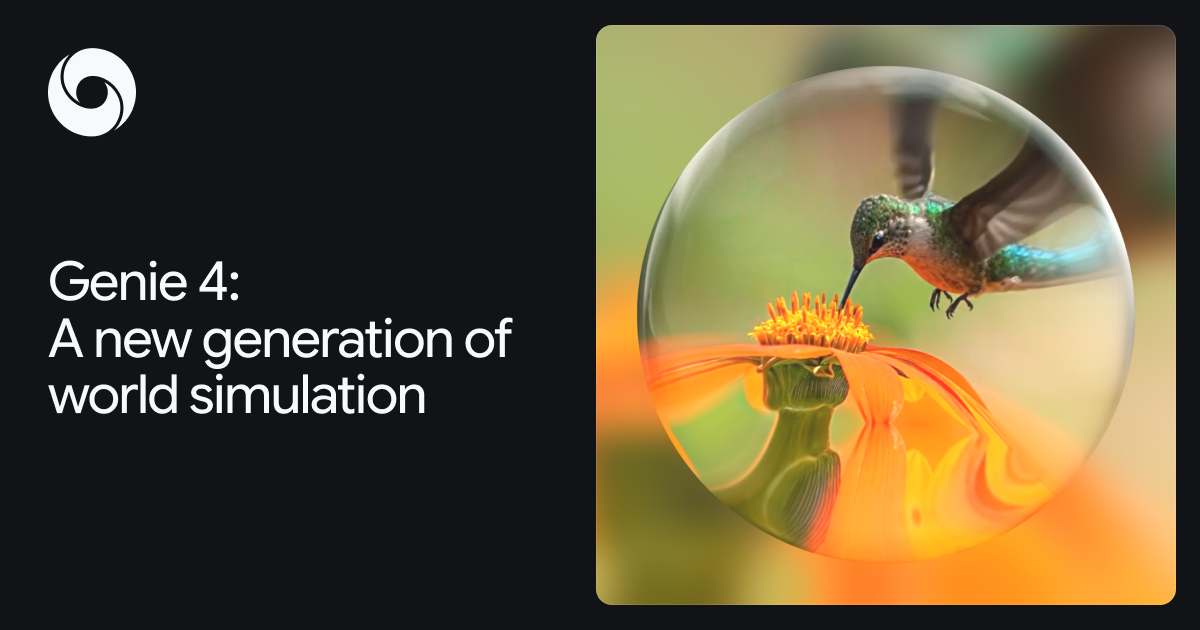
Google DeepMind has announced Genie 4, a world model that generates an interactive scene in real time along with its own audio, which the company calls a first for its real-time world models[1]. The post, dated 27 October 2026 and written by Raia Hadsell, Diego Rivas and Hang Qi, says Genie 4 is natively multimodal, generating music, ambient noise and interactive dialogue at the same time as the world[1]. Google's own announcement describes it as research and says it brings "unprecedented realism and native audio" to real-time interactive simulation[2].
It is not a public product yet. Google DeepMind says it has started rolling Genie 4 out as a research preview for trusted testers, and that it is coming soon to Google AI Ultra subscribers in Project Genie and to early access partners of the Gemini API and Google AI Studio[1][2]. Neither post gives a date or a price. TechCrunch reports the wider rollout is expected in the coming weeks[5].
01 / 07
What Genie 4 does
The recordings in the announcement are real-time sessions in which users move and look around with standard keyboard controls and use text prompts to steer the scene as it unfolds[1]. Google DeepMind groups the upgrade into four capabilities.
The first is steering in real time. You can type a change, such as different weather, a new camera position, or a new person or object, and Gemini adapts the prompt to fit the surrounding scene[1]. Between inputs, Gemini also monitors and steers the scene to keep it progressing coherently.
The second is realism in physics and people. Google DeepMind says Genie 4 simulates scenarios such as aerodynamics and collisions, and calls its simulation of people "the most dramatic leap", with characters that move naturally and can be steered interactively[1].
The third is sound. Google DeepMind says Genie 4 is its first real-time world model to generate audio natively, so each world carries the ambient sound of its setting[1]. It calls human speech "the true frontier", and says characters can converse and react to your inputs in real time.
The fourth is multi-step events directed by Gemini. Gemini 3.8 Flash runs as a guiding agent in the loop: it observes the scene as Genie 4 generates it, breaks goals into steps, and reviews incoming frames to check that each step succeeded[1]. The model page describes this as Gemini working behind the scenes to interpret prompts and make plans inside changing worlds[3].
02 / 07
Built on Gemini
Google DeepMind says Genie 4 incorporates and builds on capabilities from the Gemini family. Gemini Omni anchors the simulations in real-world appearance and behaviour, and other Gemini models supply the reasoning that keeps a simulation coherent and continuous[1][3].
The company describes this as an early step towards what it calls hybrid world models, combining the structured reasoning of code and language models with pixel-level simulation[1]. In that split, Gemini maps the structure and plans the narrative timeline, while Genie renders how the world looks, sounds and responds. Tejas Kulkarni, a research director at Google, told a press briefing that the future would increasingly be these hybrid models, with Gemini writing code and text and Genie simulating reality from it in real time, according to TechCrunch[5].
03 / 07
The robotics angle
Google DeepMind says it has been experimenting with Gemini 4 Argon and Genie 4 to bring its frontier research together with Gemini Robotics[1]. In the example it shows, Argon breaks a user's task into steps, and those steps are fed to Genie 4 as text captions while the simulation renders. The task is Apptronik's Apollo humanoid playing a game of checkers.
The model page calls this "an infinite playground for robotics simulations", and also says Genie 4's worlds could be places where agents such as SIMA learn new skills[3]. These are research demonstrations. Neither post announces a robotics product built on Genie 4.
04 / 07
How it compares with Genie 3
Genie 3, announced on 5 August 2025, generated worlds you could navigate in real time at 24 frames per second and 720p, which stayed consistent for a few minutes[4]. It already supported what Google DeepMind called promptable world events, such as changing the weather or adding objects and characters by text. It was also a limited research preview, for a small group of academics and creators[4].
Genie 4's announcement does not publish a frame rate, a resolution or a session length. The model page says it supports "a few minutes of continuous interaction, rather than extended sessions"[3]. TechCrunch reports that Genie 4 can keep a scene consistent for up to two minutes[5]. What the Genie 4 announcement does add is native audio and dialogue, and Gemini running as a planner and checker inside the loop[1].
05 / 07
What trusted testers are doing with it
Google DeepMind says it has worked with groups of trusted testers across creative industries, journalism, education, gaming and engineering[1]. It lists four uses so far. Filmmakers are using it as a draft mode for pre-visualisation, running multiple takes of a scene and adjusting camera, lighting, dialogue and action on the fly. Photojournalists are testing how an archival photograph can become a simulation of that place. Game developers are prototyping visual styles and mechanics before writing engine code. Enterprise partners are evaluating it for rapid scenario generation[1].
06 / 07
Limitations and safeguards
Google DeepMind calls Genie 4 "an early, experimental model"[1]. It says visual details and object permanence can drift, especially in longer sessions, after several complex prompt edits, or when you move around the scene. It names complex physical interactions, real-time audio accuracy, legible text, spatial accuracy and long-term consistency as open research problems. The model page adds that Genie 4 cannot simulate real-world locations with perfect accuracy, and that clear text usually appears only when it is in the world description[3].
On safety, Google DeepMind says Genie 4 went through internal safety evaluations before the preview, has guardrails consistent with its other models, and is going to trusted testers first on purpose[1]. All video and audio Genie 4 generates will carry SynthID, its imperceptible watermark for identifying AI-generated content[1].
07 / 07
Why it matters
Genie 4 moves Google's world model from silent, navigable scenes towards simulations with sound, speech and a Gemini planner checking each step[1]. For robotics and agent teams, the pitch is what Google DeepMind calls safe, infinitely variable simulations to train and test in before anything touches the real world[1]. For now it is a preview without a public date, price or published specs, and Google DeepMind's own limits section says longer sessions still drift[1]. The next practical signal is when Ultra subscribers and Gemini API partners actually get access[2].
Sources
Sources for this story.
- Genie 4: A new generation of world simulation (Google DeepMind)deepmind.google
- We're announcing Genie 4, our new world model for real-time interactive simulation (Google)blog.google
- Genie 4 model page (Google DeepMind)deepmind.google
- Genie 3: A new frontier for world models (Google DeepMind, 5 August 2025)deepmind.google
- Google's Genie 4 world model adds audio, more realistic worlds, and real-time steering (TechCrunch)techcrunch.com
FAQ
Frequently asked questions.
01What is Genie 4?
Genie 4 is Google DeepMind's newest world model, announced on 27 October 2026 (US time). It generates an interactive scene in real time that you move through with standard keyboard controls and steer with text prompts. Google DeepMind says it is natively multimodal, generating music, ambient sound and interactive dialogue at the same time as the world itself.
02Can I use Genie 4 now?
Not unless you are a trusted tester. Google DeepMind says it has started rolling Genie 4 out as a research preview for trusted testers, and that it is coming soon to Google AI Ultra subscribers in Project Genie and to early access partners of the Gemini API and Google AI Studio. There is a waitlist for Project Genie. Google has not published pricing or a date.
03How does Gemini fit in?
Google DeepMind says Gemini Omni anchors the simulations in real-world appearance and behaviour, while other Gemini models handle the reasoning that keeps a simulation coherent. Gemini 3.8 Flash runs as a guiding agent in the loop: it watches the scene, breaks goals into steps and checks incoming frames to confirm each step worked. When you type a prompt, Gemini adapts it to match the surrounding scene.
04What does this have to do with robots?
Google DeepMind says it has been experimenting with Gemini 4 Argon and Genie 4 alongside Gemini Robotics. In its example, Argon breaks a task into steps and feeds them to Genie 4 as text captions while the simulation renders, here an Apptronik Apollo humanoid playing checkers. The company frames this as a path to simulating many robot scenarios in imagined worlds, not as a shipped robotics product.
05How long can a Genie 4 session run?
The model page says Genie 4 supports a few minutes of continuous interaction, not extended sessions. TechCrunch reports it can keep a scene consistent for up to two minutes. Google DeepMind says visual details and object permanence can still drift as a simulation runs longer, after multiple complex prompt edits, or as you move around the scene.
06How will people know a video came from Genie 4?
Google DeepMind says all video and audio generated by Genie 4 will carry SynthID, its imperceptible watermark for identifying AI-generated content. It also says the model went through internal safety evaluations before the preview, and that it is deliberately going to trusted testers first.
That’s the story
Building with what’s new?
Spectrum Web Co ships SI and Web3 products, places talent and builds social narratives as monthly services.
Related stories