News · Tech
GXO and Apptronik plan up to 1,000 Apollo humanoids in warehouses
On 12 November 2026, GXO Logistics signed a letter of intent with Apptronik to expand Apollo humanoid trials in live warehouses and, if agreed KPIs are met, to work towards a global rollout of up to 1,000 robots over four years. The release describes a Robotics-as-a-Service framework. It is a letter of intent, not a purchase order, and it does not disclose a price, a contract value, sites or the KPI targets.
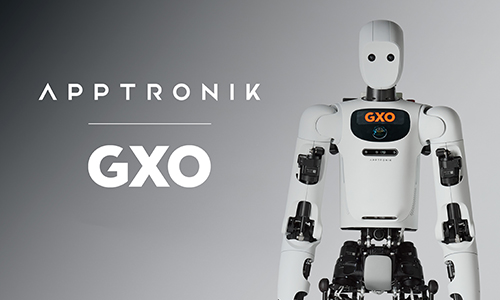
A release datelined Greenwich, Connecticut, on 12 November 2026 says GXO Logistics, Inc. (NYSE: GXO) has signed a Letter of Intent with Apptronik to expand development of Apptronik technology for deployment at scale through a Robotics-as-a-Service (RaaS) model[1][2]. GXO calls itself the world's largest pure-play contract logistics provider. The release calls Apptronik an AI-powered robotics company[1][2]. GlobeNewswire carried the same release at 07:00 ET. DC Velocity reported the letter the same day[2][3].
The letter covers expanded trials of Apptronik's Apollo humanoid in live warehouses, and a commercial framework the companies expect to follow a RaaS structure. This is a letter of intent, not a purchase order. The release does not disclose a price, a contract value, named sites or the KPI targets[1][2].
01 / 05
Trials in live warehouses
The release says that under the agreement, GXO and Apptronik will expand joint trials of Apollo in live operations. The workflows named in the release are goods-to-person and person-to-goods picking, case and tote movement, packing and sortation. Beginning in 2027, the trials will validate the safety, security and technical requirements for scaled deployment. Each use case is to be assessed and sequenced against jointly agreed productivity, safety and operational KPIs, and the trials are meant to show humanoids working alongside existing automation and GXO team members[1][2]. DC Velocity reports the same workflows, the same 2027 start and the same test against jointly agreed KPIs[3]. The release does not say how many robots the trials will use, and it does not disclose the KPI targets[1][2].
02 / 05
Up to 1,000 robots, on conditions
The scale in the announcement is conditional. Subject to the success of the deployments, and to meeting agreed performance, safety and operational KPIs, the companies say they "intend to progress toward global rollout of up to 1,000 Apollo humanoid robots over the next four years", with initial deployment in North America in late 2027[1][2]. DC Velocity reports the same letter of intent: a global rollout that could reach up to 1,000 Apollo humanoids over four years, an initial North American deployment starting in late 2027, and a RaaS model, subject to the deployments succeeding and the agreed KPIs being met[3].
The GXO release says the commercial framework is expected to follow a RaaS structure, allowing GXO to scale humanoid deployment through what the release calls a flexible, service-based offering. It does not disclose how many robots sit in the late 2027 North American deployment. The release includes a forward-looking statements notice and says actual results may differ materially[1][2].
03 / 05
What the partnership has already done
The release says the partnership began in 2024 with a proof-of-concept programme to develop practical applications for Apollo in a warehouse environment[1][2]. Earlier this year, it says, Apollo wrapped a pilot deployment with GXO in the US focused on autonomous picking for small consumer goods. The release calls that pilot successful[1][2]. It does not disclose the pilot's site, its length, the number of robots or a picking rate.
Apptronik and GXO have also conducted data collection and live autonomous evaluations on more than 50 different logistics tasks in Apptronik's Robot Park, which the release describes as a humanoid robot training facility[1][2]. The release does not name the tasks.
Spectrum has previously covered Apollo in a Mercedes-Benz kitting pilot. That pilot is separate from this letter of intent.
04 / 05
What the companies say Apollo is for
The release says Apollo is designed to perform repetitive, physically demanding tasks in warehouse environments. It says the technology is expected to help address labour availability, improve throughput and uptime, and enable employees to focus on higher-value activities. The release states that as an expectation, and it says the expanded trials begin in 2027[1][2].
Patrick Kelleher, GXO's chief executive, said: "Humanoid robots are the latest evolution of intelligent automation, and their increasing dexterity will make them one of the most transformative applications of physical AI in logistics."[1][2]
Jeff Cardenas, Apptronik's chief executive and co-founder, said: "GXO has the network and the operating discipline to take this technology to real scale, across one of the largest logistics footprints in the world."[1][2] DC Velocity carries the same sentence[3].
Apptronik describes itself as a human-centred physical AI company. It says Apollo is the culmination of more than a decade of development, drawing on its work on 15 previous robots, including NASA's Valkyrie, and that the robot is designed to collaborate with people, initially in manufacturing and logistics. Apptronik says it started out of the Human Centered Robotics Lab at the University of Texas at Austin and has nearly 500 employees[1][2]. GXO says it has over 150,000 team members across more than 1,000 facilities, totalling more than 200 million square feet, with its corporate headquarters in Greenwich, Connecticut[1][2].
05 / 05
Why it matters
The figure of up to 1,000 Apollo humanoids sits inside a letter of intent announced on 12 November 2026. The companies say they intend to move towards that global rollout only if the deployments succeed and agreed performance, safety and operational KPIs are met, with an initial deployment in North America in late 2027 and a commercial framework expected to follow a Robotics-as-a-Service structure. DC Velocity reports those same terms[1][2][3]. GXO expects Apollo to help with labour availability, throughput and uptime. The release states those as expectations for trials that begin in 2027, and it does not disclose a price, a contract value, the sites or the KPI targets[1][2].
FAQ
Frequently asked questions.
01What did GXO and Apptronik announce?
On 12 November 2026, a release datelined Greenwich, Connecticut, said GXO Logistics had signed a letter of intent with Apptronik to expand development of Apptronik technology for deployment at scale through a Robotics-as-a-Service model. GXO calls itself the world's largest pure-play contract logistics provider. GlobeNewswire carried the same release, and DC Velocity reported the letter the same day.
02Is this an order for 1,000 Apollo robots?
No. It is a letter of intent, not a purchase order. Subject to the deployments succeeding and to agreed performance, safety and operational KPIs being met, the companies say they intend to move towards a global rollout of up to 1,000 Apollo humanoids over the next four years, with an initial deployment in North America in late 2027. The release does not disclose a price, a contract value, the sites or the KPI targets.
03What will the trials cover, and when do they start?
The release says GXO and Apptronik will expand joint trials of Apollo in live warehouse operations, including goods-to-person and person-to-goods picking, case and tote movement, packing and sortation. Beginning in 2027, the trials are to validate safety, security and technical requirements for scaled deployment. Each use case is to be assessed and sequenced against jointly agreed productivity, safety and operational KPIs, and the trials are meant to show humanoids working alongside existing automation and GXO team members.
04What have GXO and Apptronik already done together?
The release says the partnership began in 2024 with a proof-of-concept programme to develop practical warehouse applications for Apollo. Earlier this year, it says, Apollo wrapped a pilot with GXO in the US focused on autonomous picking for small consumer goods, and the release calls that pilot successful. Apptronik and GXO have also run data collection and live autonomous evaluations on more than 50 different logistics tasks in Apptronik's Robot Park humanoid robot training facility.
05What is Apollo meant to do, and what is left unstated?
The release says Apollo is designed for repetitive, physically demanding warehouse tasks, and that the technology is expected to help address labour availability, improve throughput and uptime, and let employees focus on higher-value activities. Apptronik says it has nearly 500 employees and that Apollo draws on more than a decade of development and on 15 previous robots, including NASA's Valkyrie. The release does not disclose a price, a contract value, named sites or the KPI targets.
That’s the story
Building with what’s new?
Spectrum Web Co ships products, places talent, builds social narratives and builds custom business tools as monthly services.
Related stories