News · SI

Inception's Mercury 3 bets that diffusion can take on fast frontier models

Inception has released Mercury 3, a diffusion language model it says beats GPT-6 Luna and Claude Haiku 5.5 on most of its benchmarks while generating 1,068 tokens a second. It is more than 40 times the size of Mercury 1, has a 1-million-token context window, and launches at half price on Inception's API, OpenRouter, Baseten and Vercel.

InceptionMercury 3Diffusion LLMInference speedAgentsPricing

Inception has released Mercury 3, the biggest test yet of whether diffusion language models can keep up with conventional ones. The Redwood City company says its new model beats GPT-6 Luna and Claude Haiku 5.5 across a range of benchmarks while running four to eight times faster, at 1,068 tokens per second on NVIDIA GPUs[1].

Most language models write one token at a time. Inception's Mercury models instead draft text and refine it in parallel, which is where the speed comes from. The open question since Mercury 1 has been whether that approach scales. Inception's answer is that it does: Mercury 3 is more than 40 times larger than Mercury 1 in total parameters, scores about three times higher on its basket of benchmarks, and is "just as fast"[1].

01 / 04

What changed

Mercury 3 is Inception's fourth model release since Mercury 1. Mercury 2 added reasoning, Mercury 2.5 added tunable reasoning and a 260,000-token context window, and Mercury 3 raises the window to 1 million tokens[2]. Inception hasn't published an exact parameter count.

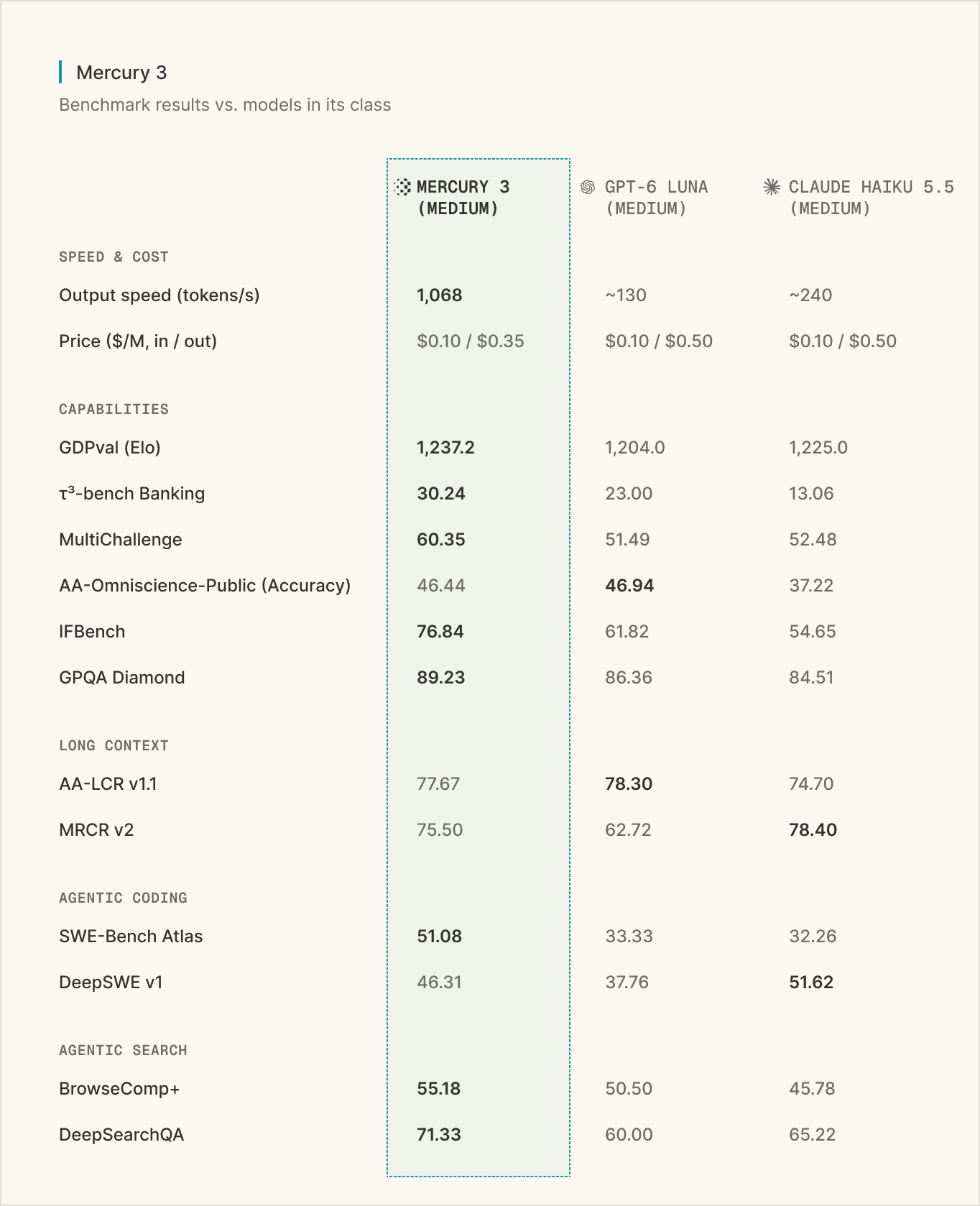
On Inception's own comparison table, Mercury 3 (medium) leads GPT-6 Luna and Claude Haiku 5.5 (both at medium settings) on GDPval, tau-cubed-bench Banking, MultiChallenge, IFBench and GPQA Diamond, where it scores 89.23 against 86.36 and 84.51[1]. It also leads on SWE-Bench Atlas for agentic coding (51.08 against 33.33 and 32.26) and on the BrowseComp+ and DeepSearchQA search tests[1].

It doesn't sweep the table. GPT-6 Luna edges it on AA-Omniscience accuracy and the AA-LCR long-context test, and Claude Haiku 5.5 beats it on MRCR v2 (78.40 against 75.50) and on DeepSWE v1 (51.62 against 46.31)[1]. All of these figures are Inception's and haven't been independently checked.
02 / 04

Price and availability

List pricing is US$0.20 per million input tokens and US$0.70 per million output tokens. At launch it is half price, at US$0.10 and US$0.35, with cached input 90% off[1]. That puts its launch input price level with GPT-6 Luna and Claude Haiku 5.5 on Inception's table, with output about 30% cheaper[1]. New API keys come with 100 million free tokens[3].

The model is live on Inception's API platform and through OpenRouter, Baseten and Vercel, and it is OpenAI API compatible[2]. Vercel lists it on its AI Gateway as inception/mercury-3[4]. Inception has also closed Mercury 2 and Mercury 2.5 to new users, and existing customers who used them before 19 October keep access until 15 November[3].

03 / 04

Who is using it

Inception quotes four early-access partners. TinyFish AI says Mercury 3 completed 50% of 50 live Mind2Web web-navigation tasks in its agent harness, "significantly more than GPT-6.1-Sol", using the same tokens and steps[1]. Tutoring app RevisionDojo says hints and marked answers now come back in about a second, and Octen AI reports a median generation time of 0.9 seconds for search answers on smart glasses[1]. Customer-support company Lorikeet says it beat other models on latency and scored higher on its evals[1].

04 / 04

Why it matters

Agents call a model over and over, so every second of generation time stacks up across a task. If a diffusion model can match the quality of the fast tier from OpenAI and Anthropic at several times the speed and a similar price, it becomes a real option for browser agents, voice and search, not just a research curiosity. The catch is that every number here comes from Inception and its customers. Independent benchmark runs on OpenRouter and Vercel over the coming weeks will show whether the speed holds up without the quality falling off.

FAQ

Questions, answered.

01

What is Mercury 3?

Mercury 3 is the newest large language model from Inception, a Redwood City, California company that builds diffusion LLMs. It was released on 19 October 2026 and is aimed at latency-sensitive work such as browser agents, real-time search, tutoring and customer support.

02

What is a diffusion LLM?

Most language models write one token at a time, left to right. A diffusion LLM drafts a whole block of text and refines it in parallel over several passes, which is how Inception gets output speeds above 1,000 tokens per second on standard NVIDIA GPUs.

03

How fast and how big is it?

Inception reports 1,068 output tokens per second, against roughly 130 for GPT-6 Luna and 240 for Claude Haiku 5.5 on its own table. It says Mercury 3 has more than 40 times the total parameters of Mercury 1 but runs at comparable speed. It hasn't published the exact parameter count.

04

How does it compare with GPT-6 Luna and Claude Haiku 5.5?

On Inception's table, Mercury 3 (medium) leads both on GDPval, tau-cubed-bench Banking, MultiChallenge, IFBench, GPQA Diamond, SWE-Bench Atlas, BrowseComp+ and DeepSearchQA. GPT-6 Luna edges it on AA-Omniscience and AA-LCR, and Claude Haiku 5.5 beats it on MRCR v2 and DeepSWE v1. These are company-reported results that haven't been independently checked.

05

How much does it cost?

List price is US$0.20 per million input tokens and US$0.70 per million output tokens. At launch it is 50% off, at US$0.10 and US$0.35, and cached input is 90% off the input price. New API keys get 100 million free tokens.

06

Where can I use it, and what happens to Mercury 2?

Mercury 3 is available on Inception's API platform and through OpenRouter, Baseten and Vercel's AI Gateway (as inception/mercury-3), and it is OpenAI API compatible. Inception has closed Mercury 2 and 2.5 to new users; existing customers with usage before 19 October keep access until 15 November 2026.