News · SI
MIT and UBC's WorldParticle uses one transformer to simulate sand, fluids, cloth and proteins
Researchers from MIT CSAIL, the University of British Columbia and others have built WorldParticle, a single transformer-based simulator that models cloth, elastic solids, fluids, granular materials and molecular dynamics as particles, replacing a patchwork of hand-coded solvers. It is headed to SIGGRAPH Asia 2026.
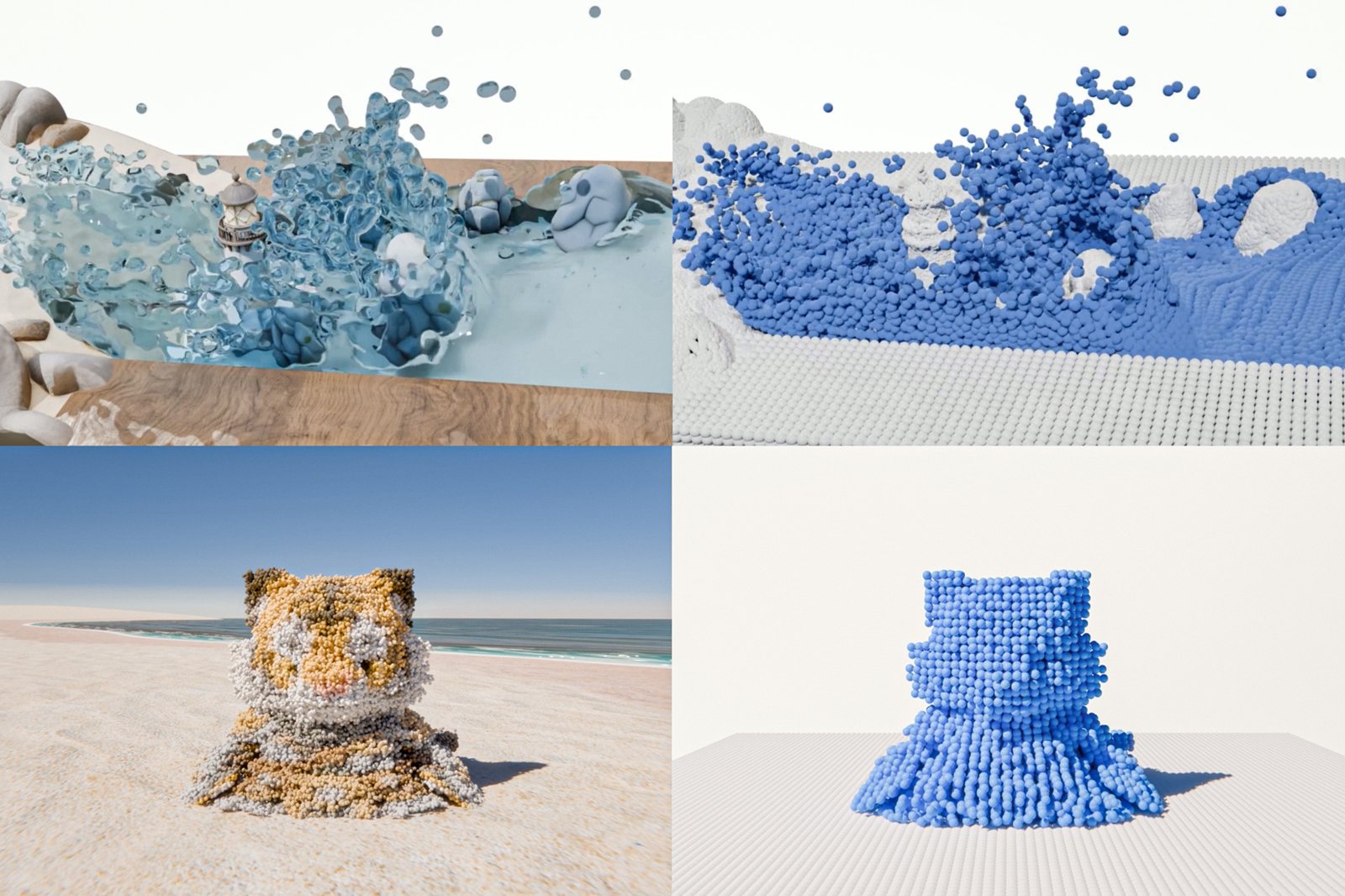
Researchers at MIT, the University of British Columbia (UBC) and several other institutions, including Georgia Tech, Inria and Meta, have unveiled WorldParticle, a single AI model that simulates how very different materials move, from sliding sand to folding proteins[1]. The work will be presented at SIGGRAPH Asia 2026, and the paper is already open on arXiv[2].
01 / 04
One model instead of many solvers
Today a scientist who wants to simulate water picks a fluid solver, and one who wants to model a protein picks a molecular one. Each is hand-coded around its own equations[1]. Coupling two regimes, such as oil sloshing against an elastic valve in a tank, usually means stitching separate simulators together.
WorldParticle replaces that patchwork with one transformer. It breaks every object into thousands or millions of 3D particles, then predicts where they will be in the next step, much as a language model predicts the next word[1]. "We want to have a GPT moment for simulation," said Peter Yichen Chen, a former MIT postdoc now an assistant professor at UBC and co-corresponding author.
02 / 04
Predict, then correct
The paper describes a prediction and correction design[2]. An explicit predictor first moves particles under the known external forces. A learned corrector then fixes the interactions between particles in three stages: a tokenizer that encodes local particle, boundary and topology interactions, an encoder that repeatedly merges tokens into a compact set of "super tokens", and a decoder that lifts those back to full resolution to output per-particle position and velocity corrections.
Halving the token count at each encoder level is what keeps millions of particles tractable. "We needed to do a lot of detailed engineering and employ many tweaks to the architecture for it to be truly generalizable and scalable," said co-lead author Minghao Guo, an MIT postdoc[1].
03 / 04
What it can do
The team tested the same architecture on six categories of dynamics: cloth, elastic solids, Newtonian and non-Newtonian fluids, granular materials and molecular dynamics[3]. It generalised to unseen materials, boundaries, starting conditions and forces, and beat numerical simulation methods on accuracy[1]. In one test a sand sculpture collapsed into a realistic pile, where some baseline methods left grains floating in the air. Protein structure changes were modelled about 100 times faster than numerical simulators.
The paper also shows interactive control, inverse design and learning from real-world robot manipulation data[2]. The researchers see uses in soft robots working in sand or soil, RNA evolution and even merging galaxies.
04 / 04
Why it matters
World models have mostly been about video and robot actions. WorldParticle applies the same idea to physics itself: learn the rules once and reuse them across materials. If it holds up beyond the six benchmark categories, it could cut the solver engineering that slows simulation-heavy work in robotics, materials and drug discovery. The authors call it a first step towards a general-purpose simulation pipeline for scientific discovery[1].
Sources
Sources for this story.
FAQ
Frequently asked questions.
01What is WorldParticle?
A learning-based physics simulator from researchers at MIT CSAIL, the University of British Columbia and several other institutions. It uses one transformer architecture to model cloth, elastic solids, Newtonian and non-Newtonian fluids, granular materials such as sand, and molecular dynamics such as protein motion.
02How is it different from a normal physics simulator?
Traditional simulators are hand-coded around the equations for one kind of material, so modelling water and a deformable solid together usually means stitching two solvers. WorldParticle treats every material as particles and learns how they move, so the same model covers all six categories it was tested on.
03How does it work?
An explicit predictor first moves the particles under known external forces. A learned corrector then encodes local particle interactions as tokens, merges them into a smaller set of super tokens to keep attention costs down, and decodes them back to per-particle position and velocity corrections.
04Is it faster than existing methods?
The team reports higher accuracy than numerical simulation methods across its six test categories, and says protein structure changes were modelled about 100 times faster than numerical simulators.
05Why does it matter for robotics?
The researchers say it could help engineers predict how sand or soil moves when a soft robot touches it, and the paper demonstrates interactive control, inverse design and learning from real-world manipulation data.
06Where will it be presented?
At the ACM SIGGRAPH Asia 2026 conference. The paper is open access on arXiv.
That’s the story
Building with what’s new?
Spectrum Web Co ships products, places talent, builds social narratives and builds custom business tools as monthly services.
Related stories