News · SI
MUSE raises JPY 1.75 billion to mass-produce its Armo store robot and push into the US
Tokyo retail robotics startup MUSE has raised JPY 1.75 billion (about US$11 million) in equity and debt, led by ALPHA, to set up mass production of its multi-task Armo store robot and expand in US supermarkets.
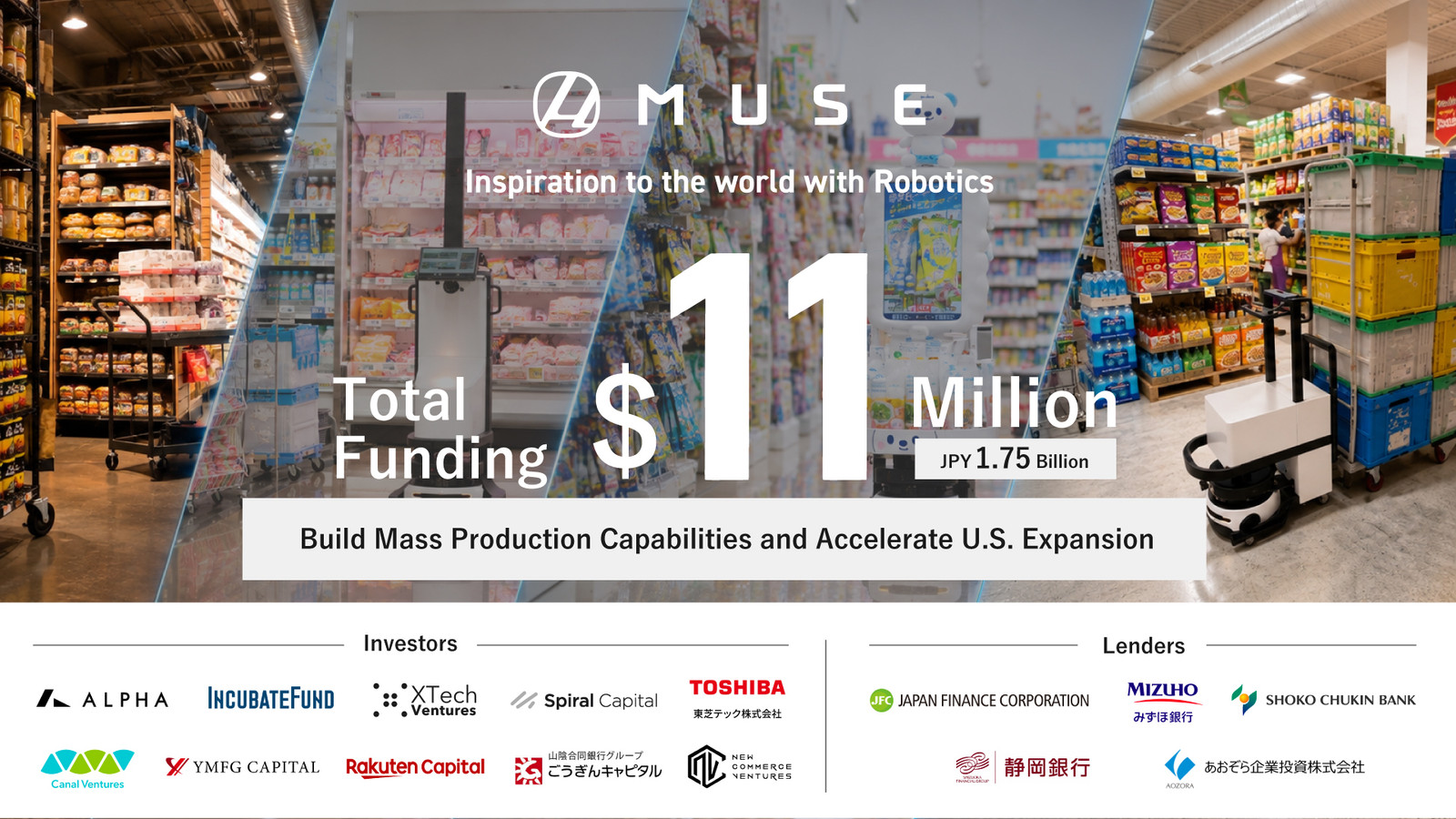
Tokyo startup MUSE has raised JPY 1.75 billion, about US$11 million, to move its Armo store robot into mass production and grow in the United States[1].
01 / 04
The round
The money comes from 15 corporate investors, venture firms and financial institutions through a mix of equity and debt[1]. Nikkei reports that JPY 650 million of the total is new equity, with the rest in loans[4].
ALPHA joined as the new lead investor[3]. Existing backers Incubate Fund, XTech Ventures, Spiral Capital, Toshiba Tec, Canal Ventures and YMFG Capital put in more, and Rakuten Capital, Gogin Capital and New Commerce Ventures are new to the cap table[1][2].
02 / 04
One robot, several store jobs
Armo is built to share the floor with staff and shoppers in supermarkets, home improvement stores and drugstores[1]. A single unit moves goods for shelf replenishment and online grocery picking, scans shelves for out-of-stock items, runs promotions and guides customers, changing tasks by time of day and store needs[1].
MUSE's pitch is utilisation. Rather than a robot that only scans shelves or only hauls stock, one machine stays busy across the day, which it says improves the return on each unit[1]. The shelf data Armo collects also feeds Eureka Platform, the company's cloud service for analysing stock gaps and displays[1].
03 / 04
Mass production and the US
The company plans to work with outside manufacturers to set up full-scale production and to strengthen quality assurance and maintenance[1]. Armo is already deployed with major Japanese retailers and has begun working in US stores, including Foodcellar Market in Long Island City, New York[1]. Its US subsidiary, MUSE US Inc., will lead sales, installation support and maintenance there[1]. Nikkei reports MUSE wants overseas sales to make up half its revenue within three years[4].
"Armo has moved beyond proof-of-concept trials to become part of daily store operations," said founder and chief executive Yasutaka Kasagi[1].
04 / 04
Why it matters
Retail is a tough place for robots: narrow aisles, crowds and a long list of small jobs. MUSE is betting that a general-purpose store robot will pay off faster than single-task machines, and existing investor Toshiba Tec calls it a strategic partner for smart stores[1]. The company has not disclosed how many robots it has deployed or named its Japanese retail customers.
Sources
Sources for this story.
- MUSE Raises USD 11 million to Scale Retail Robotics Adoption (MUSE Inc.)muse-gr.com
- MUSE raises JPY 1.75 billion in total (MUSE Inc., in Japanese)muse-gr.com
- Investment in MUSE, developer of the Armo store robot (ALPHA, in Japanese)alphavc.jp
- Retail robot maker MUSE raises JPY 1.75 billion to strengthen overseas expansion (Nikkei, in Japanese)nikkei.com
FAQ
Frequently asked questions.
01How much did MUSE raise?
JPY 1.75 billion, which MUSE converts to about US$11 million. It came from 15 investors and financial institutions through a mix of equity and debt.
02Who led the round?
Tokyo venture firm ALPHA joined as the new lead investor. Incubate Fund, XTech Ventures, Spiral Capital, Toshiba Tec, Canal Ventures and YMFG Capital followed on, and Rakuten Capital, Gogin Capital and New Commerce Ventures came in as new investors.
03What is Armo?
A store robot that works alongside staff in supermarkets, home improvement stores and drugstores. One unit moves stock for shelf replenishment and online grocery orders, scans shelves for gaps, runs in-store promotions and guides shoppers, switching jobs by time of day.
04Is Armo already in use?
MUSE says it is deployed with major retailers in Japan and has started operating in US stores, including Foodcellar Market in Long Island City, New York.
05What will the money pay for?
Mass production with outside manufacturing partners, stronger quality assurance and maintenance, US expansion through its subsidiary MUSE US Inc., and work on autonomous navigation, perception and its Eureka Platform for shelf and sales floor data.
That’s the story
Building with what’s new?
Spectrum Web Co ships products, places talent, builds social narratives and builds custom business tools as monthly services.
Related stories