News · SI
Runway releases Praxis-1 world action model weights under Apache 2.0
Runway has released Praxis-1, its 27 billion parameter world action model for robots, as open weights under the Apache 2.0 licence. The release includes inference and fine-tuning code, with checkpoints for a single arm, a two-arm rig and a base model you can adapt.
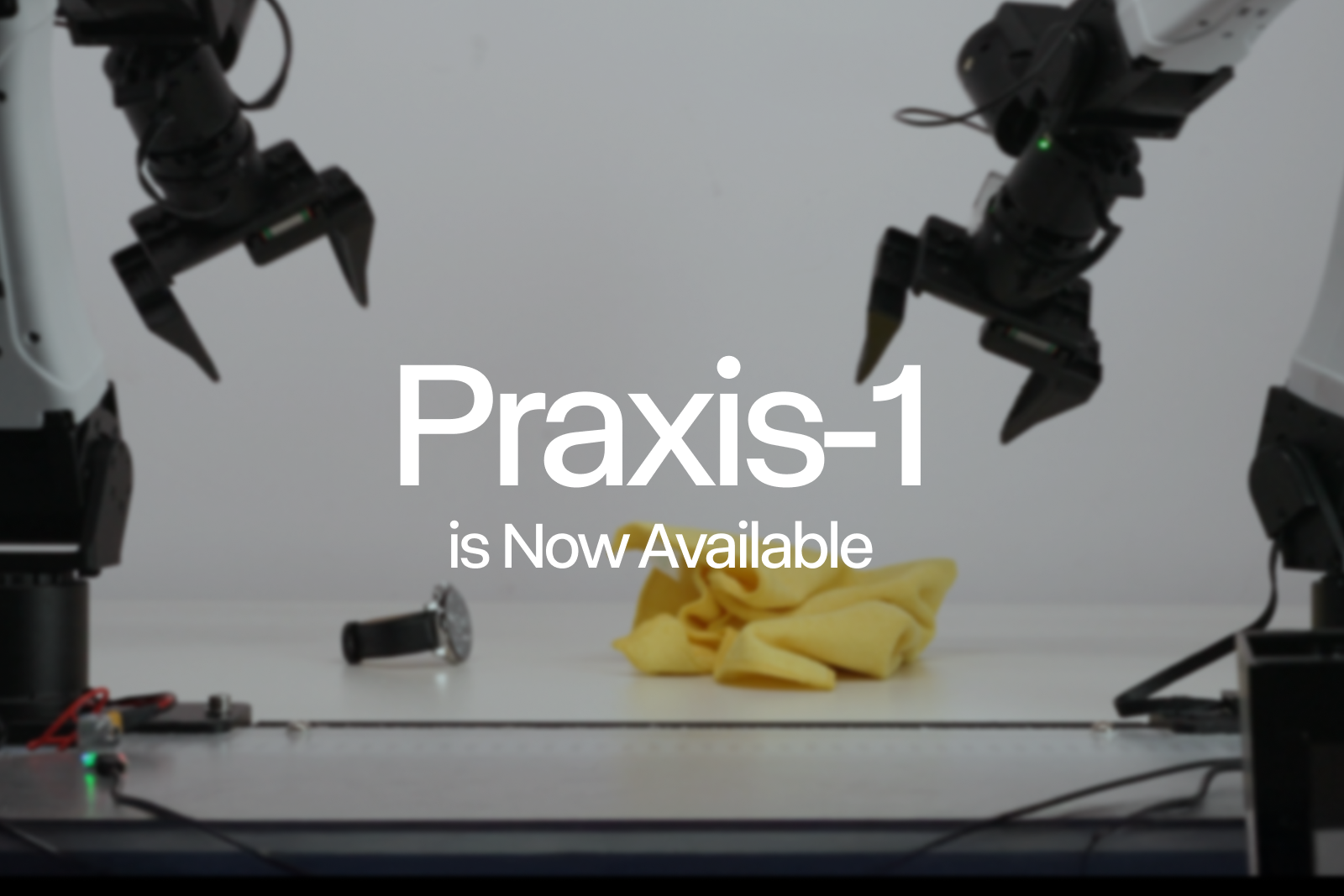
Runway has released Praxis-1, its world action model for robots, as open weights under the Apache 2.0 licence[1]. The announcement is dated 11 November 2026. Praxis-1 is the model Runway introduced in September, built on the same large-scale video pretraining as its general world models, and the one Noble Machines, Standard Bots and Ultra have been running on their own hardware: a legged humanoid, a six-axis industrial arm and a dual-arm warehouse robot[1].
01 / 05
What one call returns
Praxis-1 is a 27 billion parameter mixture-of-experts diffusion transformer. It predicts the next stretch of video and the robot's actions together[1]. In the open code, one call takes a written task, the current camera frames, frames from chunks the robot has already executed, and the arm's pose. It returns commands at 15 Hz: 21 steps, 1.4 seconds, on the first call of a window, then 24 steps, 1.6 seconds, after that, along with a predicted video of the same span[2].
A video backbone denoises the camera latents and passes hidden states to an action expert, which produces the motion. The checkpoint holds the backbone and the action expert together, about 54 GB in bfloat16. The Wan2.2 video autoencoder and a frozen Qwen3.5-2B text encoder are public models you download separately[2].
02 / 05
The checkpoints
The weights are on Hugging Face, the code is on GitHub, and Runway also lists native LeRobot support, vLLM-Omni and hosted inference on Reactor, plus a try-it page on Runway Dev[1][3]. The collection holds a base model and fine-tunes for two rigs, and the policy repositories are marked as 27 billion parameters[3].
- praxis-1-droid drives a single arm with an exterior camera and a wrist camera. Hugging Face's LeRobot notes describe that rig as a Franka arm in the DROID setup[2][4].
- praxis-1-yam drives two YAM arms, with a top camera and a wrist camera on each arm[2].
- praxis-1-base is the pretrained trunk without a rig's action heads. It is the starting point for a fine-tune on a new single arm, after you add those heads[2][4].
Each checkpoint is 17 safetensors shards plus a config and checksums[2]. Hugging Face also hosts LeRobot conversions of the three checkpoints, and NVFP4 variants of the DROID and YAM weights whose routed experts run in 4-bit on Blackwell workstation GPUs[3]. LeRobot's adapter describes the trunk as about 3 billion parameters active per token, and says the converted DROID checkpoint is a 54 GB download[4].
Runway says large-scale video gives the model a head start on a robot it has not been fine-tuned for, and that its research found web video matches teleoperated robot video as pretraining data for the policy. With LoRA, a team can adapt a checkpoint to its own cameras and tasks without retraining the full model[1].
03 / 05
The numbers Runway is leading with
On NVIDIA's RoboLab-120 leaderboard, Runway reports 46.2% success across 1,200 episodes, ahead of FLUX 3 Action at 42.9%, Cosmos3 Nano at 36.8% and π0.5 at 28.0%. It calls Praxis-1 the top world action model on that board, and says it beats every open-weight vision-language-action model. The table is dated November 2026, and the figures are Runway's own[1].
A second result is on a robot the model had not seen. Fine-tuned on Google's RT-1, Praxis-1 reaches 80.0% success on SimplerEnv, against 52.4% for the original RT-1 policy[1].
Hugging Face's LeRobot documentation reports a smaller check of the released DROID checkpoint. On the droid_guard suite, seven tasks across eight scenes, both the original runner and LeRobot's eval score 54 of 56 episodes on one H100[4]. That suite is 56 episodes of a fixed simulator. RoboLab-120 is the 1,200-episode board in Runway's table.
04 / 05
What it takes to run
Runway says the Apache 2.0 licence covers the weights and the inference and fine-tuning code, including commercial use, with both a full fine-tune and LoRA[1]. The repository's licence file is Apache 2.0. The Wan2.2 autoencoder and the Qwen3.5 text encoder have their own licences[2].
The quick start for the default bfloat16 weights asks for Python 3.12 and one CUDA GPU with at least 80 GB of memory[2]. Runway says the model runs across NVIDIA hardware from data centre GPUs such as the H100 and B200 to workstation cards such as the RTX 5090 and RTX PRO 6000, and on Jetson Thor on the robot itself[1]. LeRobot measured the converted DROID checkpoint at about 62 GB peak on an RTX PRO 6000 with 96 GB[4].
The repository's route onto a smaller Blackwell workstation GPU is an experimental NVFP4 path that packs only the routed experts. The policy drops from 54.4 GB to 17.5 GB, and with the text encoder and autoencoder the weights are about 23.5 GB before activations. The guide says a 32 GB RTX 5090 should fit and a 24 GB card does not. It also says the peak is not yet measured, the 4-bit path changes the actions, and it has not been run closed-loop on an SM120 GPU[2].
Fine-tuning is documented beside the inference code. A LoRA adaptation of the DROID checkpoint is set up for one GPU, and a full fine-tune of the base checkpoint is set up for eight[2]. LeRobot puts a full fine-tune at about 218 GB of weights, gradients and optimiser state, which needs at least four 80 GB GPUs, and it measured a LoRA run at 5.5 million trainable parameters[4]. Runway also points developers to NVIDIA's NeMo Automodel tutorials for post-training[1].
The LeRobot adapter spells out a few limits. Fine-tuning and the simulator cover the single arm: there is no YAM simulation yet, and no bimanual training recipe. The policy outputs Cartesian pose targets, and LeRobot has no Franka driver, so a real arm needs a client that executes those targets. Remote serving is not part of the adapter, which expects the policy to run in the same process[4]. The Praxis repository includes its own policy server and a MuJoCo simulator for the single-arm tasks[2].
05 / 05
Why it matters
A lab can now download a video-pretrained world action model, fine-tune it and run it on its own hardware, with the weights, the training code and a LeRobot adapter in public repositories. The RoboLab-120 lead is Runway's own November 2026 reading of that board: 46.2% across 1,200 episodes, a few points ahead of FLUX 3 Action. The practical gate is memory. The default weights need an 80 GB GPU. Runway also names the RTX 5090 and Jetson Thor, and the repository's 4-bit path for a 32 GB RTX 5090 is still experimental, with no closed-loop result on an SM120 GPU yet.
FAQ
Frequently asked questions.
01What is Praxis-1?
Praxis-1 is Runway's world action model for robots. It is a 27 billion parameter mixture-of-experts diffusion transformer that predicts a short stretch of camera video and the robot's next actions together. Runway introduced it in September as its first world action model and released the weights on 11 November 2026.
02What licence is Praxis-1 under?
Runway released the weights and the inference and fine-tuning code under the Apache 2.0 licence, including for commercial use. The GitHub repository's licence file is Apache 2.0. The Wan2.2 video autoencoder and the Qwen3.5-2B text encoder are separate downloads and have their own licences, so check those before shipping a product on Praxis-1.
03Which robots does Praxis-1 support?
The released checkpoints cover a single-arm DROID rig, which the LeRobot docs describe as a Franka arm with an exterior camera and a wrist camera, and a bimanual rig of two YAM arms with a top camera and two wrist cameras. A base checkpoint has no action heads and is the starting point for a fine-tune on a new single arm. Runway says partners have also run the model on a legged humanoid, a six-axis industrial arm and a dual-arm warehouse robot.
04What GPU do I need to run Praxis-1?
The default bfloat16 weights are about 54 GB, and the install guide asks for one CUDA GPU with at least 80 GB of memory, such as an H100. Runway also lists the RTX 5090, the RTX PRO 6000 and Jetson Thor, and LeRobot measured the converted DROID checkpoint at about 62 GB peak on a 96 GB RTX PRO 6000. For a smaller Blackwell workstation GPU, the repository documents an experimental 4-bit mode for the routed experts: it should fit a 32 GB RTX 5090, it will not fit a 24 GB card, and it has not been run closed-loop on an SM120 GPU.
05Where can I download Praxis-1?
The code is on GitHub at runwayml/praxis-1-oss. The weights, including LeRobot conversions of the base, DROID and YAM checkpoints, are in the runwayml Praxis-1 collection on Hugging Face. Runway also offers hosted inference on Reactor and a demo on Runway Dev.
That’s the story
Building with what’s new?
Spectrum Web Co ships products, places talent, builds social narratives and builds custom business tools as monthly services.
Related stories