News · SI
NVIDIA unveils GR00T 2 and Isaac Lab 3.0 to teach robots fine manipulation
At the Conference on Robot Learning in Austin, NVIDIA introduced GR00T 2, an open world action model trained partly on 100,000 hours of first-person human video, alongside Isaac Lab 3.0 and two new industrial robot benchmarks. Foxconn, Siemens and Nexuni are testing the model.
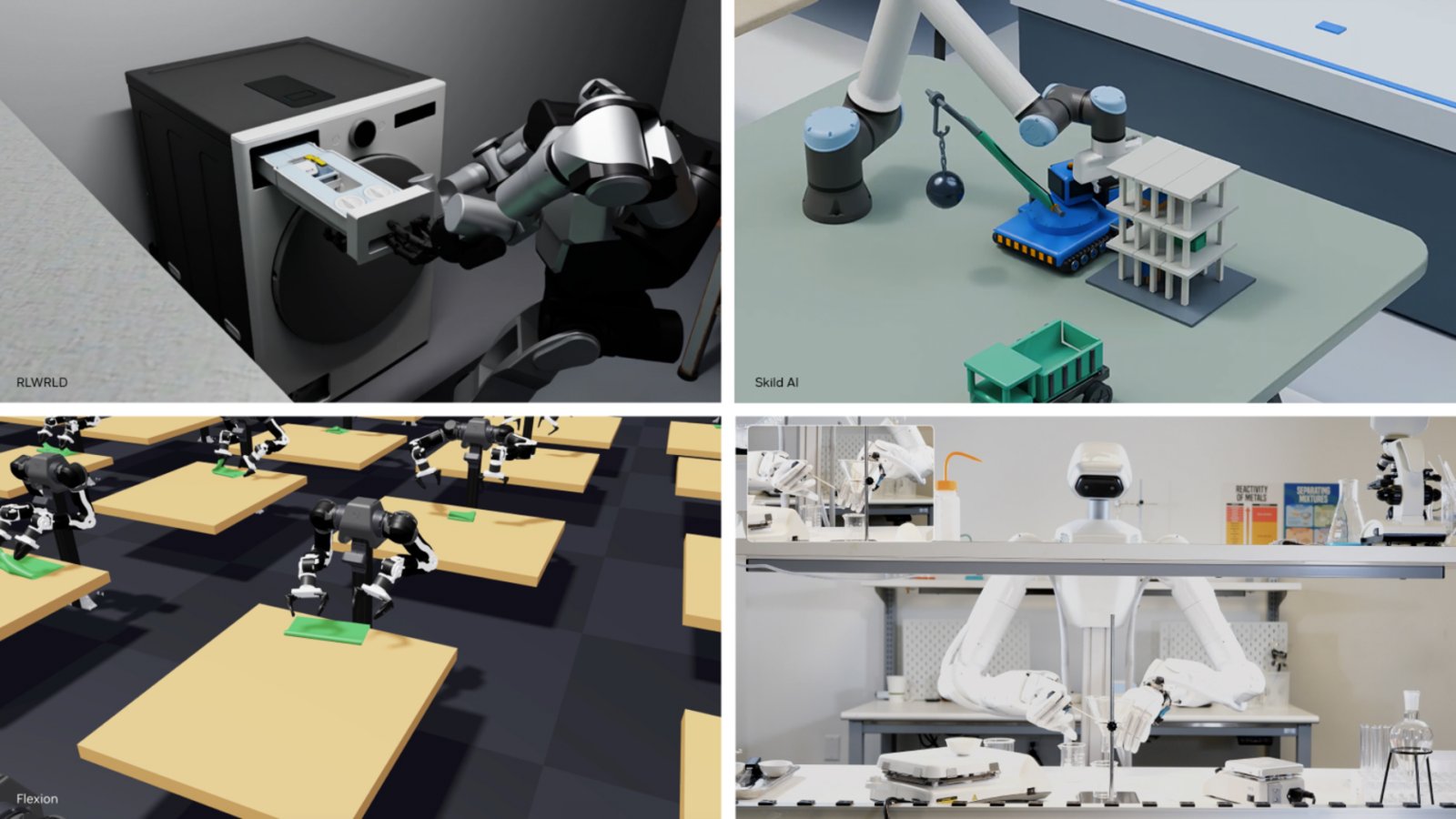
NVIDIA has introduced GR00T 2, an open world action model for robots, along with Isaac Lab 3.0, the newest version of its open source robot learning framework, at the Conference on Robot Learning (CoRL) in Austin, Texas[1]. The theme of the launch is a shift in what simulation is used for: from teaching robots to walk and roll towards fine work such as aligning gears, connecting cables and assembling small parts[1].
01 / 04
GR00T 2: fewer demonstrations per skill
GR00T 2 is built on NVIDIA Cosmos and trained on robot and human data, including 100,000 hours of open source first-person human video from NVIDIA[1]. A world action model tries to anticipate how a robot's actions will change what it sees before it moves, which matters for multistep tasks that need precision.
NVIDIA reports these results, all its own[1]:
- It completed 40 of 50 evaluated tasks at least once without any task-specific demonstrations.
- It averaged 71% success across 50 tasks with one demonstration per task, and 95% with five.
- It can learn from human demonstrations and transfer skills between different robot bodies without robot demonstrations.
- AI agents can call its API and supporting tools to run skills in sequence and recover from errors.
The company says GR00T 2 ranks in the top three across vision language action and world action model categories on the RoboCasa365, RoboLab, RoboDojo and MolmoSpaces benchmarks[1]. Nexuni is testing it for laundry handling, Foxconn is applying it to server manufacturing and Siemens is evaluating it across industrial use cases, while MicroAGI used a reinforcement learning post-trained version to swap Ethernet cables with a robot arm[1]. None of those partners has been described as running it in production.
NVIDIA also released a Video to Data workflow that turns human video into simulated robot demonstrations, and says its EgoHand model for reconstructing 3D hand motion passed 40,000 Hugging Face downloads in its first two weeks[1].
02 / 04
Isaac Lab 3.0 and Newton
Isaac Lab 3.0 lets researchers use agents to set up training environments with simulation-ready assets, switch between the PhysX and Newton physics engines, pick renderers for perception-based training and apply a new reinforcement post-training library to models like GR00T[2]. Tighter integration with Newton means it can now model deformable objects such as cables and cloth, and robot hands with many interacting joints. On one vision-based dexterous manipulation benchmark, NVIDIA says Isaac Lab 3.0 with Newton reached up to 2.5 times the training throughput of Isaac Lab 2.3 with PhysX[1].
Partners are building on it. Skild AI announced STEEL, a rigid-body physics solver built on Newton, and an Isaac Lab demo called AlphaNIST trained a single policy across all 20 tasks on the NIST Assembly Task Board with more than 98% training success, using about 39 times less GPU time than separate per-task policies[1].
03 / 04
New industrial benchmarks
Two new open benchmarks run on Isaac Lab-Arena, NVIDIA's framework for evaluating policies across thousands of variations. DexBench, built by RLWRLD with NVIDIA, has 15 dexterity tasks across retail, logistics, manufacturing and hospitality scenes. VABAR, from UC Berkeley and NVIDIA, tests robots on six industrial tasks with standard variations and difficulty tiers[1].
04 / 04
Why it matters
Robot learning has been held back by how expensive it is to collect demonstrations on real hardware. If GR00T 2's one-to-five demonstration numbers hold up outside NVIDIA's tests, teams could teach a new task in an afternoon rather than weeks. The caveat is that every figure here is NVIDIA's own, and the announcement does not yet link a model card, weights or licence for GR00T 2, so independent results and download details are the next things to watch.
FAQ
Frequently asked questions.
01What is GR00T 2?
An open world action model from NVIDIA, built on its Cosmos world models, that lets robots predict how their actions will change their surroundings and learn dexterous manipulation skills.
02What was it trained on?
Diverse robot and human data, including 100,000 hours of open source first-person human video released by NVIDIA.
03How well does it perform?
By NVIDIA's own figures, it completed 40 of 50 evaluated tasks at least once with no task-specific demonstrations, and averaged 71% success across 50 tasks with one demonstration per task, rising to 95% with five.
04Who is using it?
NVIDIA says Nexuni is testing it for robotic laundry handling, Foxconn is applying it to server manufacturing, Siemens is evaluating it for industrial work, and MicroAGI has used it for Ethernet cable swapping on a robot arm.
05What is new in Isaac Lab 3.0?
Agents can set up training environments, researchers can switch between the PhysX and Newton physics engines, choose renderers for perception training and use a new reinforcement post-training library. NVIDIA reports up to 2.5 times the training throughput of Isaac Lab 2.3 on one dexterous manipulation benchmark.
06Can I download GR00T 2 now?
NVIDIA calls it open, but its announcement does not link a model card, weights or licence, so check NVIDIA's developer channels before planning around it.
That’s the story
Building with what’s new?
Spectrum Web Co ships products, places talent, builds social narratives and builds custom business tools as monthly services.
Related stories