News · SI
Archon Robotics unveils Anchor 1 whole-body humanoid controller
Archon Robotics has unveiled Anchor 1, a whole-body controller for humanoid robots that the company says cuts tracking error by 30% to 80%. Weights are not published. The project page, dated 30 October 2026, expects them in late 2026.
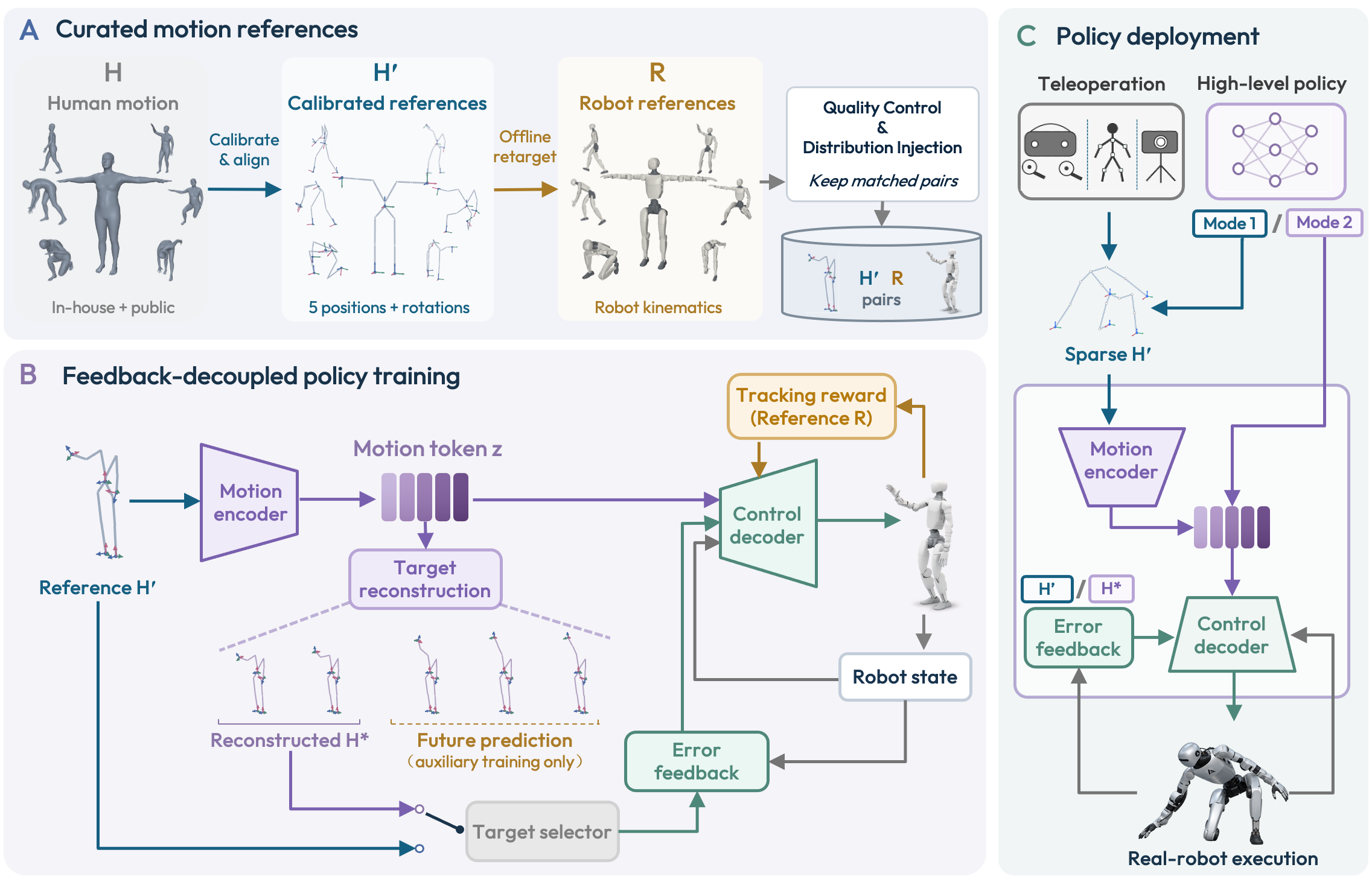
Archon Robotics (源策未来), an embodied AI company based in Shanghai's Xuhui district and incubated by the Shanghai Innovation Institute (上海创智学院), has formally launched Anchor 1, a whole-body control model for humanoid robots[3]. The Paper's Xuhui government account reported that launch on 11 November 2026, with the research and real-robot demonstrations[3]. The company's project page is dated 30 October 2026[1].
The headline figure is Archon's own. The paper says that under the strictest real-world global scoring setting, Anchor 1 cuts tracking error by 30% to 80%, with fewer look-ahead inputs and without retargeting, compared with the existing controllers it tested[2]. The Paper reports the same 30% to 80% range, and fewer look-ahead inputs[3]. Model weights are not out. Archon says a release is expected in late 2026[1].
01 / 06
A command of five poses
Anchor 1 takes five target poses: the pelvis, both wrists and both ankles[1]. A geometric calibration maps the human motion to the robot's scale, and those targets are sent without online joint-space retargeting[1]. Archon names GMR and UMR as online retargeting methods whose poor solutions can hand the controller a robot reference that drifts from the intended human motion or changes abruptly. Those errors, Archon says, can then propagate into execution[1].
Training pairs each calibrated human sequence with an offline-retargeted robot motion of the same movement. The human poses are the commands. The robot motion guides the rest of the body[1]. The reference is encoded into tokens, and explicit tracking errors go separately to the control decoder, so the correction stays out of the motion encoder[1]. The controller builds on the SONIC motion-token formulation and adds a reconstruction head, so a higher-level policy can supply tokens directly[1].
The Paper uses a door for the same idea. A person's arm length and joint angles differ from the robot's, so the joint path cannot be copied. What matters is the hand's path to the handle, the centre-of-gravity shift, and the change in foot support[3]. Anchor 1, The Paper says, works with Archon's motion-control foundation model system, S0, to turn that intent into stable whole-body movement fitted to the robot[3].
02 / 06
Four operators, one interface
03 / 06
Archon's three tracks
Archon compares Anchor 1 with ScaleBFM, SONIC v1.1 and MimicLite on three tracks[1][2]. The in-house track has 15,342 motions. The public track has 2,230 motions from AMASS, BONES-SEED, CIRCLE and OMOMO. The reachability track has 3,210 references across standing, shallow squat, deep squat, staggered stance and half kneeling[1][2].
On the real robot, the project page and the paper both report 72 motions from the in-house track[1][2]. The paper also reports 51 standing reaches[2]. Archon says Anchor 1 shows lower global tracking errors and higher overall motion success across the position tolerances it tested[1].
The Paper says training used more than 400,000 real human motion clips, combined with simulation[3]. The paper's table is a different count: 406,222 sequences after left-right mirroring, approximately 1,081.4 hours, from in-house capture and public datasets[2].
04 / 06
Demonstrations, then an autonomous policy
For teleoperation, Archon compares SONIC v1.1 (SMPL) with Anchor 1[1][2]. Kicking a cardboard box, SONIC records 9 successful demonstrations an hour at 37.50% success, and Anchor 1 records 43 an hour at 98.03%. Picking up slippers, SONIC records 41 an hour at 68.33%, and Anchor 1 records 62 an hour at 97.37%[1][2]. Those Anchor 1 rows send errors to the decoder. The encoder-feedback variant records 45 an hour at 94.74% for the kick, and 67 an hour at 93.10% for the slippers[1][2].
Archon then trains vision-language-action policies on those demonstrations. They can command Anchor 1 with sparse body-part targets or with motion tokens[1]. Over 20 trials, box-kick success is 0.70, plus or minus 0.14, for SONIC with motion tokens, and 0.90, plus or minus 0.00, for Anchor 1 with reconstruction feedback and motion tokens. Slipper pickup is 0.10, plus or minus 0.00, against 0.45, plus or minus 0.07[1][2]. Commanded with motion tokens, the encoder-feedback variant scores zero on both tasks[2].
05 / 06
Expected in late 2026
Model weights are expected in late 2026, and they are not published on the project page[1]. Deployment code, PICO teleoperation, demonstration collection and setup guides are expected in late 2026 as well. Leaderboards are in preparation, and an early access form is open[1]. Archon is preparing a community whole-body control challenge for early 2027, built around accurate target tracking, sustained coordination and stable support. It says the tracks, the submission details and the schedule will follow[1].
06 / 06
Why it matters
That 30% to 80% figure is Archon's result under the strictest real-world global scoring setting, with fewer look-ahead inputs and without retargeting[2]. The Paper's door example puts that interface in plain terms: the hand's path, the centre-of-gravity shift and the change in foot support, not a human joint angle the robot does not share[3]. The paper says the tests cover a single humanoid, and that tracking alone does not ensure a successful object interaction, because the sparse targets leave out object geometry, contact forces and grasp stability[2]. Weights and deployment code are still listed as upcoming[1].
Spectrum has covered a separate warehouse letter of intent, GXO and Apptronik's plan for up to 1,000 Apollo humanoids.
FAQ
Frequently asked questions.
01What is Anchor 1?
Anchor 1 is a whole-body control model for humanoid robots from Archon Robotics (源策未来), an embodied AI company based in Shanghai's Xuhui district and incubated by the Shanghai Innovation Institute (上海创智学院). The Paper's Xuhui government account reported the formal launch on 11 November 2026, with the research and real-robot demonstrations. The project page is dated 30 October 2026. The command is five target poses: the pelvis, both wrists and both ankles.
02Are the Anchor 1 weights available?
No. Archon says the model weights are expected in late 2026, and the project page does not offer them now. Deployment code, PICO teleoperation, demonstration collection and setup guides are also expected in late 2026. Leaderboards are listed as in preparation. The page has an early access form, and Archon is preparing a community whole-body control challenge for early 2027.
03What does the 30% to 80% tracking-error figure mean?
It is Archon's own benchmark, not an independent leaderboard. The paper says that under the strictest real-world global scoring setting, Anchor 1 cuts tracking error by 30% to 80% compared with the existing controllers it tested, with fewer look-ahead inputs and without retargeting. The Paper reports the same 30% to 80% range and fewer look-ahead inputs.
04How does demonstration collection compare with SONIC?
On Archon's teleoperation table, kicking a cardboard box, SONIC v1.1 (SMPL) records 9 successful demonstrations an hour at 37.50% success, and Anchor 1 records 43 an hour at 98.03%. Picking up slippers, SONIC records 41 an hour at 68.33%, and Anchor 1 records 62 an hour at 97.37%. Those Anchor 1 rows send tracking errors to the decoder. A variant that sends them to the encoder records 45 and 67 demonstrations an hour, at 94.74% and 93.10%.
05What did the autonomous tests show?
Archon trained vision-language-action policies on the teleoperated demonstrations. Over 20 trials, box-kick success is 0.70, plus or minus 0.14, for SONIC with motion tokens, and 0.90, plus or minus 0.00, for Anchor 1 with reconstruction feedback and motion tokens. Slipper pickup on that same pairing is 0.10, plus or minus 0.00, against 0.45, plus or minus 0.07. The encoder-feedback variant of Anchor 1 scores zero on both tasks when it is commanded with motion tokens.
That’s the story
Building with what’s new?
Spectrum Web Co ships products, places talent, builds social narratives and builds custom business tools as monthly services.
Related stories