News · SI
AGIBOT's GO-3 Preview robot model tops three embodied AI leaderboards, open source promised by year-end
AGIBOT has unveiled GO-3 Preview, an embodied foundation model it says ranks first on three robot benchmarks. It pairs the model with a 100-robot post-training fleet and an agent framework that lets deployed robots keep learning, and says GO-3 Preview will be fully open-sourced by the end of 2026.
Chinese robotics company AGIBOT has unveiled GO-3 Preview, a new embodied foundation model that it says takes first place on three robot-learning leaderboards, and it plans to open-source the model fully by the end of 2026[1].
01 / 06
The model
GO-3 Preview is built on WRAM, AGIBOT's World Reasoning Action Model architecture, which ties together understanding a task, predicting what the scene should look like next and generating the actions to get there[1]. Three pieces do the work. A control-oriented autoencoder (CoAE) extracts visual features that keep object positions, shapes and spatial relationships. A component called SVP predicts the full future state in a single step, and an action module learns to move from the current state toward it. KASO then keeps the predicted futures that best match the actions actually taken during training, so prediction and action stay aligned[1].
Pre-training mixes first-person human video with robot trajectories. AGIBOT says the result can take on new tasks zero-shot, without task-specific fine-tuning on physical robots, and can learn harder jobs like LEGO assembly from a small number of demonstrations[1].
02 / 06
Practice at fleet scale
For post-training, AGIBOT built Genie Evolver, which combines a fleet of 100 physical robots with physics simulation and world models[1]. Successes and failures are pooled across the fleet so one robot's lesson can help the rest, while the world model lets the system revisit a key moment and compare what different actions would have done. AGIBOT's demos include tabletop curling, where it says a robot beat typical human players after a few hours of practice, pulling target blocks from a shifting stack, and throwing a ball into a moving basket[1].
03 / 06
Learning on the job
The third piece, Genie Master, is an agent framework for deployed robots. It records what worked and what didn't, folds reusable lessons into long-term memory at the end of each day, and turns execution trajectories into training data for the action policy[1]. AGIBOT showed a Genie G2 robot working in a real convenience store that, by the company's account, kept improving at precise manipulation tasks without human demonstrations or manual tuning. AGIBOT calls this "Physical RSI", recursive self-improvement in the physical world[1].
04 / 06
The leaderboard claims
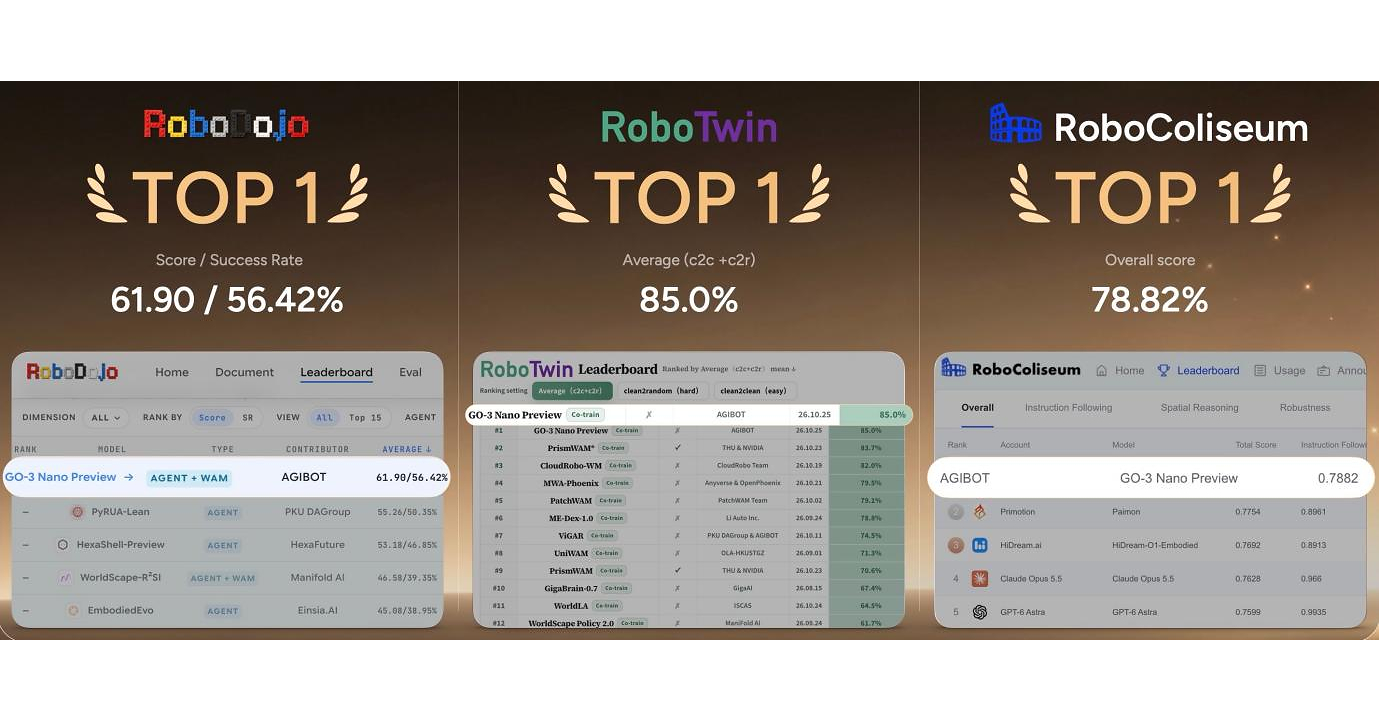
AGIBOT says GO-3 Preview ranks first on RoboDojo, RoboTwin and RoboColiseum[1]. Its release graphic shows 61.90 score / 56.42% success on RoboDojo, an 85.0% average on RoboTwin and a 78.82% overall score on RoboColiseum, where it sits just ahead of entries from Primotion and HiDream.ai. The leaderboard entries are labelled GO-3 Nano Preview, which suggests a smaller variant was submitted.
05 / 06
The caveats
Everything here comes from AGIBOT. Humanoids Daily notes the company hasn't published a full comparison protocol that would let others check the rankings, and hasn't said exactly when the model will be released, under what licence, or which training resources will come with it[2]. Parameter counts weren't disclosed either.
06 / 06
Why it matters
Most robot foundation models still treat training as finished once a model ships. AGIBOT is betting on scaling across the whole lifecycle, from pre-training to fleet practice to learning in the field, and the company says it rolled its 20,000th robot off the line in September[1]. If the year-end open-source release lands as promised, GO-3 would give researchers a strong open baseline for robot manipulation from one of China's biggest humanoid makers.
FAQ
Frequently asked questions.
01What is GO-3 Preview?
An embodied foundation model from AGIBOT that controls robot manipulation. It is built on AGIBOT's WRAM (World Reasoning Action Model) architecture, which combines task understanding, prediction of future states and action generation in one model.
02Which benchmarks does it lead?
AGIBOT says it ranks first on RoboDojo, RoboTwin and RoboColiseum. Its own leaderboard graphic shows 61.90 score / 56.42% success on RoboDojo, 85.0% on RoboTwin and a 78.82% overall score on RoboColiseum, with the entries listed as GO-3 Nano Preview.
03Is it open source?
Not yet. AGIBOT says GO-3 Preview will be fully open-sourced by the end of 2026, but it hasn't given a date, a licence or a list of what will be released.
04What are Genie Evolver and Genie Master?
Genie Evolver is AGIBOT's post-training system, which combines a fleet of 100 physical robots with physics simulation and world models. Genie Master is an agent framework that lets deployed robots plan, recover from failures and turn their work experience into memory and new training data.
05Have the results been independently checked?
No. The rankings and demos come from AGIBOT, and the company hasn't published a full comparison protocol that would let others verify them.
That’s the story
Building with what’s new?
Spectrum Web Co ships products, places talent, builds social narratives and builds custom business tools as monthly services.
Related stories