News · SI
Autoware Foundation releases AutoE2E, an open-source driving model
On 11 November 2026 the Autoware Foundation's Robotaxi Working Group released AutoE2E, an open-source end-to-end driving model with 79.9 million parameters. The v1.0 checkpoints are the reactive planner, the published score is an open-loop comparison with logged human driving, and the model card says those weights must not control a vehicle on public roads.
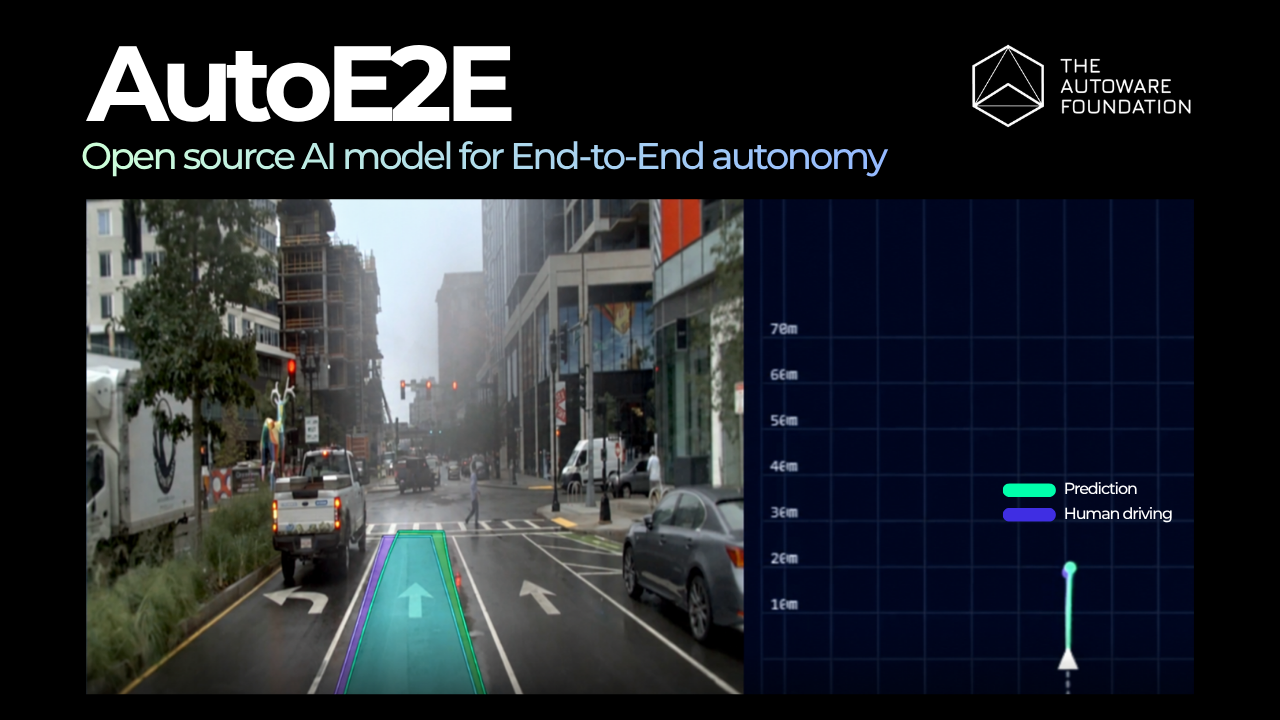
On 11 November 2026, the Autoware Foundation's Robotaxi Working Group, sponsored by TIER IV, released AutoE2E, an open-source end-to-end driving model[1]. The foundation describes it as a model for applications from L2++ hands-free driving assistance to future L4 driverless services, with 79.9 million parameters[1]. TIER IV says development is led by the foundation and TIER IV, that the model can run on computing platforms beyond NVIDIA hardware, and that it is lighter than NVIDIA's Alpamayo 2 Edge, which has 2 billion parameters[2].
01 / 05
The reactive model in v1.0
The foundation calls v1.0 the Reactive model and says it runs at 10 Hz: ten times a second it fuses six camera views into a bird's-eye view of the road and plans the next 6.4 seconds of acceleration and steering. The foundation calls this the layer that drives[1]. The repository describes a GRU planner that turns that bird's-eye scene, an optional map raster and the vehicle's recent motion into 6.4 seconds of acceleration and curvature[3]. The model card states the same output as 64 steps of longitudinal acceleration and curvature at 10 Hz, integrated into a trajectory in the vehicle's frame[4].
Two slower layers, both at 1 Hz, are still in development. One is a JEPA world model that predicts how the scene will evolve without rendering pixels. The other is a language-free reasoning layer that works out why the car should act, such as easing off for a pedestrian about to cross, without generating a word[1]. The model card says both branches are disabled in the v1.0 weights, and the foundation says every published result comes from the Reactive model alone[1][4].
The foundation says a camera-only setup is for hands-free driving on highways and city streets, and that the output can be paired with LiDAR and radar safety layers for fully driverless applications[1]. TIER IV says the model can cover configurations from cameras alone through to LiDAR and radar[2].
02 / 05
Open-loop error on KITScenes
On KITScenes-Multimodal validation, the foundation reports an average displacement error of 0.744 metres over three seconds for the fine-tuned model, ranking second among eight open-weight model configurations[1]. The repository and the model card put that figure on 202 keyframes, with an error of 1.980 metres at the three-second point. In the foundation's table, only Qwen Drive 1.0 is ahead on those keyframes, at 0.565 metres average displacement and 1.397 metres at three seconds[3][4].
The foundation says the comparison is open-loop: each model predicts the next three seconds from logged camera frames, and the score is the distance from the path the human driver took[1][3]. AutoE2E also receives a map raster and a route. The model card says that route is an oracle rebuilt from the logged future trajectory, so the figure measures route-conditioned driving. It says the validation ground truth comes from a trajectory field made with an older coordinate conversion, that rescoring against the official pose file is still open, and that closed-loop behaviour is not measured in these results[4].
A nuPlan-trained checkpoint, evaluated zero-shot, is listed at 0.915 metres average displacement over three seconds on 11,035 validation samples, a larger set than those 202 keyframes[3][4]. On the official KITScenes test split, cameras and ego-motion only, the fine-tuned checkpoint is listed at 0.826 metres average displacement over three seconds on 23,690 samples. The model card says neither checkpoint saw those scenes in training[4].
03 / 05
Two licences
Source code is on GitHub under the Apache 2.0 licence, which the foundation says allows research and commercial use[1][3]. The v1.0 checkpoints are on Hugging Face[1][4]. One, nuplan-epoch-5, is trained on nuPlan v1.1 and is the baseline for a new city or a fine-tune. The other, kitscenes-epoch-5, is that checkpoint fine-tuned on KITScenes-Multimodal for Karlsruhe and the KITScenes camera rig[4].
The model card puts the checkpoint files under CC BY-NC-SA 4.0. They may be used, fine-tuned and shared for non-commercial work, with attribution, and shared adaptations stay under the same licence. Commercial use needs permission from the upstream rights holders, including a commercial licence from Motional covering nuPlan and nuScenes material used to build the weights[3][4]. The card says v1.0 is a research model for open-loop evaluation, visualisation, benchmarking and further training. It says the release is not a certified driving system and must not control a vehicle on public roads[4].
04 / 05
Trials planned for 2027
The Reactive model is integrated with Autoware for open-loop evaluation[1][2]. The foundation says real-vehicle closed-loop testing is underway, with further on-road trials planned for 2027, alongside continued development and automotive system-on-chip optimisation. It says those steps support eventual commercialisation, that L4 capability remains a development goal, and that deployment performance remains subject to evaluation on each platform[1]. TIER IV says robotaxi commercialisation is under consideration while the world model and the reasoning model are still being developed[2].
05 / 05
Why it matters
That 0.744 metre result is the foundation's open-loop score on 202 validation keyframes, with a map and a route supplied. The code is under Apache 2.0. The checkpoints carry a non-commercial licence, and the model card says they must not control a vehicle on public roads.
Sources
Sources for this story.
- AWF Robotaxi WG releases AutoE2E, an open-source end-to-end AI model (Autoware Foundation)autoware.org
- TIER IV unveils end-to-end autonomous driving adaptable to map information and sensor configurations (TIER IV)tier4.co.jp
- auto_e2e (Autoware Foundation on GitHub)github.com
- AutoE2E (Autoware Foundation on Hugging Face)huggingface.co
FAQ
Frequently asked questions.
01What is AutoE2E?
AutoE2E is an open-source end-to-end driving model released on 11 November 2026 by the Autoware Foundation's Robotaxi Working Group, sponsored by TIER IV. It has 79.9 million parameters. The foundation says it is designed for applications from L2++ hands-free driving assistance to future L4 driverless services, and that L4 capability remains a development goal.
02What is in the AutoE2E v1.0 release?
v1.0 is the Reactive model, which runs at 10 Hz. It fuses six camera views into a bird's-eye view and plans the next 6.4 seconds of acceleration and steering. The model card describes that output as 64 steps of longitudinal acceleration and curvature. A JEPA world model and a language-free reasoning layer, both at 1 Hz, are still in development and are disabled in these weights. The checkpoints are on Hugging Face and the code is on GitHub.
03What score did the foundation report for AutoE2E?
On KITScenes-Multimodal validation, the foundation reports an average displacement error of 0.744 metres over three seconds for the fine-tuned checkpoint, second of eight open-weight configurations. The repository places that figure on 202 keyframes, with Qwen Drive 1.0 ahead at 0.565 metres. The test is open-loop: each prediction is compared with the path in a human driving log, and AutoE2E also receives a map raster and a route.
04What licence covers AutoE2E?
The GitHub source code is under the Apache 2.0 licence, which the foundation says covers research and commercial use. The Hugging Face model card licenses the v1.0 checkpoint files under CC BY-NC-SA 4.0. It says they may be used, fine-tuned and shared for non-commercial purposes, with attribution, and that commercial use needs permission from the upstream rights holders, including a commercial licence from Motional for nuPlan and nuScenes material.
05Can the published AutoE2E checkpoints drive on a public road?
The model card says AutoE2E v1.0 is a research model for open-loop evaluation, visualisation, benchmarking and further training. It says the release is not a certified driving system and must not control a vehicle on public roads. The foundation says real-vehicle closed-loop testing is underway separately, with further on-road trials planned for 2027.
That’s the story
Building with what’s new?
Spectrum Web Co ships products, places talent, builds social narratives and builds custom business tools as monthly services.
Related stories