News · SI
NVIDIA releases Alpamayo 2 Edge weights for in-vehicle driving
On 10 November 2026 NVIDIA published the Alpamayo 2 Edge weights on Hugging Face, a reasoning model for in-vehicle driving on DRIVE AGX Thor. The weights are under the OpenMDW-1.1 licence and the inference code is under Apache 2.0. NVIDIA says a TensorRT Edge-LLM recipe reaches 160 to 190 milliseconds from camera pixels to a trajectory on DRIVE AGX Thor, and that a deployment still needs further testing.
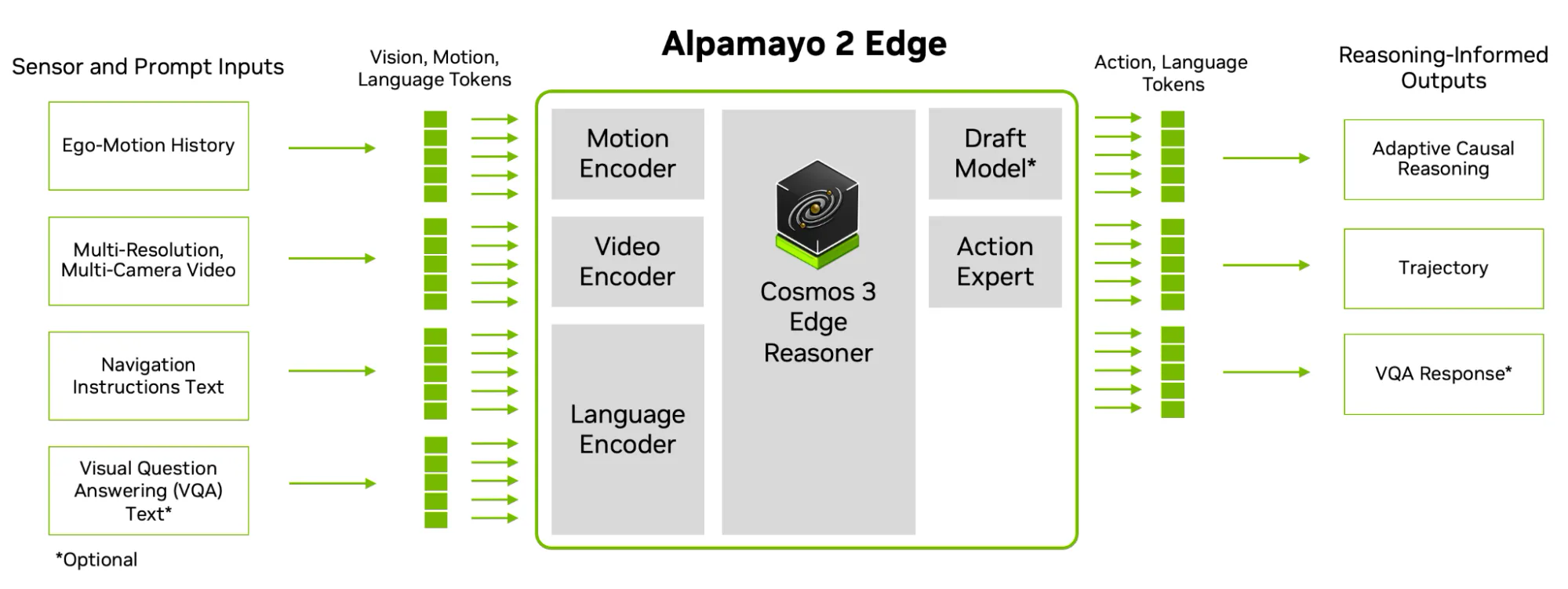
On 10 November 2026, NVIDIA published the weights for Alpamayo 2 Edge on Hugging Face[1]. NVIDIA calls it a reasoning vision-language-action model with 2 billion parameters, built on the Nemotron-based backbone of Cosmos 3 Edge, for fine-tuning and in-vehicle use on DRIVE AGX Thor[1]. It generates navigation-conditioned trajectories and causal explanations, and it can answer questions about a driving scene[1]. The weights are under the OpenMDW-1.1 licence. The inference code, in the NVlabs repository alpamayo2-edge, is under the Apache 2.0 licence[1][2].
01 / 05
A compact reasoning model
The model card lists a finer count beside that 2 billion parameter description. The backbone is 2.45 billion parameters: 1.96 billion in the language model, 0.41 billion in a SigLIP2 vision encoder and 0.08 billion in a projector. A separate action expert has 0.2 billion parameters. The released weights are BF16[1].
NVIDIA's technical blog the same day, by Marco Pavone and Boris Ivanovic, calls the action piece a diffusion action expert. It takes surround-camera video, recent ego motion and a navigation instruction, and it produces Chain-of-Causation reasoning and a future trajectory[3]. The model card says the expert predicts acceleration and curvature at each step, which a unicycle model turns into 64 waypoints from 0.1 seconds to 6.4 seconds, each with a position and a rotation[1][2].
The documented driving input is six cameras and 22 frames, a navigation instruction, and 20 historical ego poses from 1.9 seconds before the query to the query time. The two front cameras supply five frames each, and the other four supply three[1][2]. NVIDIA says the model writes a reasoning trace only when it needs one, so routine driving generates less text[3]. The blog also describes offline distillation on Chain-of-Causation labels generated by Alpamayo 2 Super[3]. The PyTorch examples were tested on one H100 with 80 GB of memory. NVIDIA says other GPUs have not been validated, and recommends at least 16 GB for those examples[1][2].
02 / 05
Training data and reported scores
NVIDIA says the training set comprises roughly 115,000 hours of multi-camera driving video, with ego-motion and trajectory annotations, and roughly 3.7 million Chain-of-Causation traces. The card says that driving data comes from cameras, inertial measurement units and GPS, and that the reasoning traces are synthetic. The traces are in English and link a driving decision to the causes they name[1].
On the card's benchmarks, open-loop minimum average displacement error (minADE_6) is 0.52 metres at five seconds, on 1,392 samples from PhysicalAI-AV. In AlpaSim, NVIDIA reports 15.15 kilometres driven per at-fault incident, with a standard deviation of 0.04 kilometres across three rollout sets, on 875 scenarios from PhysicalAI-AV-NuRec. An at-fault incident means leaving the road or an at-fault collision. Lingo-Judge scores LingoQA at 75.2[1].
The blog says closed-loop reinforcement learning in AlpaGym improved closed-loop driving performance by 48.9% on top of the best checkpoint without that post-training[3]. NVIDIA gives that percentage without naming the score behind it. In the same post, NVIDIA compares the model with Qwen-Drive-1.0 and says Alpamayo 2 Edge achieves about 60 times the distance between at-fault incidents in AlpaSim[3].
AlpaJudge is the human-calibrated critic NVIDIA says it used to score reasoning traces, select training examples and supply a post-training reward[3]. The 21 October announcement described it as a way to score driving explanations, filter weak annotations and reduce manual review[4]. The November post points to two Hugging Face checkpoints. AlpaJudge-RB compares a candidate answer with a reference, using text only. AlpaJudge-RF reads front-camera frames, meta-actions and a candidate rationale[3].
03 / 05
Latency on DRIVE AGX Thor
The BF16 weights run as a PyTorch model. NVIDIA says real-time use on DRIVE AGX Thor needs a further recipe: a DFlash2 drafter, FP8 calibration, ONNX export and TensorRT engines built with TensorRT Edge-LLM plugins[3]. On DRIVE AGX Thor-X, with DRIVE OS 7.2.7.0, CUDA 13.4 and TensorRT 11.3.1.9, NVIDIA reports a pixel-to-trajectory latency of 160 to 190 milliseconds, depending on how much reasoning the model writes[3]. The October announcement described a 10 Hz design for in-vehicle scene understanding and motion planning[4]. The model card says a deployment still needs further testing on data for that use, at unit and system level, before the model is integrated into a system[1].
04 / 05
Announced with Hyperion
NVIDIA announced Alpamayo 2 Edge on 21 October 2026 with the Hyperion computing platform at GTC Berlin, calling it a 2 billion parameter reasoning model built on Cosmos and optimised for DRIVE AGX Thor[4]. An NVIDIA blog the same day said the weights would be posted on GitHub and Hugging Face later that month[5]. The Alpamayo product page now lists the model as available[6].
On 11 November 2026, TIER IV said it has integrated Alpamayo 2 Edge with Autoware and is adapting the model to real vehicles. In that release, TIER IV described AutoE2E as lighter than Alpamayo 2 Edge, at 79.9 million parameters[7]. The AutoE2E release is reported in Autoware Foundation releases AutoE2E, an open-source driving model.
05 / 05
Why it matters
Developers can run, fine-tune and score a compact driving model, and NVIDIA has published a Thor recipe with a measured latency. The model card still treats a vehicle deployment as further work: the checkpoint is a starting point, and a system that uses it needs testing on that system's own data.
Sources
Sources for this story.
- Alpamayo 2 Edge (NVIDIA on Hugging Face)huggingface.co
- alpamayo2-edge (NVIDIA on GitHub)github.com
- Running AV Reasoning Models Within Onboard Compute and Latency Limits (NVIDIA Technical Blog)developer.nvidia.com
- European Mobility Leaders Build Safe Vehicles and Robotaxi Fleets on NVIDIA Hyperion (NVIDIA Newsroom)nvidianews.nvidia.com
- NVIDIA Open Models Advance Europe's Sovereign Intelligence Across Industries (NVIDIA Blog)blogs.nvidia.com
- Open Models for Robotaxis and Autonomous Vehicles (NVIDIA)nvidia.com
- TIER IV unveils end-to-end autonomous driving adaptable to map information and sensor configurations (TIER IV)tier4.co.jp
FAQ
Frequently asked questions.
01What is Alpamayo 2 Edge?
Alpamayo 2 Edge is a reasoning vision-language-action model whose weights NVIDIA published on Hugging Face on 10 November 2026. NVIDIA describes it as a 2 billion parameter model for in-vehicle driving on DRIVE AGX Thor, built on the Nemotron-based backbone of Cosmos 3 Edge with a diffusion action expert. It produces driving trajectories and Chain-of-Causation explanations, and it can answer questions about a driving scene.
02What licences cover the weights and the code?
NVIDIA releases the model weights under the OpenMDW-1.1 licence. The inference source code, in the NVlabs repository alpamayo2-edge, is under the Apache 2.0 licence. The repository is a PyTorch path for the released checkpoint, including examples that load clips from NVIDIA's PhysicalAI-Autonomous-Vehicles dataset.
03How many parameters does the model card list?
NVIDIA calls Alpamayo 2 Edge a 2 billion parameter model. The model card also lists a backbone of 2.45 billion parameters: 1.96 billion in the language model, 0.41 billion in a SigLIP2 vision encoder and 0.08 billion in a projector, plus an action expert of 0.2 billion parameters. The published weights are BF16.
04What latency does NVIDIA report on DRIVE AGX Thor?
NVIDIA's TensorRT Edge-LLM recipe, measured on DRIVE AGX Thor-X with DRIVE OS 7.2.7.0, CUDA 13.4 and TensorRT 11.3.1.9, reports a pixel-to-trajectory latency of 160 to 190 milliseconds, depending on how much reasoning the model generates. That path adds FP8 calibration, ONNX export and a DFlash2 drafter on top of the downloaded BF16 PyTorch weights. In October, NVIDIA said the model is designed to run at 10 Hz.
05Does NVIDIA say a deployment needs further testing?
Yes. The model card says integrating the model, or a fine-tune of it, into a system requires additional testing on data for that use, at unit and system level, before deployment. NVIDIA presents the checkpoint as a starting point for fine-tuning and for in-vehicle deployment, and says real-time use on DRIVE AGX Thor needs the separate inference recipe.
That’s the story
Building with what’s new?
Spectrum Web Co ships products, places talent, builds social narratives and builds custom business tools as monthly services.
Related stories