News · SI
NC AI's VAETKI Vision 3B is a tiny vision-language model built to run inside robots and factory gear
Korea's NC AI has built VAETKI Vision 3B, a lightweight vision-language model meant to run directly on robots and industrial edge devices. It says the model beats larger 4B and 8B open models from Qwen and Mistral on spatial reasoning benchmarks, and a welding-tuned version nearly doubles defect classification accuracy.
Korean AI company NC AI has developed VAETKI Vision 3B, an ultra-light vision-language model (VLM) built to run directly on robots and industrial equipment, and says it outperforms open models two to three times its size on robot and spatial reasoning tests[1].
01 / 06
What it is for
The model targets hardware with limited compute, such as robots and edge devices on factory floors. NC AI describes it as the vision engine for its future vision-language-action (VLA) models, which let robots understand their surroundings and the state of objects and then act on them[1][2].
For video, it analyses frames in 4-second, 8-frame windows at once, which NC AI says covers a wider time span than similar-sized models and helps the model pick up subtle robot movements and object trajectories. Its training data includes real industrial imagery, such as welding defects, along with robot and spatial reasoning data[1].
02 / 06
The benchmark claims
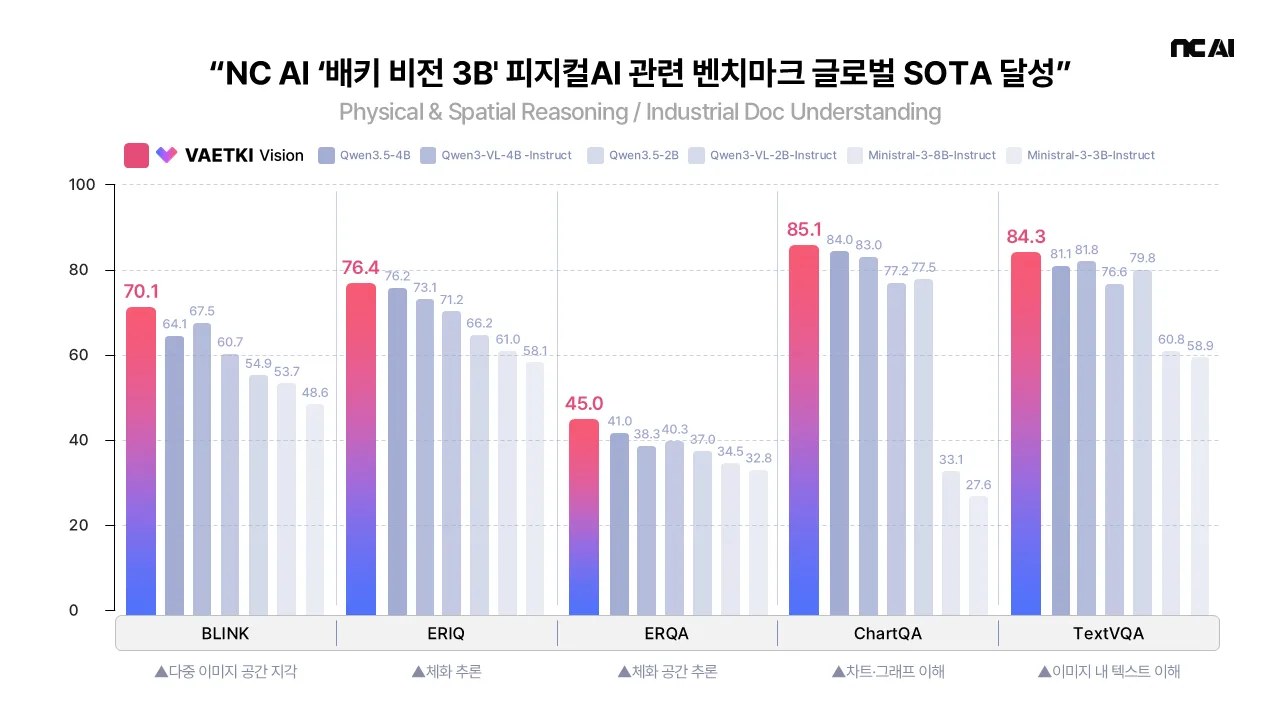
In its default mode, which skips step-by-step reasoning so it can answer quickly enough for real-time control, VAETKI Vision 3B averaged 63.8 across three robot and spatial understanding benchmarks: BLINK (multi-image spatial perception), ERIQ (embodied reasoning) and ERQA (embodied spatial reasoning). NC AI says that beats all six comparison models, Qwen3-VL-2B and 4B, Qwen3.5-2B and 4B, and Ministral-3-3B and 8B[1]. Its chart puts VAETKI at 70.1 on BLINK, 76.4 on ERIQ and 45.0 on ERQA.
In "Think mode", with deeper reasoning switched on, it scored 63.2, well ahead of Ministral-3-8B-Reasoning at 48.4. It also posted the top scores among the compared models on ChartQA (85.1) and TextVQA (84.3), which NC AI pitches as reading gauges, drawings and work orders on site[1].
03 / 06
A welding specialist
NC AI also fine-tuned a welding model, VAETKI-Vision-3B-Weld, on a small domain dataset while keeping the general vision skills intact. Compared with the base model, weld classification accuracy on RIAWELC rose from 41.1 to 80.9, defect detection and state inference on Khvatskii went from 39.3 to 69.8, and weld position and shape recognition on RefWeld jumped from 5.3 to 72.5[1][2].
04 / 06
Sovereign physical AI
NC AI says it built the pre-training and two-stage fine-tuning recipe on its own infrastructure, so that Korea's key industries and defence sector don't depend on outside technology. The company already works with Hanwha Ocean on autonomous welding robots, with POSCO DX on humanoid robot trials in industrial sites, and with Hyundai Rotem on world models[1].
Next, it plans to add reinforcement learning on top of the model and deploy it as the core vision engine and VLA base for robots and edge devices across its physical AI projects[1][2].
05 / 06
The caveats
All numbers come from NC AI's own announcement, and the company hasn't published a paper or evaluation protocol alongside it. It also hasn't said whether the weights will be released, though earlier VAETKI language and vision models went up on Hugging Face under the NC AI consortium account[3].
06 / 06
Why it matters
Robots can't always call a big model in the cloud, and the move to vision-language-action models puts a premium on small vision models that understand space well enough to drive real-time control. If NC AI's results hold, a 3B model that beats 8B rivals on embodied reasoning, and can be cheaply tuned for jobs like weld inspection, is exactly the kind of component industrial robot makers need.
FAQ
Frequently asked questions.
01What is VAETKI Vision 3B?
A lightweight vision-language model from Korea's NC AI with roughly 3 billion parameters. It's designed to sit directly on robots and industrial edge devices with limited compute and handle their visual perception.
02How does it compare with other small models?
NC AI says it averaged 63.8 across the BLINK, ERIQ and ERQA spatial and embodied reasoning benchmarks in its fast, non-reasoning mode, ahead of six open models including Qwen3-VL-4B, Qwen3.5-4B and Ministral-3-8B. In its reasoning mode it scored 63.2, against 48.4 for Ministral-3-8B-Reasoning.
03What is the welding version?
VAETKI-Vision-3B-Weld is a fine-tune for welding inspection. NC AI says it lifted weld classification accuracy on RIAWELC from 41.1 to 80.9, defect detection on Khvatskii from 39.3 to 69.8, and weld position recognition on RefWeld from 5.3 to 72.5, compared with the base model.
04Can I download it?
NC AI's announcement doesn't say whether the weights will be published. Earlier VAETKI language and vision models were released on Hugging Face under the NC AI consortium account.
05Have the results been independently verified?
No. All benchmark figures come from NC AI's own announcement and charts.
That’s the story
Building with what’s new?
Spectrum Web Co ships products, places talent, builds social narratives and builds custom business tools as monthly services.
Related stories